

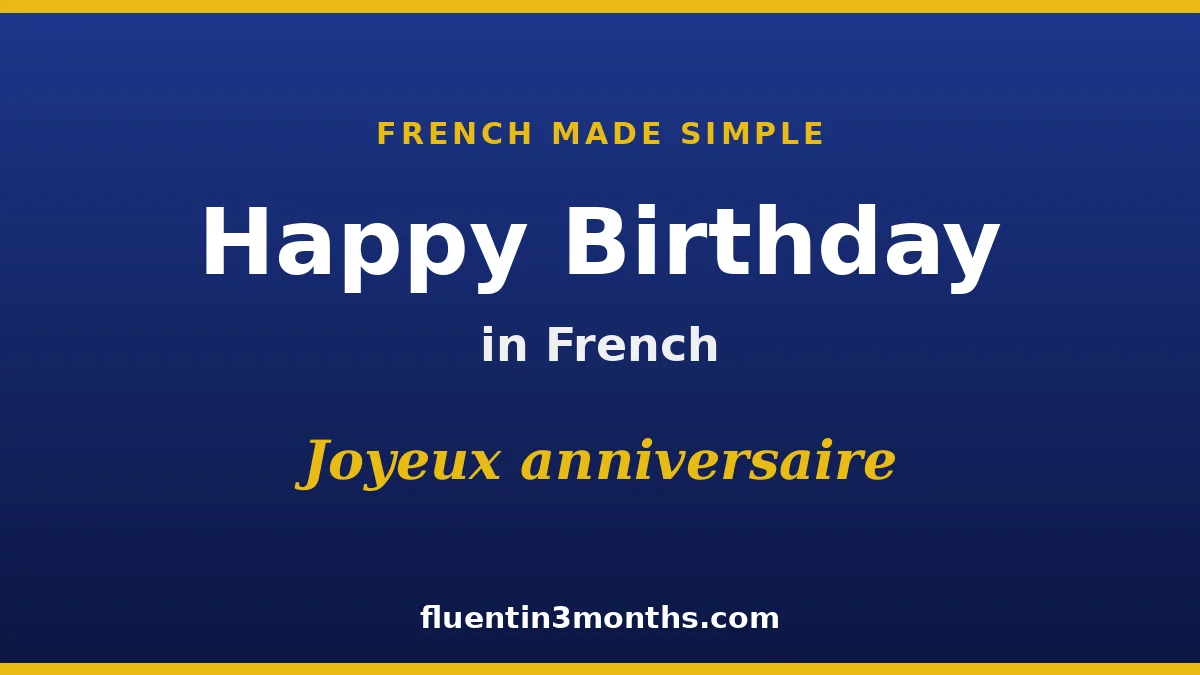
The French language, spoken by over 300 million people across five continents, presents a complex tapestry of regional dialects and social etiquettes that are perhaps most visible during personal celebrations such as birthdays. For the non-native speaker, navigating the transition from a literal translation to a culturally appropriate greeting requires an understanding of both linguistic mechanics and historical context. While the core phrases "Joyeux anniversaire" and "Bon anniversaire" serve as the standard across much of the Hexagon, the evolution of these terms and the customs surrounding them reveal significant insights into the French-speaking world’s social hierarchy and regional identities.
The Linguistic Foundation of French Birthday Greetings
At the center of the French birthday celebration are two primary phrases: Joyeux anniversaire and Bon anniversaire. While both are used interchangeably in most social contexts, they carry distinct etymological weights. The word anniversaire is derived from the Latin anniversarius, meaning "returning yearly," a compound of annus (year) and versus (to turn). In French, this term functions as both a noun for "birthday" and "anniversary," necessitating contextual clues to distinguish between a birth celebration and a wedding anniversary.
Joyeux, meaning "joyful" or "merry," is often viewed as the more emotive of the two adjectives. Bon, meaning "good," is utilitarian and direct. Sociolinguistic data suggests that neither phrase inherently dictates a level of formality; rather, the level of polish is determined by the surrounding sentence structure and the choice between the pronouns tu (informal) and vous (formal). In recent decades, a linguistic shortening has occurred among younger demographics and in digital communication, where the word anniversaire is frequently clipped to anniv. This trend mirrors the English use of "b-day" and reflects a broader global movement toward brevity in casual correspondence.
Regional Divergence and the Quebecois Distinction
One of the most significant divides in the Francophone world regarding birthday greetings is the distinction between European French and Canadian French, specifically in Quebec. In France, the phrase Bonne fête is traditionally reserved for a person’s "name day"—the feast day of the saint for whom they were named. While the importance of name days has waned in secular modern France, the phrase remains distinct from a birthday greeting.
Conversely, in Quebec and other parts of French-speaking Canada, Bonne fête is the standard, primary way to say "Happy Birthday." This usage is officially recognized by the Office québécois de la langue française (OQLF), which notes that fête has historically served as a synonym for anniversaire in North American French. For a traveler or expatriate, using Bonne fête in Paris may result in confusion or a polite correction, while using Joyeux anniversaire in Montreal, though understood, may mark the speaker as an outsider. This regional variation highlights the importance of "localization" in language learning—the practice of adapting one’s vocabulary to the specific geographic and cultural environment.
The Chronology of a French Birthday Celebration
The traditions surrounding birthdays in France follow a structured chronology that often differs from Anglo-American norms. In a professional setting, the responsibility for the celebration frequently falls upon the person celebrating. It is a common custom in French offices and schools for the "birthday person" to bring in le gâteau (the cake) or a selection of pastries from a local boulangerie to share with colleagues. This practice, known as arroser son anniversaire (literally "to water one’s birthday"), shifts the social burden of hospitality onto the celebrant, fostering a sense of community through shared contribution.
The social interaction during these events is governed by the ritual of la bise—the exchange of cheek kisses. The number of kisses and the starting cheek vary significantly by region. For instance, in Paris, two kisses are standard, while in parts of southern France or the Loire Valley, three or even four may be expected. In formal or professional environments, a handshake remains the safer alternative, particularly when the degree of intimacy is low. Analysts of French social behavior note that these rituals serve as "social glue," reinforcing bonds within a peer group or family unit.
Musical Traditions and Historical Context
The auditory landscape of a French birthday is dominated by two distinct songs. The first is a direct melodic adaptation of the English "Happy Birthday to You," using the lyrics Joyeux anniversaire, nos vœux les plus sincères… while maintaining the globally recognized tune. However, France also possesses a unique, homegrown anthem titled Bon anniversaire.
This second song was composed by Louiguy with lyrics by Jacques Larue and was famously recorded by André Claveau in 1951. Unlike the English adaptation, this version is a complete musical composition with its own refrain and verses. It rose to prominence during the mid-20th century and remains a staple at more traditional or formal gatherings. The existence of a separate, copyrighted French birthday song underscores the country’s historical commitment to cultural exception—the idea that French culture should be protected and distinguished from the creeping influence of Anglophone media.
Phonetic Mechanics and the Importance of Liaison
For the non-native speaker, the pronunciation of birthday greetings provides a masterclass in French phonetics, specifically the concept of liaison. A liaison occurs when a normally silent final consonant is pronounced at the start of the following word beginning with a vowel or a silent ‘h’.
In the phrase Joyeux anniversaire, the final ‘x’ in joyeux—which is typically silent—is pronounced as a /z/ sound because it precedes the vowel ‘a’ in anniversaire. This creates a phonetic flow: /ʒwa.jø.z‿a.ni.vɛʁ.sɛʁ/. Similarly, in Bon anniversaire, the final ‘n’ of bon links to the ‘a’, causing the vowel in bon to lose its nasal quality and the ‘n’ to be clearly articulated: /bɔ.n‿a.ni.vɛʁ.sɛʁ/. Mastering these transitions is essential for achieving a natural cadence, as failure to perform the liaison can make the greeting sound stilted or "chopped" to the French ear.
The Superstition of Advance Greetings
A subtle but important cultural nuance in France is the hesitation to offer birthday wishes before the actual date. While in some cultures it is common to send a card or a message a few days early to ensure it arrives on time, some French speakers consider souhaiter un anniversaire en avance (wishing a birthday in advance) to be "porte-malheur" (bringing bad luck).
This superstition, though not universal among the younger generation, is rooted in older European traditions where celebrating an event before it occurred was seen as tempting fate. Consequently, most French people will wait until the day of the anniversary, or even the day after (belatedly), to offer their congratulations. This timing reflects a broader cultural respect for the specific calendar date of an event.
Broader Implications for Social Etiquette
The choice of a birthday message in French acts as a microcosm of the speaker’s relationship with the recipient. The French language is highly sensitive to social hierarchy, primarily through the distinction between tu and vous.
- The Informal (Tu): Used for friends, family, and peers. A message might read: "Je te souhaite un très joyeux anniversaire."
- The Formal (Vous): Used for superiors, elders, or acquaintances. A message might read: "Je vous souhaite un excellent anniversaire."
Using the incorrect pronoun can lead to social friction; using tu with a superior may be seen as disrespectful, while using vous with a close friend might be perceived as cold or distancing. Therefore, the simple act of wishing someone a happy birthday requires a quick mental assessment of the social distance between the two parties.
Data and Trends in French Gift-Giving
Recent consumer data from the French retail sector indicates that birthday celebrations remain a significant economic driver. According to market research, the average French consumer spends between €30 and €75 on a birthday gift for a close friend or family member. Popular gift categories include books, high-quality food items (gastronomie), and "experience" gifts such as vouchers for restaurants or spas.
Furthermore, the "digitalization" of birthdays has seen a rise in the use of social media platforms for greetings. However, unlike the perfunctory "HBD" often seen on English-speaking social media, French users frequently opt for slightly more elaborate digital messages, often including emojis or short, sentimental phrases like Plein de bisous (Lots of kisses) or Profite bien de ta journée (Enjoy your day).
Summary of Best Practices for International Communication
For those engaging with the Francophone world, whether for business or leisure, adhering to these cultural and linguistic standards is vital for building rapport. To summarize the professional approach:
- Use Joyeux anniversaire or Bon anniversaire as the standard in France and Europe.
- Adopt Bonne fête exclusively when communicating with residents of Quebec or other parts of French-speaking Canada.
- Observe the liaison rules (/z/ for Joyeux, /n/ for Bon) to ensure phonetic accuracy.
- Respect the social hierarchy by choosing the correct pronoun (tu vs. vous).
- Avoid sending wishes in advance to respect traditional superstitions regarding luck.
By understanding these nuances, the speaker moves beyond mere translation and enters the realm of cultural fluency. The French birthday greeting is not just a phrase; it is a reflection of regional history, linguistic precision, and the enduring importance of social ritual in the Francophone world. As the French say, la forme est aussi importante que le fond—the form is just as important as the content—and in the case of birthdays, getting the form right is the ultimate sign of respect.
