

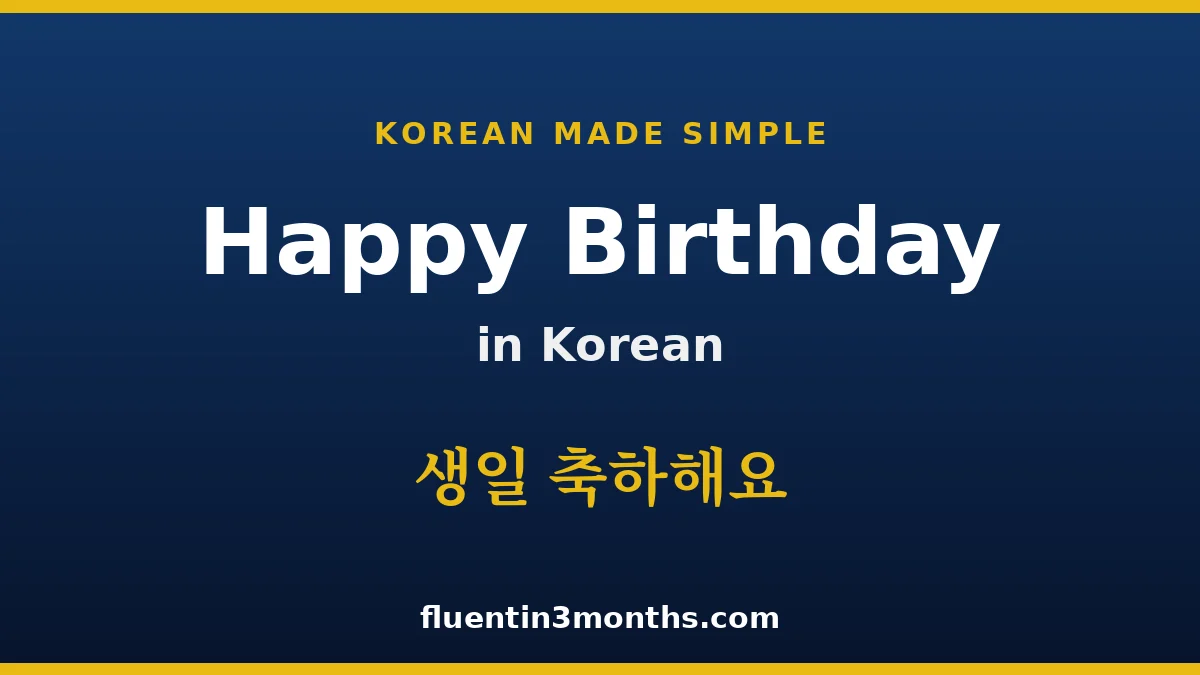
The phrase saengil chukhahaeyo serves as the primary linguistic bridge for those wishing to convey birthday greetings in South Korea, yet its application reveals a complex tapestry of social hierarchy, honorifics, and recent legislative shifts. In the Korean language, the expression of a simple "happy birthday" is rarely a one-size-fits-all endeavor. Instead, it is governed by the principles of Jondaemal (polite speech) and Banmal (informal speech), reflecting a societal structure rooted in Confucian values where age and social status dictate the choice of vocabulary and verb endings. This linguistic complexity has been further complicated by a landmark legal shift in 2023, which saw South Korea transition from its traditional "Korean age" system to the internationally recognized standard, a move that has significant implications for administrative clarity and social interaction.
The Hierarchical Framework of Korean Birthday Greetings
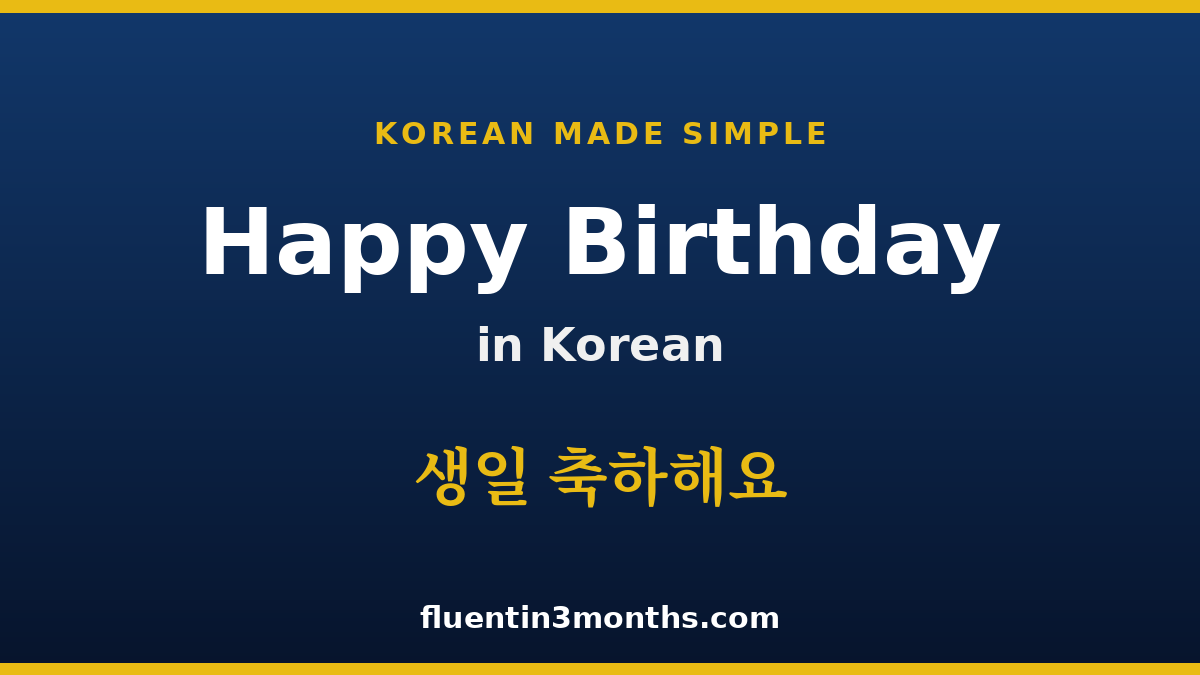
To understand the mechanics of a Korean birthday greeting, one must first dissect the standard phrase: saengil chukhahaeyo. The term saengil translates to "birthday," while chukha signifies "congratulation." The verb hada (to do) is combined with the polite ending -haeyo to create a greeting that is appropriate for colleagues, acquaintances, and those of similar social standing. However, the Korean language offers at least four distinct registers for this single sentiment, each tailored to a specific relationship dynamic.
In casual settings, typically between close friends of the same age or when speaking to someone younger in a familiar context, the ending is dropped to become saengil chukhahae. Conversely, in formal or ceremonial settings—such as a public speech or a professional milestone—the greeting shifts to saengil chukhahamnida. The most profound shift occurs when addressing elders, such as parents, grandparents, or mentors. In these instances, the word for birthday itself changes from saengil to the honorific saengsin, and the verb is replaced with the humble deurida (to offer), resulting in saengsin chukha-deurimnida. This version carries a level of deference that transcends simple politeness, acknowledging the recipient’s wisdom and status within the family or society.
Legislative Reform and the Standardization of Age
The most significant recent development in South Korean social life occurred on June 28, 2023, when the country officially abolished the traditional age-counting system in favor of the international standard. Under the previous "Korean age" system, or seneun nai, a child was considered one year old at birth and gained a year every New Year’s Day. This meant that a baby born on December 31 would technically turn two years old on January 1, despite having lived for only two days.
The transition to man nai (international age) was a key campaign promise of President Yoon Suk-yeol’s administration. The Ministry of Government Legislation championed the change, citing the need to reduce "unnecessary social and economic costs." Prior to this standardization, the discrepancy between "Korean age" and "civil age" led to persistent confusion in administrative services, medical records, and legal disputes. For instance, disputes frequently arose over the eligibility for insurance benefits and the "peak wage" system, where age was the determining factor.
According to data released by the Ministry of Government Legislation shortly after the law’s implementation, approximately 80% of South Koreans supported the transition to the international system. However, the shift remains a complex social adjustment. While the "international age" is now the legal standard for passports, contracts, and medical procedures, the "year age" (current year minus birth year) is still used for certain regulations, such as the legal age for purchasing alcohol or tobacco and the start of mandatory military service.
The Chronology of Age and Life Milestones
The history of age-counting in Korea reflects a broader East Asian tradition that once included China and Japan, both of which have since moved to the international system. In Korea, the timeline of age-related milestones remains culturally sacred, even as the legal definitions shift.
- The First Birthday (Doljanchi): Historically, when infant mortality rates were high, reaching the first year of life was a momentous occasion. The doljanchi remains one of the most significant celebrations in a Korean person’s life.
- The 60th Birthday (Hwangap): Traditionally, the 60th birthday was celebrated as the completion of a full cycle of the 60-year zodiac. While increased life expectancy has made the hwangap a more modest affair today, it remains a symbol of longevity and wisdom.
- The 70th Birthday (Gohui): As life expectancy in South Korea has risen to among the highest in the world, the 70th birthday has gained prominence as the new milestone for a major family celebration.
Culinary Traditions and the Symbolism of Seaweed Soup
Central to the Korean birthday experience is the consumption of miyeokguk, or seaweed soup. This tradition is deeply rooted in the maternal experience. Miyeokguk is exceptionally high in iodine and calcium, making it the primary dish served to mothers in the weeks following childbirth to aid in recovery and lactation. By eating miyeokguk on their birthday, Koreans symbolically honor their mother’s sacrifice and the care they received during infancy.
While modern celebrations often include Western-style birthday cakes and the "Happy Birthday" song (sung to the familiar melody but with Korean lyrics), the presence of miyeokguk remains a non-negotiable cultural staple. It serves as a reminder of the "birth" aspect of the birthday, grounding the celebration in family lineage rather than just individual aging.
The Ritual of Doljabi: Predicting the Future
During the doljanchi (first birthday), a specific ritual known as doljabi is performed. The child is placed before a variety of objects, and their future is playfully predicted based on which item they pick up first.
- Thread or String: Represents a long and healthy life.
- Money or Rice: Symbolizes future wealth and financial stability.
- Books or Calligraphy Brushes: Predicts a career in scholarship or civil service.
- Stethoscope or Gavel: Modern additions symbolizing careers in medicine or law.
This tradition highlights the collective nature of Korean birthdays, where the focus is often on the hopes and aspirations the family holds for the individual.
Linguistic Evolution and Global Influence
The global rise of "Hallyu" or the Korean Wave has brought Korean birthday traditions to an international audience. The popularity of K-dramas and K-pop has led to a surge in interest in the Korean language, particularly in how to navigate the complex social etiquette of greetings.
Linguistic experts note that while the 2023 law change standardized age for legal purposes, it has not yet fully dismantled the social hierarchy based on birth year. In South Korea, even a one-year difference in age can determine the level of formality used in speech. Therefore, the question "How old are you?" is often less about chronology and more about establishing the linguistic "rank" between two speakers. The government’s move toward the international age system is seen by some sociologists as an attempt to modernize these social hierarchies, potentially making Korean society more egalitarian and less focused on rigid age-based seniority.
Professional Implications of the Age Change
The transition to the international age system has had immediate practical effects on the South Korean workforce. Lee Wan-kyu, the Minister of Government Legislation, stated during the transition period that the goal was to "eliminate legal instability" that had plagued the country for decades. In the corporate sector, the "year age" system often led to confusion regarding retirement eligibility and seniority-based promotions.
By aligning the civil code with international standards, South Korea has streamlined its administrative processes. However, the ministry has acknowledged that social habits are harder to change than laws. The use of "Korean age" persists in social circles, particularly when determining school grade levels and social cliques, which are traditionally organized by birth year rather than exact birth date.
Conclusion: A Society in Transition
The study of Korean birthday greetings and traditions offers a window into a society that is simultaneously deeply traditional and aggressively modern. The linguistic variations of saengil chukhahaeyo demonstrate the enduring importance of social hierarchy and respect for elders. Meanwhile, the 2023 legislative change to standardize age reflects a nation striving for administrative efficiency and global alignment.
For the language learner or the cultural observer, understanding these nuances is essential. A birthday in South Korea is not merely a personal celebration of another year passed; it is a ritual of maternal honor, a communal prediction of the future, and a carefully calibrated linguistic performance. As the country continues to navigate the aftermath of its "age revolution," the way Koreans celebrate and communicate these milestones will likely continue to evolve, blending centuries-old Confucian ethics with the demands of a 21st-century global power.
