

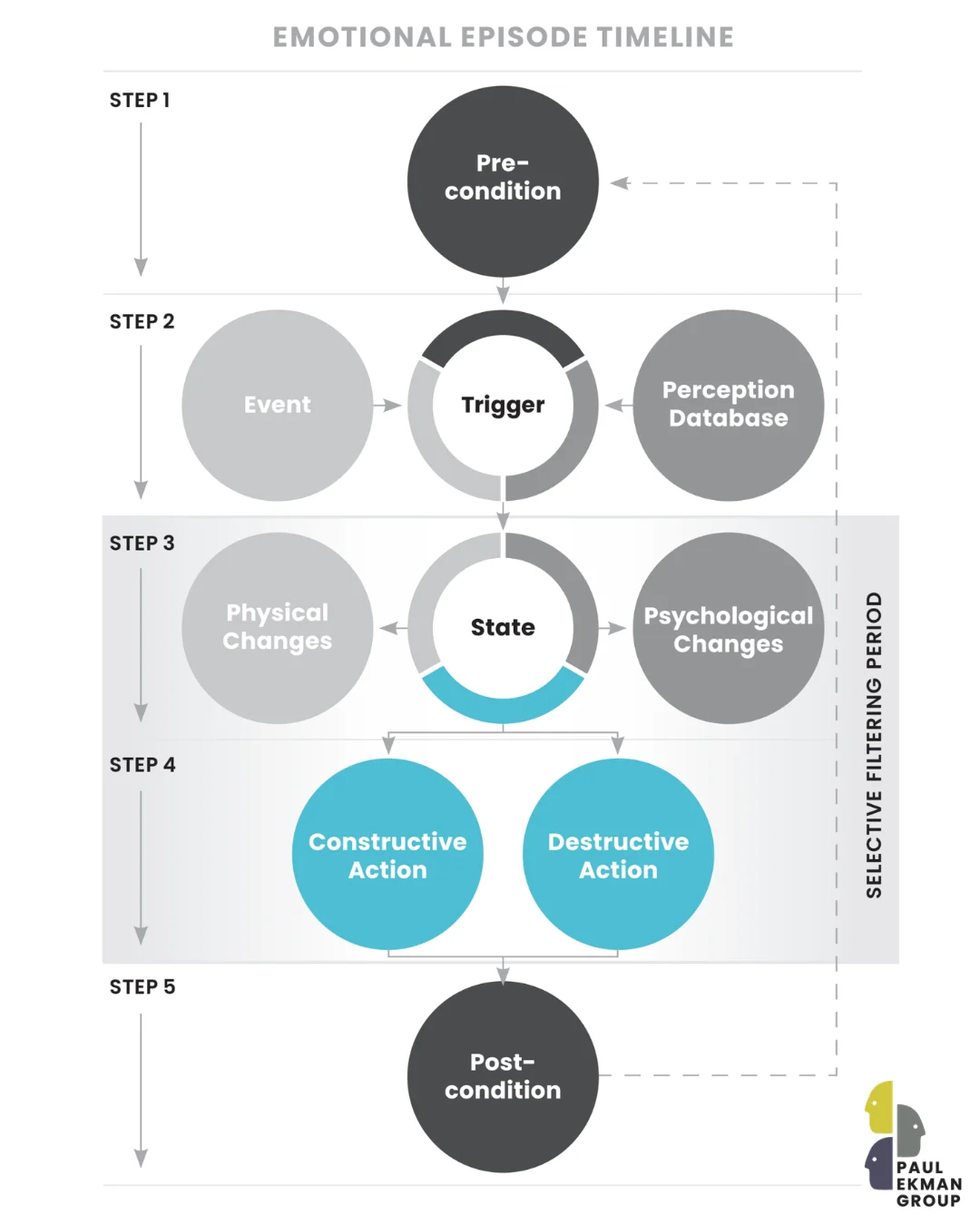
The human experience is often characterized by sudden emotional shifts, leaving individuals questioning the origins of their feelings. While emotions can feel instantaneous and unpredictable, scientific research reveals a structured, multi-stage process underlying every emotional episode. Understanding this process, known as the Emotional Episode Timeline, offers a powerful framework for recognizing emotions earlier, responding with greater skill, and ultimately, reshaping emotional patterns that may no longer serve us. This timeline breaks down the complex interplay of internal states and external stimuli into five key stages: Pre-condition, Trigger, State, Action, and Post-condition.
The Architecture of an Emotional Episode
At its core, an emotional experience can be simplified into a three-step sequence: Trigger – Experience – Response. This fundamental cycle occurs countless times daily, often with minor emotional episodes, such as frustration over misplaced keys or a brief annoyance at a delayed notification, passing by without conscious recall. However, even these seemingly small events offer valuable insights into our ingrained habits and unconscious patterns, revealing tendencies like seeking external blame or engaging in harsh self-criticism. The more detailed Emotional Episode Timeline expands this basic framework into five distinct stages, providing a more granular understanding of the internal and external factors that shape our emotional lives.
Step 1: The Pre-condition – Setting the Emotional Stage
The journey of an emotion begins with the Pre-condition, representing the individual’s physical and emotional context at the outset of any given moment. This can be conceptualized as an "emotional starting point." Factors contributing to the pre-condition are diverse and can include physiological states such as fatigue from inadequate sleep, hunger, or a general sense of well-being. Psychological states, like stress stemming from work obligations or exhilaration following positive news, also play a crucial role. Even a state of calm and restfulness constitutes a pre-condition. This initial state significantly influences the ease with which an emotion can arise. For instance, an individual already experiencing high levels of stress may find themselves more susceptible to irritation or anxiety when faced with a minor inconvenience compared to someone who is feeling neutral or at ease. When an individual is feeling neutral or at ease, the pre-condition might be minimal, allowing for a more measured response to subsequent stimuli.
Step 2: The Trigger – The Catalyst of Emotion
The Trigger is the pivotal event that initiates an emotional response. It is not merely an external occurrence but a complex interplay between an event, the individual’s appraisal of that event, their internal "perception database," and the prevailing pre-condition.
The Event: External and Internal Stimuli
An event is any encounter, whether external or internal, that captures our attention. This can manifest as the presence of a person, a particular place, a specific situation, or even an internal mental construct such as a thought, memory, or fantasy. Sensory input through sight, smell, sound, taste, and touch also serve as events. Our minds are in a constant state of unconscious monitoring and rapid evaluation of our surroundings, assessing potential opportunities or threats and preparing us for appropriate action. This process is termed "automatic appraisal." A classic example is the reflexive swerving of a car to avoid an animal in the road, or the perception of rejection upon not receiving an immediate text response from a new acquaintance.
The Perception Database: Our Emotional Blueprint
Each individual possesses a unique perception database, an internal repository of emotional memories and pre-programmed responses that shapes how they interpret the world. This database functions as an "emotional alert system," enabling the mind to quickly ascertain the significance of incoming information. The perception database draws from two primary sources:
- Learned Experiences: This includes all past emotional encounters, both positive and negative, and the lessons derived from them. For example, a past experience of being publicly embarrassed might lead to a heightened sensitivity to potential social judgment in future situations.
- Innate Predispositions: Emerging research in genetics and neuroscience suggests that humans may possess certain innate predispositions that influence emotional reactivity. These could include inherent levels of sensitivity or reactivity to specific types of stimuli, potentially shaped by evolutionary pressures. For instance, an innate predisposition to fear snakes might explain why encountering one can trigger an immediate fear response, even without prior negative personal experiences.
The combination of the current event and the individual’s perception database, influenced by their pre-condition, culminates in the trigger that sets the emotional episode in motion.
Step 3: The State – The Embodied Experience of Emotion
The State represents the emotion itself, aligning with the "Experience" step in the simplified model. This is a holistic mind-body phenomenon characterized by both physiological and psychological shifts.
Physiological Changes: The Body’s Emotional Symphony
This aspect encompasses the physical manifestations of an emotion. Depending on the specific emotion, individuals might observe a range of bodily responses: a rapid heartbeat, facial flushing, jaw tension, a sensation of "butterflies" in the stomach, the formation of tears, muscle tightening, or alterations in breathing patterns. Scientific research indicates that each universal emotion is associated with a distinct pattern of physiological changes designed to prepare the organism for action. For instance, the physiological response to fear—increased heart rate, dilated pupils, and sharpened senses—is evolutionarily advantageous for immediate escape or defense. It is important to note that individuals may not always be consciously aware of the trigger event but may become attuned to these bodily sensations as the emotion begins to manifest.
Psychological Changes: The Subjective Felt Sense
This refers to the internal, subjective experience of an emotion – its "felt sense." For example, sadness might be characterized by a feeling of heaviness and slowness, while anger can feel hot and sharp. Each emotion possesses a unique "flavor," coloring our psychological experience in a distinct way. This subjective dimension is crucial for understanding the personal impact of emotions. The intensity and quality of these psychological changes are heavily influenced by an individual’s cognitive appraisal of the situation and their underlying beliefs and values.
Step 4: Action – The Manifestation of Emotion
Emotions inherently propel us toward action. This Action can be overt, such as an external outburst of anger or an embrace of joy, or internal, like suppressing anger or softening into compassion. Rather than categorizing emotions as "positive" or "negative," a more constructive approach involves assessing whether the resulting actions are beneficial or detrimental.
- Constructive Actions: These are behaviors that are beneficial to oneself and/or others, promoting well-being and effective problem-solving. For example, expressing anger assertively to address an injustice can be constructive.
- Destructive Actions: These are behaviors that cause harm to oneself or others, hinder progress, or damage relationships. Yelling abusively in anger or withdrawing completely in sadness could be considered destructive.
It is important to recognize that even emotions often labeled as "negative," such as anger, can lead to constructive outcomes. For instance, anger can be a powerful motivator for social change or personal boundary setting. The key lies not in the emotion itself, but in the action taken in response to it.
Step 5: Post-condition – The Lingering Echoes of Emotion
Every emotional episode leaves a residual impact, forming the Post-condition. If, for example, an individual yelled in anger, the recipient might retaliate with their own outburst, creating a cycle of escalating anger. Conversely, if anger was suppressed, irritation might persist internally, potentially influencing future interactions. These post-conditions can serve as precursors to subsequent emotional episodes, reigniting the same emotion or triggering new ones, such as fear of reprisal or regret over past behavior. However, these lingering effects also present a critical opportunity for reflection and learning. By pausing to analyze the preceding emotional episode, individuals can gain valuable insights into their patterns of response and identify areas for personal growth.
The Selective Filtering Period: A Crucial Interlude
It is essential to understand that the Selective Filtering Period is not a separate, sequential step, but rather a phenomenon that occurs during Steps 3 (State) and 4 (Action). When an emotion is actively experienced, our perception tends to narrow, leading us to filter information in a way that aligns with the prevailing emotion. In a state of fear, for instance, individuals may become hyper-focused on perceived threats, both real and imagined. Similarly, during anger, attention may become fixated on frustrating aspects of a situation, while positive elements are overlooked. This selective filtering, while crucial for survival by prioritizing immediate concerns, can also distort our perception of reality if we are not aware of its influence. This bias can significantly impact decision-making and interpersonal interactions.
Broader Implications and Future Directions
The Emotional Episode Timeline provides a robust framework for understanding the fundamental mechanics of human emotion. Its implications extend beyond individual self-awareness, offering insights into interpersonal dynamics, therapeutic interventions, and even the design of artificial intelligence systems capable of understanding and responding to human emotions.
The recognition that emotions are not simply random occurrences but follow a predictable sequence empowers individuals to take a more proactive role in managing their emotional lives. By identifying the various stages, from the subtle influence of pre-condition to the lasting effects of post-condition, individuals can develop strategies to intervene at different points in the process. For example, cultivating mindfulness practices can enhance awareness of pre-conditions, while developing emotional regulation techniques can help manage the state and action phases.
The concept of the "Perception Database" highlights the profound impact of past experiences and learned associations on our emotional responses. This understanding is central to many psychotherapeutic approaches, such as Cognitive Behavioral Therapy (CBT), which aim to identify and modify maladaptive thought patterns and emotional responses rooted in these databases.
Furthermore, the distinction between constructive and destructive actions underscores the importance of intentionality and skill-building in emotional expression. The ability to choose constructive responses, even when experiencing intense emotions, is a hallmark of emotional intelligence and resilience.
The ongoing development of tools like the Atlas of Emotions, an interactive platform designed to deepen understanding of emotional processes, demonstrates a growing commitment to translating scientific research into accessible resources for the public. The forthcoming Atlas of Emotions book promises to further expand on these concepts, offering practical guidance and deeper insights.
Frequently Asked Questions
Why do I react before I even know what’s happening?
This phenomenon is attributed to automatic appraisal, which occurs unconsciously during the trigger stage. Your brain rapidly evaluates potential help or harm before your conscious awareness fully processes the event.
Why do small things set me off more on some days than others?
Your pre-condition – your current state of tiredness, stress, hunger, or calmness – significantly influences your emotional threshold. A compromised pre-condition makes you more susceptible to emotional reactivity.
Why can’t I think clearly when I’m upset?
During the state and action stages, you enter a selective filtering period. Your perception narrows to focus on the prevailing emotion, limiting your ability to consider a broader range of information or engage in complex cognitive processing.
Can I control how I react to an emotion?
While the trigger and state stages are largely automatic, the action stage – the choice of how to respond – offers a significant opportunity for control. It is within this stage that constructive choices and skillful responses become possible.
By demystifying the process of emotional experience, the Emotional Episode Timeline empowers individuals to navigate their inner worlds with greater awareness, intention, and resilience, fostering healthier relationships with themselves and others.
