

Google DeepMind has officially unveiled the Gemini Decisions API, a specialized endpoint engineered to deliver high-speed, closed-set decisions powered by the newly developed Gemini Decision 1 model. This launch represents a significant pivot in the generative AI landscape, moving away from generalized conversational outputs toward purpose-built, high-efficiency primitives designed for enterprise-grade automation. The new model, identified as gemini-decision-1, is now available through the Gemini API in Google AI Studio, offering developers a streamlined method for executing bounded choices such as tool selection, policy compliance checks, model routing, and granular context grading.
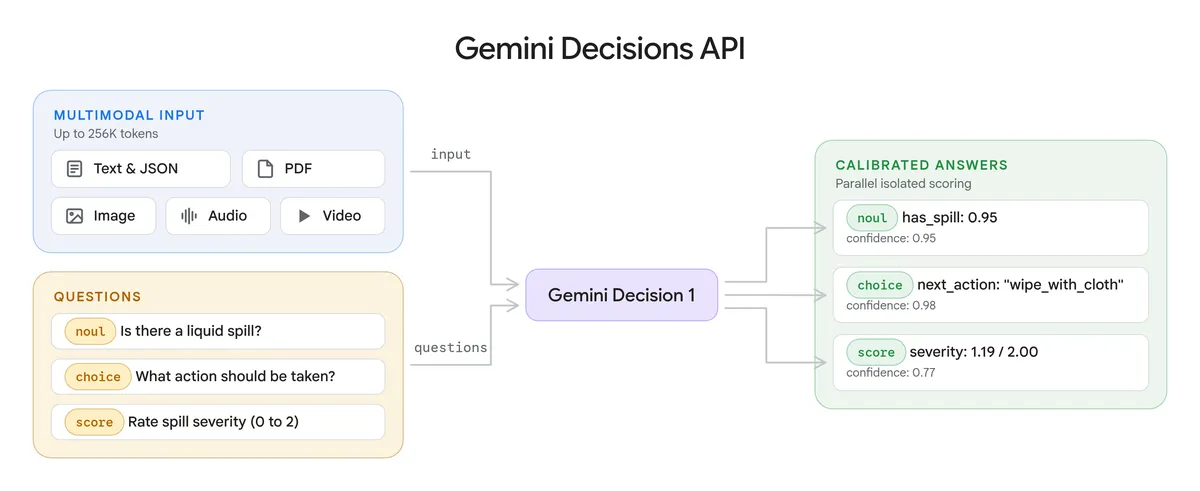
The introduction of the Decisions API addresses a critical bottleneck in current artificial intelligence workflows: the latency and cost associated with traditional token-by-token text generation. By utilizing a native multimodal architecture, the Gemini Decision 1 model allows for the simultaneous evaluation of text, images, audio, video, and PDF documents within a single request. This architectural shift enables the system to process up to 1,000 independent questions across a shared input of up to 256,000 tokens, returning results with an end-to-end latency of 150 to 250 milliseconds.
Technical Architecture and the Shift to Single-Pass Scoring
At the core of the Gemini Decisions API is a fundamental departure from the standard Large Language Model (LLM) inference process. Most generative models operate via autoregressive decoding, where the model predicts the next token in a sequence repeatedly until a full answer is formed. While effective for chat, this method is inherently slow and computationally expensive for simple classification or decision-making tasks.
In contrast, Gemini Decision 1 employs a single forward pass mechanism. Instead of generating a textual response, the model scores candidate options directly. This allows the API to return probabilities and confidence scores for yes/no questions, multiple-choice selections, and rubric-based grading without the overhead of decoding. The result is a median latency of 50 to 100 milliseconds for model computation, which remains remarkably stable even as the number of questions scales from one to 100 per request.
This "closed-set" approach is particularly beneficial for developers building "agentic" systems—AI agents that must make rapid-fire decisions to navigate complex workflows. By providing a "low-latency control plane," Google DeepMind is positioning the Decisions API as the steering mechanism for more complex, multi-model architectures.

Benchmarking Performance and Calibration Accuracy
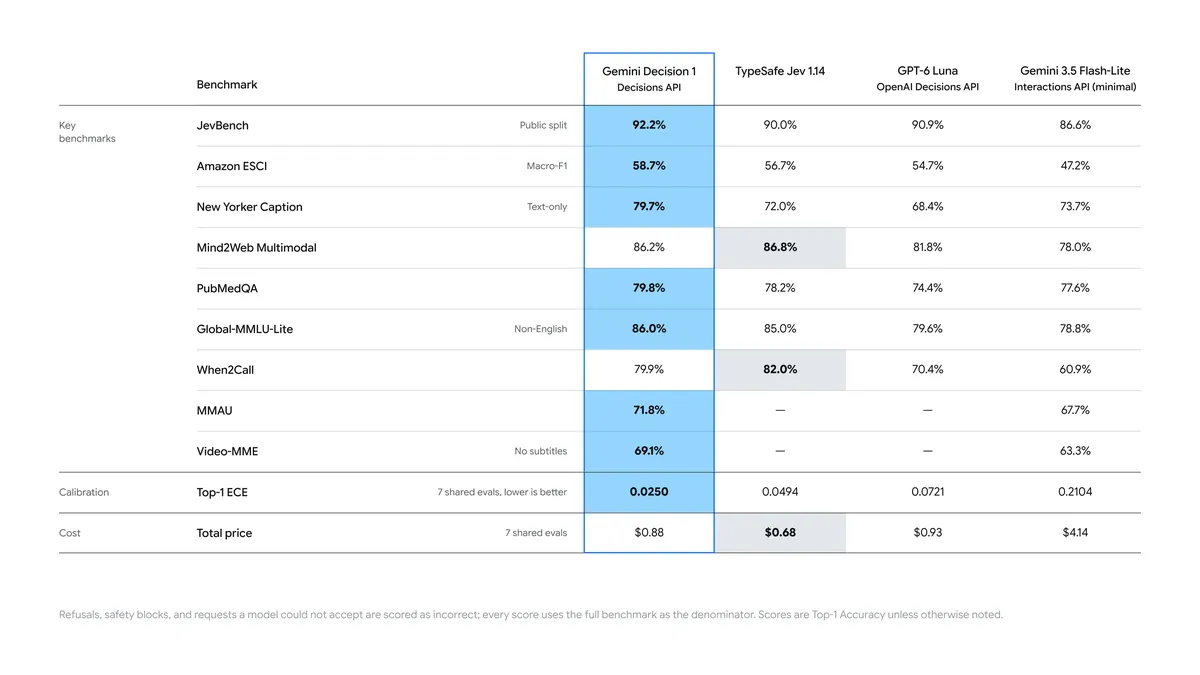
Google DeepMind has released data indicating that Gemini Decision 1 leads across a suite of benchmarks spanning agent routing, logical reasoning, ranking, and multimodal understanding. A key highlight of the model’s performance is its low calibration error. In the context of machine learning, calibration refers to the alignment between a model’s predicted probability and the actual likelihood of a correct outcome. A well-calibrated model that assigns a 90% confidence score to a decision should, in practice, be correct 90% of the time.
High calibration is essential for industrial and safety-critical applications. For instance, if an AI is tasked with identifying safety hazards in a manufacturing plant via video feed, a human supervisor needs to know exactly how much to trust the AI’s "all clear" signal. Gemini Decision 1’s ability to provide reliable confidence scores (ranging from 0 to 1) allows developers to programmatically route ambiguous cases—those with low confidence scores—to human reviewers or more powerful, albeit slower, models like Gemini 1.5 Pro.
According to internal comparisons, the Gemini Decisions API is nearly five times more cost-effective than using Gemini 1.5 Flash-Lite via traditional interaction APIs for the same benchmark tasks. This efficiency is driven by the elimination of output token billing and the consolidation of multiple evaluations into a single input pass.
Economic Implications and Pricing Structure
The pricing strategy for the Gemini Decisions API appears designed to disrupt the current market for AI-driven classification and moderation. The service is priced at $0.10 per one million input tokens, with a notable $0 charge for output tokens. This "zero-output" billing model removes the unpredictability often associated with generative AI costs, where long-winded or repetitive model responses can inflate invoices.
Furthermore, the shared input architecture ensures that developers are only billed once for the primary data—such as a high-resolution video or a lengthy PDF—regardless of how many questions (up to 1,000) are asked about that data. Each additional question only adds the token count of its specific instructions and criteria to the total. There are also no separate charges for features that typically command a premium, such as Optical Character Recognition (OCR) for PDFs or audio transcription for video files.
This pricing makes the Gemini Decisions API a viable replacement for traditional custom-trained classifiers. Traditionally, companies would need to train and host their own BERT or ResNet models for specific tasks like sentiment analysis or image categorization. The Decisions API offers the flexibility of a foundation model with the cost-profile and speed of a specialized classifier.
Multimodal Versatility in Real-World Applications
The API’s native multimodality allows it to synthesize information across different media types simultaneously. Developers can pair a call recording (audio) with account metadata (text) to determine a customer’s intent, or combine a scanned insurance claim (PDF) with photos of property damage (image) to assess the severity of a claim.
In one demonstrated use case, a photo of a breakroom counter was analyzed alongside a text note. The API was tasked with three simultaneous evaluations:
- Boolean Check: Is there an uncleaned liquid spill on the counter?
- Multiple Choice: Which cleanup action fits the scene (wipe with cloth, dispatch janitorial, or ready for meeting)?
- Rubric Scoring: Rate the severity of the mess on a scale of 1 to 3 based on specific safety criteria.
This ability to perform varied types of analysis in a single 200ms window enables real-time physical monitoring and automated logistics. Google noted that teams within the company are already utilizing the API to ship features faster by defining decision criteria in natural language rather than waiting for custom models to be trained or fine-tuned.
Timeline and Ecosystem Integration
The rollout of the Gemini Decisions API follows a period of intensive internal testing and pilot programs with Google partners. The model is currently available in a "v1beta" version, signaling that while it is ready for developer use, Google continues to refine the endpoint based on real-world feedback.
To ensure broad adoption, Google DeepMind has coordinated with several major AI ecosystem players. Integrations are currently rolling out across:
- Developer Frameworks: LangChain, Vercel AI SDK, and Pydantic AI.
- Infrastructure and Routing: OpenRouter and LiteLLM.
- Real-Time Communication: Pipecat and LiveKit.
Furthermore, support for the Decisions API is expected to arrive on the Google Cloud Vertex AI platform in the near future, which will provide enterprise-level Service Level Agreements (SLAs) and data residency guarantees required by large-scale corporate users.
Analysis of Broader Industry Impact
The launch of the Gemini Decisions API suggests a maturation of the AI industry. The "hype cycle" of general-purpose chatbots is giving way to a more pragmatic era focused on utility, speed, and cost-efficiency. By providing a model that excels at "thinking fast" rather than "thinking out loud," Google is targeting the high-volume, low-latency needs of the modern digital economy.
From a competitive standpoint, this move puts pressure on other major AI labs to offer specialized decision-making endpoints. While OpenAI and Anthropic have focused on increasing the reasoning capabilities of their models (the "System 2" thinking), Google is carving out a dominant position in "System 1" AI—the rapid, intuitive, and reliable decision-making required for the plumbing of the internet.
For the developer community, the Decisions API lowers the barrier to entry for creating complex multimodal applications. By eliminating the need for separate OCR, transcription, and classification pipelines, Google has simplified the stack required to turn raw multimodal data into actionable insights. As AI agents become more prevalent, the Gemini Decisions API is likely to serve as the "pre-frontal cortex" of these systems, filtering information and making the split-second choices that allow higher-level models to focus on more complex creative tasks.
As the technology moves toward general availability, the primary challenge for Google will be maintaining this level of performance as global traffic scales. However, the architectural decision to move away from autoregressive decoding provides a sustainable path for scaling that traditional LLMs currently lack. For now, the Gemini Decisions API stands as a significant milestone in the quest to make AI both faster and more reliable for everyday business logic.
