

Google has officially unveiled Tabletop, a new experimental platform developed within the Google Labs incubator designed to streamline group coordination through real-time collaboration and generative artificial intelligence. Positioned as a versatile digital canvas, Tabletop allows users to aggregate links, files, and ideas into a centralized space where participants can build, discuss, and finalize plans simultaneously. The initiative represents a significant step in Google’s broader strategy to integrate advanced AI capabilities into practical, everyday consumer utilities, moving beyond simple chatbots to functional, agentic tools that assist with logistics, financial tracking, and event management.
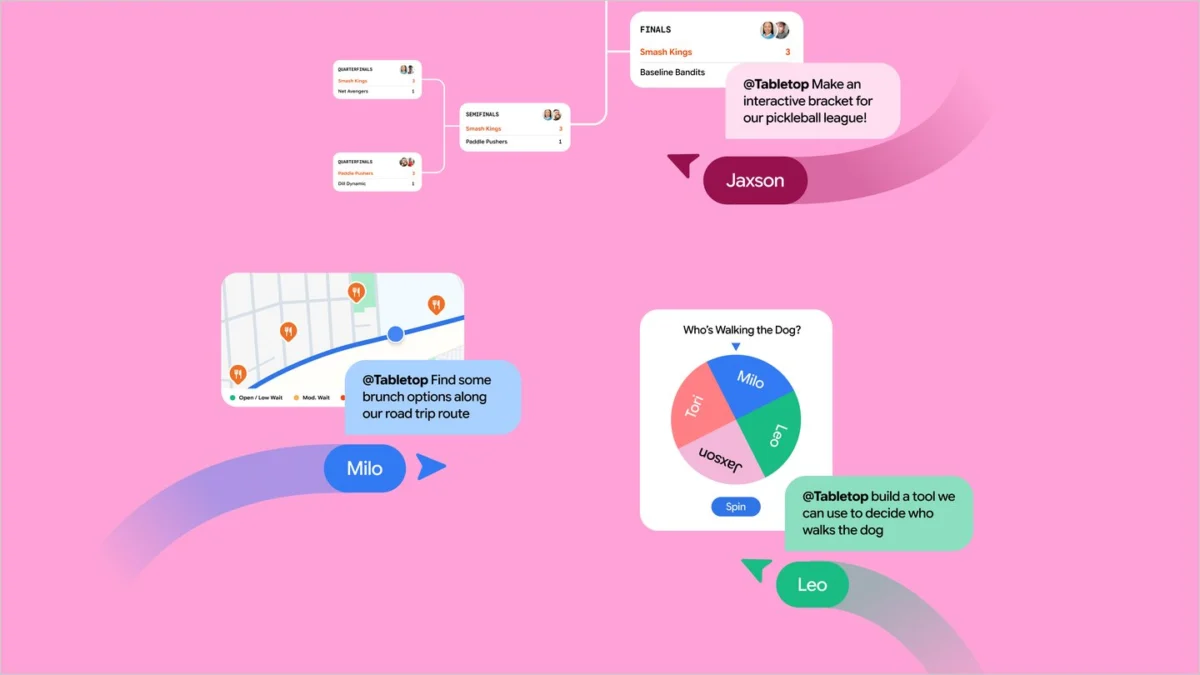
The launch of Tabletop addresses a persistent friction point in digital communication: the fragmentation of group planning. Currently, most groups rely on a disjointed combination of messaging apps for conversation, spreadsheets for budgeting, and shared documents for itineraries. Tabletop seeks to consolidate these functions into a single, interactive interface. By using the "@tabletop" command, users can prompt the platform’s underlying AI to generate specific organizational assets, such as custom trip itineraries, dinner polls, expense splitters, and tournament brackets. This automation is intended to reduce the administrative burden often associated with organizing family trips, recreational sports leagues, or social gatherings like potlucks.
The Architecture of Real-Time Collaboration
At its core, Tabletop is built on the same collaborative infrastructure that powers Google Docs and Sheets, allowing multiple users to edit and interact with the space in real-time. This "multiplayer" approach ensures that all members of a group have visibility into the planning process as it unfolds. Once a workspace is created, the organizer can distribute an invite link via standard group chat platforms, enabling immediate participation without the need for complex file-sharing permissions.
The platform’s versatility is enhanced by a library of starter templates. These templates provide a structural foundation for common group activities, which can then be customized through AI prompts or manual edits. For instance, a group planning a vacation can input their destination and interests, and Tabletop can generate a structured itinerary that includes maps, estimated travel times, and integrated voting mechanisms for choosing activities. This level of interactivity distinguishes Tabletop from static document editors, transforming it into a dynamic environment where data is not just stored but actively managed.
Google Labs and the Evolution of Experimental Software
The introduction of Tabletop marks a continuation of Google’s recent trend of releasing experimental products under the Google Labs banner. Historically, Google Labs has served as a testing ground for innovative concepts that eventually become core components of the Google ecosystem—Gmail and Google Maps both had their origins in similar experimental programs. In the current era of generative AI, Google Labs has been revitalized to serve as a fast-paced incubator for AI-driven applications, including NotebookLM and Magic Editor.
By releasing Tabletop as a Labs experiment, Google can gather granular user feedback and observe how diverse groups interact with the AI-generated tools. This iterative development process is crucial for refining the accuracy of the AI’s suggestions and ensuring the user interface is intuitive enough for non-technical users. The rollout is currently limited to users in the United States who are 18 years of age or older, accessible via a waitlist at the official Google Labs website.
Strategic Market Context and the Rise of Canvas-Based Tools
The emergence of Tabletop occurs within a broader shift in the productivity software market toward "canvas-based" or "spatial" interfaces. For several years, platforms like Notion, Miro, and Trello have gained significant market share by offering flexible workspaces that move away from the traditional constraints of linear documents or grid-based spreadsheets. According to market research data, the global collaborative software market was valued at approximately $19 billion in 2022 and is projected to grow at a compound annual growth rate (CAGR) of over 14% through 2030.
Google’s entry into this specific niche with Tabletop suggests an effort to reclaim users who may have migrated to more flexible competitors for their personal and small-group planning needs. While Google Workspace remains a dominant force in corporate environments, Tabletop is clearly targeted at the consumer segment—individuals looking for a "low-stakes" but high-utility way to organize their social lives. The integration of AI as a primary interface (via the @tabletop prompt) gives Google a potential competitive advantage, leveraging its extensive work in Large Language Models (LLMs) to provide a more automated experience than existing manual canvas tools.
Technical Capabilities and the Role of Generative AI
The functionality of Tabletop relies heavily on the integration of Google’s Gemini models, which allow the platform to understand natural language prompts and translate them into structured data formats. When a user asks for an "expense splitter," the AI does not just provide a text summary; it creates a functional widget capable of performing calculations based on user input. This transition from "content generation" to "functional generation" is a hallmark of the next wave of AI development.
Supporting data suggests that group decision-making is often hindered by "decision fatigue" and the "paradox of choice." By providing structured polls and curated itineraries, Tabletop’s AI acts as a digital facilitator, narrowing down options based on the group’s specific parameters. This reduces the cognitive load on the organizer and encourages more democratic participation from group members who might otherwise remain passive in a standard text-based chat.
Timeline of Development and Rollout
The development of Tabletop follows a timeline of increased AI integration across Google’s product suite. In early 2023, Google began heavily emphasizing "Duet AI" (now Gemini for Workspace) in its professional tools. By late 2023 and early 2024, the focus shifted toward more creative and experimental consumer-facing AI.
- May 2023: Google reintroduces Google Labs at its I/O conference, signaling a new era of public-facing AI experimentation.
- Late 2023: Internal testing of various "spatial" planning tools begins within Google’s experimental divisions.
- Mid-2024: Tabletop is finalized as a candidate for public waitlist testing, focusing on the U.S. market to refine the English-language AI models.
- Current Phase: The platform is now accepting sign-ups, with invites being issued in waves to manage server load and monitor AI safety.
Privacy, Safety, and User Reactions
As with any experimental AI tool, privacy and data security remain central concerns. Google has stated that Tabletop operates under the standard privacy protections afforded to Google Labs projects, though it emphasizes that as an experiment, the AI may occasionally produce unexpected results. Users are encouraged to provide feedback on the accuracy and appropriateness of AI-generated content.
Initial reactions from tech analysts suggest that Tabletop could bridge the gap between "chat" and "work." Industry observers note that while WhatsApp and iMessage are the primary venues for group coordination, they are notoriously poor at tracking logistics. "The challenge for Google," noted one industry analyst, "is not just building a better tool, but changing the habit of groups who are used to the chaos of a 50-message-long thread." The success of Tabletop will likely depend on how seamlessly it can be integrated into those existing communication habits.
Broader Implications for the Future of Productivity
The long-term implications of Tabletop extend beyond simple trip planning. If successful, the underlying technology could influence the future of Google Workspace as a whole. We may see the "Tabletop" philosophy—AI-generated, interactive widgets within a collaborative canvas—integrated directly into Google Docs or a new hybrid version of Google Drive.
Furthermore, Tabletop represents a move toward "agentic workflows," where the software doesn’t just wait for a user to type, but actively assists in the completion of a task. When the AI generates a tournament bracket or a potluck list, it is performing a sequence of logic that previously required human manual labor. As these agents become more sophisticated, the role of the user may shift from "creator" to "editor," overseeing AI-generated frameworks that manage the complexities of daily life.
In conclusion, Tabletop is more than just a new app; it is a laboratory for testing how groups interact with AI in a shared environment. By focusing on the U.S. market and utilizing a waitlist, Google is taking a measured approach to what could be a significant shift in how personal and social organization is handled in the digital age. As the experiment progresses, the data gathered will likely inform the next decade of Google’s productivity and collaboration software development, potentially making the fragmented group chat a thing of the past.
