

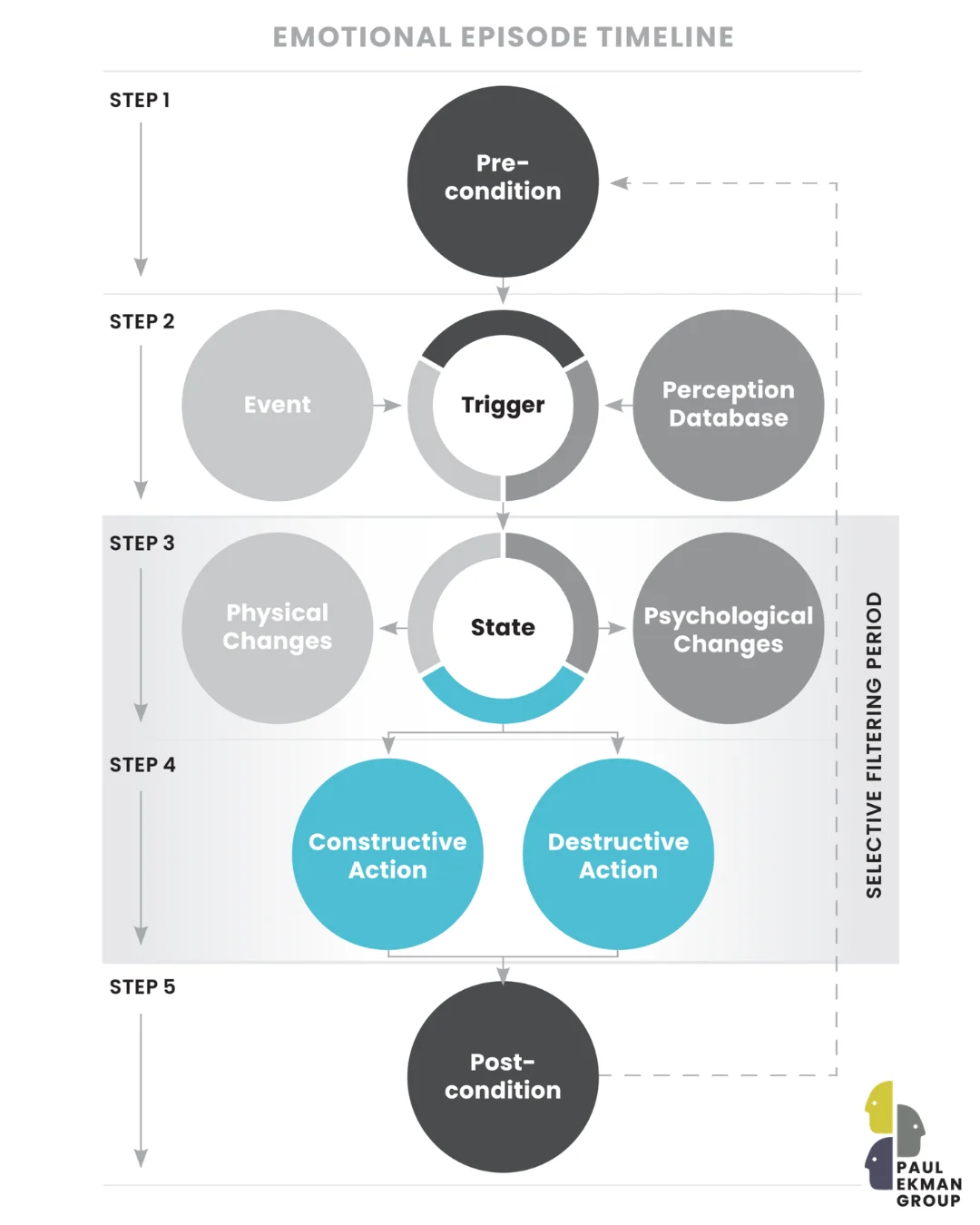
The human experience is often characterized by sudden, seemingly unpredictable emotional reactions. These responses, which can arise before conscious awareness fully registers, are not random occurrences. Instead, they follow a discernible, sequential process that scientists have meticulously mapped. Understanding this "Emotional Episode Timeline" offers a powerful framework for recognizing emotions earlier, responding with greater skill, and ultimately, reshaping unhelpful emotional patterns. This detailed exploration delves into the five key stages of this timeline, providing a scientific lens through which to view our inner lives.
The Fundamental Architecture of Emotion: Trigger, Experience, Response
At its most basic, an emotional episode unfolds in a three-step sequence: Trigger, Experience, and Response. This fundamental cycle repeats countless times daily, often in subtle, unremarked moments, such as minor frustrations like misplacing keys or a phone. Even these seemingly insignificant episodes offer valuable insights into our ingrained habits and unconscious biases, such as a tendency to assign blame or engage in harsh self-criticism. To gain a deeper understanding of the intricate mechanisms underlying these common reactions, the Emotional Episode Timeline expands this basic model into a more granular, five-step process.
Step 1: Pre-condition – The Emotional Starting Point
The initial phase of any emotional experience is the "Pre-condition." This refers to the internal physical and emotional landscape an individual brings to any given moment, essentially serving as their "emotional starting point." This pre-condition is a complex interplay of physiological states and accumulated psychological influences. Factors such as fatigue from insufficient sleep, hunger, stress accumulated from work or personal life, excitement from positive news, or a state of calm and well-being all contribute to this baseline.
A significant body of research in psychophysiology underscores the impact of pre-existing states on emotional reactivity. For instance, studies have demonstrated that individuals experiencing higher levels of chronic stress exhibit a heightened amygdala response to perceived threats, even in the absence of immediate danger. This suggests that a pre-conditioned state of heightened alert can lower the threshold for emotional activation. Conversely, when an individual is feeling neutral or at ease, there may be minimal pre-condition, making the emergence of strong emotions less likely. The pre-condition acts as a crucial modulator, determining the ease with which subsequent emotional triggers can elicit a response.
Step 2: Trigger – The Catalyst for Emotion
The "Trigger" is the event or stimulus that initiates the emotional cascade. This stage is not merely the external event itself, but rather a sophisticated interaction between the event, our subjective interpretation of it, and our internal "perception database," all filtered through our current pre-condition.
The Event: External and Internal Stimuli
An "event" can manifest in a myriad of forms, encompassing anything encountered externally or internally. This includes direct sensory input such as seeing a familiar face, hearing a specific sound, smelling a particular scent, or feeling a texture. It can also involve more abstract stimuli, such as recalling a memory, engaging in a daydream, or even experiencing a bodily sensation.
The mind’s constant, largely unconscious process of "automatic appraisal" plays a pivotal role here. This rapid evaluation system assesses incoming information for potential opportunities or threats, preparing the individual for a swift response. For example, a driver’s sudden swerve to avoid a dog in the road is a clear instance of automatic appraisal, prioritizing immediate safety. Similarly, the perceived sting of rejection after a delayed text message from a new acquaintance exemplifies how internal interpretations of social cues can act as potent triggers. Neuroscientific studies using fMRI have shown that specific neural pathways, particularly involving the amygdala and prefrontal cortex, are activated during this automatic appraisal process, even before conscious awareness fully grasps the situation.
Perception Database: The Internal Library of Experience
Each individual possesses a unique "perception database." This internal repository functions as a comprehensive library of emotional memories, learned responses, and innate predispositions that shape how the world is interpreted. It acts as an "emotional alert system," enabling the mind to quickly ascertain the significance of an event. This database is constructed from two primary sources:
- Evolutionary Predispositions: These are innate, universal patterns of emotional response that have been shaped by millions of years of evolution. For example, the innate fear of snakes or heights in many individuals can be traced to evolutionary pressures that favored survival. Research in evolutionary psychology suggests that certain core emotions and their associated triggers are hardwired into our biological makeup.
- Personal Learning and Experience: This encompasses all the lessons learned throughout an individual’s life, from early childhood conditioning to significant life events. Every interaction, every success, and every failure contributes to the data within this database. For instance, a person who experienced bullying in childhood might have a heightened sensitivity to perceived criticism, leading to an anger response that might appear disproportionate to an observer. Studies in developmental psychology highlight how early attachment styles and formative experiences significantly influence an individual’s emotional schema throughout life.
Step 3: State – The Embodiment of Emotion
The "State" represents the emotion itself – the subjective "Experience" part of the simplified Trigger-Experience-Response model. This is a holistic mind-body phenomenon characterized by a confluence of physical and psychological changes.
Physical Changes: The Body’s Emotional Symphony
The physical manifestations of emotion are diverse and often immediate. These can include a racing heart, a flushing sensation in the face, tension in the jaw, the feeling of "butterflies" in the stomach, the onset of tears, muscle tightening, or alterations in breathing patterns. Scientific research, particularly in the field of affective neuroscience, has identified distinct physiological signatures associated with universal emotions. For instance, studies by Paul Ekman and his colleagues have demonstrated that emotions like happiness, sadness, anger, fear, surprise, and disgust are accompanied by specific, measurable patterns of physiological arousal. These changes are not arbitrary; they are believed to prepare the body for action, aligning with the evolutionary purpose of emotions. It is noteworthy that individuals may become aware of these bodily sensations before they consciously identify the emotion itself, highlighting the primacy of physiological response in the emotional process.
Psychological Changes: The Subjective Felt Sense
Beyond the physical, the "State" also encompasses the internal, subjective "felt sense" of an emotion. This is the qualitative experience that defines the emotion’s character. For example, sadness might be described as a heavy, slow sensation, while anger can feel hot and sharp. Each emotion possesses a unique "flavor" that colors our psychological experience. Research into consciousness and emotion suggests that these subjective experiences arise from complex neural computations integrating sensory input, bodily feedback, and cognitive appraisal. The richness and nuance of these psychological states are what make our emotional lives so complex and varied.
Step 4: Action – The Behavioral Manifestation
Emotions are inherently action-oriented. The "Action" phase is the behavioral output, whether overt or covert, that arises from the emotional state. This response can be external, such as an outburst of anger or an embrace of joy, or internal, such as suppressing anger or yielding to compassion.
Rather than categorizing emotions as simply "positive" or "negative," a more functional approach is to assess whether the resulting actions are constructive or destructive. This distinction is critical because emotions themselves are not inherently good or bad; their impact is determined by the actions they prompt. For instance, anger, often labeled "negative," can, when channeled constructively, serve as a powerful motivator for addressing injustice or advocating for personal needs. Conversely, unchecked anger can lead to aggression and relationship damage. The ability to discern between constructive and destructive actions is a hallmark of emotional intelligence and self-regulation.
Step 5: Post-Condition – The Lingering Impact and Learning Opportunity
Every emotional episode leaves a residual impact, shaping the "Post-condition." This phase is crucial as it sets the stage for future emotional experiences. If an individual yelled in anger, the recipient might react with defensiveness or reciprocal anger, potentially triggering a new cycle of anger. Conversely, suppressing anger can lead to lingering resentment or irritation.
These post-conditions are not merely epiphenomenal; they can actively influence subsequent emotional episodes. The regret over past behavior, the fear of future repercussions, or the continued feeling of being wronged can all serve as nascent triggers for new emotional journeys. However, the post-condition also presents a vital opportunity for reflection and learning. By pausing to examine the events, the emotional state, and the resulting actions, individuals can gain valuable insights into their patterns of behavior and identify areas for growth and adjustment. This reflective process is central to developing more adaptive emotional responses over time.
The Selective Filtering Period: Emotion’s Lens on Perception
It is important to note that a critical phenomenon, the "Selective Filtering Period," occurs concurrently with Steps 3 (State) and 4 (Action). During an active emotional state, an individual’s perception undergoes a significant narrowing. Information is filtered to align with the prevailing emotion. In a state of fear, for example, attention becomes hyper-focused on perceived threats, both real and imagined, while potentially overlooking safety cues. Similarly, during anger, individuals tend to amplify aspects of a situation that are frustrating while discounting elements that are proceeding well.
This selective filtering, while adaptive in evolutionary terms by prioritizing immediate survival responses, can also lead to a distortion of reality. Acknowledging this filtering mechanism is crucial for objective assessment and rational decision-making. Without awareness of this phenomenon, individuals may operate under a biased perception, reinforcing existing emotional patterns and hindering effective problem-solving.
Continuing the Exploration of Emotional Science
The Emotional Episode Timeline provides a robust framework for understanding the intricate journey of our emotions. For those seeking a deeper dive into the science of emotion, resources like "The Feelings Field Guide" offer comprehensive explorations, including the Emotional Episode Timeline within its companion guidebook. This guide delves into emotion science fundamentals, practical exercises, and activities designed to cultivate emotional awareness.
Furthermore, the Emotional Episode Timeline is a core concept within the "Atlas of Emotions," a free interactive tool developed by Drs. Paul and Eve Ekman. This platform aims to enhance public understanding of how emotions arise, evolve, and influence human behavior. The upcoming "Atlas of Emotions book," currently under development by Dr. Eve Ekman, promises to expand upon these concepts with further insights, illustrations, and practical guidance, offering an even richer resource for emotional literacy.
Frequently Asked Questions on Emotional Experience
Why do I react before I even know what’s happening?
This phenomenon is attributed to "automatic appraisal," which occurs unconsciously during the trigger stage. Your brain rapidly evaluates potential help or harm before your conscious awareness can fully process the situation.
Why do small things set me off more on some days than others?
Your "pre-condition" – your current state of fatigue, stress, hunger, or overall calmness – significantly influences how easily an emotion arises. On days when your pre-condition is less optimal, your emotional threshold is lower.
Why can’t I think clearly when I’m upset?
During the state and action stages, you enter a "selective filtering period." Your perception narrows, focusing intensely on the aspects of the situation that align with your current emotion, which can impair objective thinking.
Can I control how I react to an emotion?
While the trigger and state stages are largely automatic and beyond immediate conscious control, the action stage – how you choose to respond – is where you can exert influence. This is the primary arena for developing constructive choices and regulating emotional expression.
