

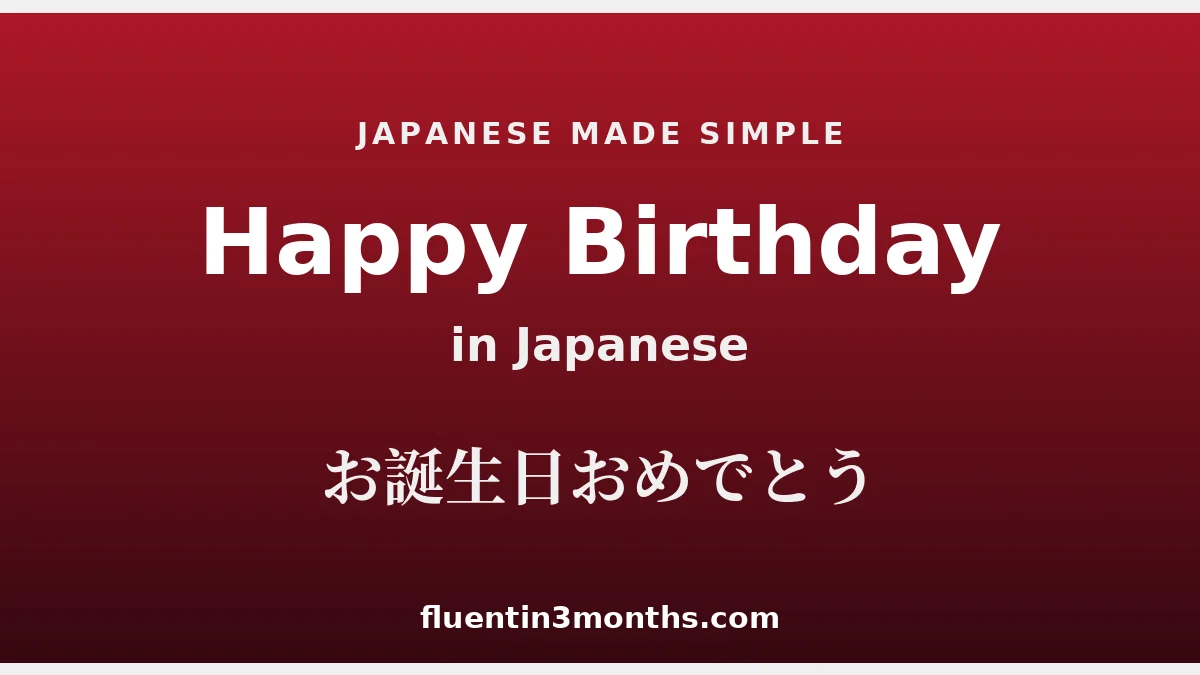
In the intricate landscape of Japanese social interaction, the phrase otanjoubi omedetou gozaimasu serves as more than a simple greeting; it is a reflection of a complex hierarchy of politeness and a history of cultural synthesis. While the modern Japanese birthday celebration mirrors many Western customs, the linguistic and historical underpinnings of these festivities reveal a society that has transitioned from collective aging to the celebration of individual milestones. Understanding how to navigate these celebrations requires an appreciation of the Japanese language’s levels of formality, the historical shift in age-counting systems, and the specific rituals associated with longevity.
The Linguistic Mechanics of Birthday Greetings
The standard expression for Happy Birthday in Japanese is otanjoubi omedetou (お誕生日おめでとう). To understand the weight of this phrase, one must dissect its constituent parts, which demonstrate the inherent respect built into the Japanese language. The prefix "o" (お) is an honorific that elevates the noun it precedes, in this case, "tanjoubi" (誕生日), which translates literally to "birthday." The term "omedetou" (おめでとう) is the casual form of "congratulations."
In professional or formal settings—such as addressing a superior, a teacher, or an elder—the addition of "gozaimasu" (ございます) is mandatory. This auxiliary verb transforms the greeting into otanjoubi omedetou gozaimasu, providing the necessary level of keigo (honorific speech) required to maintain social harmony. Failure to use the polite form in appropriate contexts can be perceived as a breach of etiquette, whereas being overly polite is generally viewed as a safe and respectful default for language learners.
Beyond the standard phrase, the Japanese lexicon includes several variations and related terms used in written correspondence and digital communication. For example, "omedetou" is used broadly for various milestones, including weddings (gokekkon omedetou), the New Year (akemashite omedetou), and academic achievements (goukaku omedetou). This versatility underscores the importance of the word "omedetou" as a cornerstone of Japanese social etiquette.
Historical Transition: From Kazoedoshi to Man’nenrei
The concept of celebrating an individual’s birth date is a relatively modern phenomenon in Japan. For centuries, Japan, along with many other East Asian nations, utilized the kazoedoshi (数え年) system, or "counted years." Under this traditional method, a child was considered one year old at the moment of birth, accounting for the time spent in the womb. Furthermore, instead of aging on the anniversary of their birth, every member of society gained a year simultaneously on New Year’s Day. Consequently, the New Year was the primary occasion for celebrating aging, and individual birthdays held little to no social significance for the average person.
The transition to the Western-style man’nenrei (満年齢) system, where a person ages on their actual birth date, was a protracted legal and cultural process. The chronological milestones of this transition are as follows:
- 1902: The Japanese government officially adopted the Western age-counting system via the "Act on Calculation of Age." However, this law was largely ignored by the public, who continued to use kazoedoshi in daily life.
- 1950: Following World War II, the government implemented the "Act on Counting of Age" to modernize administrative processes and align with international standards. This law actively encouraged citizens to use the man’nenrei system for legal documents, census data, and social interactions.
- Late 20th Century: Birthday celebrations became fully integrated into Japanese domestic life, influenced heavily by Western media and the commercialization of holidays.
Today, while man’nenrei is the standard for law and daily life, the kazoedoshi system still persists in certain traditional contexts, such as calculating ages for specific Shinto rituals or traditional funeral services.
Longevity Milestones and the Symbolism of Rebirth
Despite the adoption of Western birthday traditions, Japan maintains several unique milestones that celebrate longevity. These events, known as gaiaoi (celebrations of age), are deeply rooted in the sexagenary cycle of the lunar calendar.
The most significant of these is the Kanreki (還暦), or 60th birthday. This milestone signifies the completion of five cycles of the twelve zodiac animals, returning the individual to the zodiac sign of their birth year. Symbolically, this is viewed as a "rebirth." To honor this, the celebrated individual is traditionally gifted a red vest and cap, known as an akai chanchanko (赤いちゃんちゃんこ). In Japanese culture, red is the color associated with infants (the word for baby, akachan, literally means "little red one") and is believed to ward off evil spirits.
Other notable longevity milestones include:
- Koki (古希): The 70th birthday, originating from a Chinese poem suggesting that reaching seventy is a rare feat.
- Kiju (喜寿): The 77th birthday, named after the cursive character for "joy," which resembles the characters for seventy-seven.
- Sanju (傘寿): The 80th birthday.
- Beiju (米寿): The 88th birthday, celebrated because the character for "rice" (米) looks like the characters for eighty-eight. This is particularly auspicious as rice is a symbol of vitality and wealth.
Modern Celebrations and the Influence of Loanwords
Contemporary birthday parties in Japan are a blend of domestic preferences and international influences. A staple of these events is the "strawberry shortcake" (ショートケーキ), a light sponge cake layered with whipped cream and fresh strawberries. Unlike the heavy buttercream cakes common in the United States, the Japanese version is prized for its lightness and aesthetic simplicity.
The linguistic influence of English is also prominent in these celebrations. The loanword "happii baasudee" (ハッピーバースデー) is frequently used, particularly in the context of the "Happy Birthday to You" song. Interestingly, while the song is sung to the familiar Western melody, the lyrics are often kept in English or transliterated into katakana. This use of English loanwords is a common feature of Gairaigo (loanwords from foreign languages), which are often perceived as trendy or modern.
In the digital age, social media platforms like LINE and X (formerly Twitter) have introduced new shorthand for birthday greetings. Users may use "otanjoubi omedetou" accompanied by various emojis, or in very casual settings, shorten the phrase significantly. However, linguistic experts note that the traditional structure remains the foundation for all communication.
Phonetic Nuances and Pronunciation
For non-native speakers, the pronunciation of otanjoubi omedetou gozaimasu requires attention to the specific rhythmic structure of the Japanese language. Unlike English, which is a stress-timed language, Japanese is a mora-timed language. This means that every syllable (or mora) is given roughly equal duration.
Key phonetic considerations include:
- Vowel Purity: Japanese vowels (a, i, u, e, o) are short and consistent. The "o" sound in "omedetou" is a pure "oh" sound, without the "oo" glide often found in English.
- Long Vowels: The final "u" in both "tanjoubi" and "omedetou" serves to lengthen the preceding "o" sound. In Rōmaji (Romanized Japanese), this is often represented as "ō." Pronouncing these long vowels correctly is essential for clarity; a short "o" where a long "ō" is required can occasionally change the meaning of a word.
- The "G" Sound: In "gozaimasu," the "g" is a hard "g" as in "gate." The "u" at the end of "masu" is often devoiced or whispered in standard Tokyo dialect, making it sound more like "ma-ss."
Socio-Economic Impact and Market Data
The commercialization of birthdays has created a robust market in Japan. According to data from the Japan Anniversary Association, the economic impact of personal anniversaries and birthdays has grown steadily over the last two decades. The confectionery industry, in particular, sees a significant portion of its annual revenue from birthday cake sales, with high demand for seasonal fruit toppings.
Furthermore, the gift-giving culture in Japan, known as zoutou, extends to birthdays. While traditional gifts like the red chanchanko for the 60th birthday remain relevant, modern gift-giving often involves high-quality stationery, luxury food items, or "experience" gifts. Market research indicates that Japanese consumers place a high value on packaging and the presentation of gifts, reflecting the broader cultural emphasis on omotenashi (hospitality and thoughtfulness).
Broader Implications for Language Learners
Mastering the various ways to say "Happy Birthday" in Japanese provides a window into the broader mechanics of the language. It introduces the learner to the three writing systems: Kanji (used for the core meaning in tanjoubi), Hiragana (used for native grammatical markers in omedetou), and Katakana (used for foreign loanwords like happii baasudee).
Moreover, the birthday greeting serves as a practical application of Japanese social hierarchy. By choosing between the casual and polite versions of the phrase, a speaker demonstrates their awareness of social distance and respect. This cultural literacy is as vital as vocabulary and grammar for anyone seeking to communicate effectively in a Japanese context.
In conclusion, the evolution of the Japanese birthday from a collective New Year’s event to a personalized celebration reflects Japan’s unique ability to adopt global customs while preserving its traditional values. Whether through the formal chanting of otanjoubi omedetou gozaimasu or the symbolic gifting of a red vest to a 60-year-old, these traditions continue to reinforce social bonds and honor the passage of time in a rapidly changing society. For the student of Japanese, the birthday greeting is not merely a phrase to be memorized, but a gateway into the heart of Japanese etiquette and history.
