

The Spanish verb dar, translated primarily as "to give," represents one of the most significant morphological and semantic pillars within the Romance language family. Despite its brevity—consisting of a single-letter stem in its infinitive form—dar functions as a high-frequency linguistic workhorse, appearing in a vast array of idiomatic expressions, phrasal constructions, and grammatical structures. Its mastery is considered a critical milestone for students of Spanish, as it bridges the gap between basic communication and nuanced, native-level fluency. Linguists categorize dar as a highly irregular verb, notable for its idiosyncratic behavior in the present indicative and its tendency to borrow conjugation patterns from other verb classes in the preterite tense.
Morphological Analysis and Historical Context of Irregularities
The irregularity of dar is not a random occurrence but rather a result of the historical evolution of the Spanish language from Vulgar Latin. In the present indicative, the first-person singular form is doy. This "-oy" ending is shared by a select group of high-frequency verbs, including ser (soy), estar (estoy), and ir (voy). These are often referred to by educators as "the four -oy verbs." This deviation from the standard -o ending for -ar verbs is a fossilized remnant of archaic phonetic shifts that prioritized ease of pronunciation for commonly used terms.
Furthermore, dar exhibits a unique crossover in its past tense (preterite) forms. Although it is classified as an -ar verb, it rejects the standard -ar preterite endings (such as -é, -aste, -ó). Instead, it adopts the endings typically reserved for -er and -ir verbs, specifically di, diste, and dio. This morphological borrowing is significant because it mirrors the conjugation of the verb ver (to see), another high-frequency verb. This parallel suggests a linguistic convergence where short, frequently used verbs evolved toward similar, simplified structures to facilitate rapid speech.
Strategic Pedagogy: The Hierarchy of Tense Acquisition
Educational experts in second-language acquisition (SLA) suggest that learners should not approach the seventeen Spanish tenses with equal weight. Instead, a data-driven approach prioritizes tenses based on their frequency in daily conversation. The present indicative of dar serves as the foundational layer, facilitating expressions related to gift-giving, providing directions, and executing favors.
Following the present tense, the preterite and imperfect tenses are prioritized. The preterite (di, diste, dio) is utilized for completed actions in the past, while the imperfect (daba, dabas, daba) describes habitual actions or background conditions. Statistical analyses of Spanish corpora indicate that these three tenses—present, preterite, and imperfect—account for the vast majority of verb usage in non-technical discourse. By mastering these first, learners achieve a functional competency that allows them to navigate most social interactions before tackling more complex moods like the subjunctive.
Comprehensive Conjugation Data: Indicative Mood
The indicative mood is the primary vehicle for stating facts and describing reality. For dar, the simple tenses are structured as follows:
Simple Tenses of Dar:
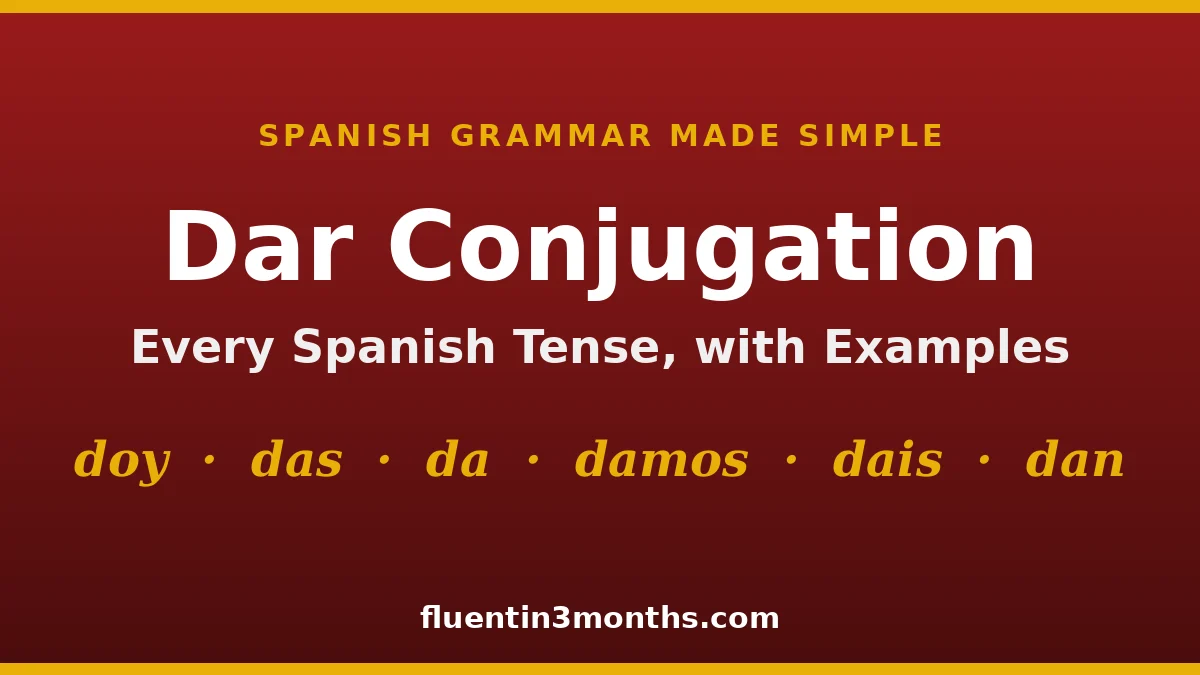
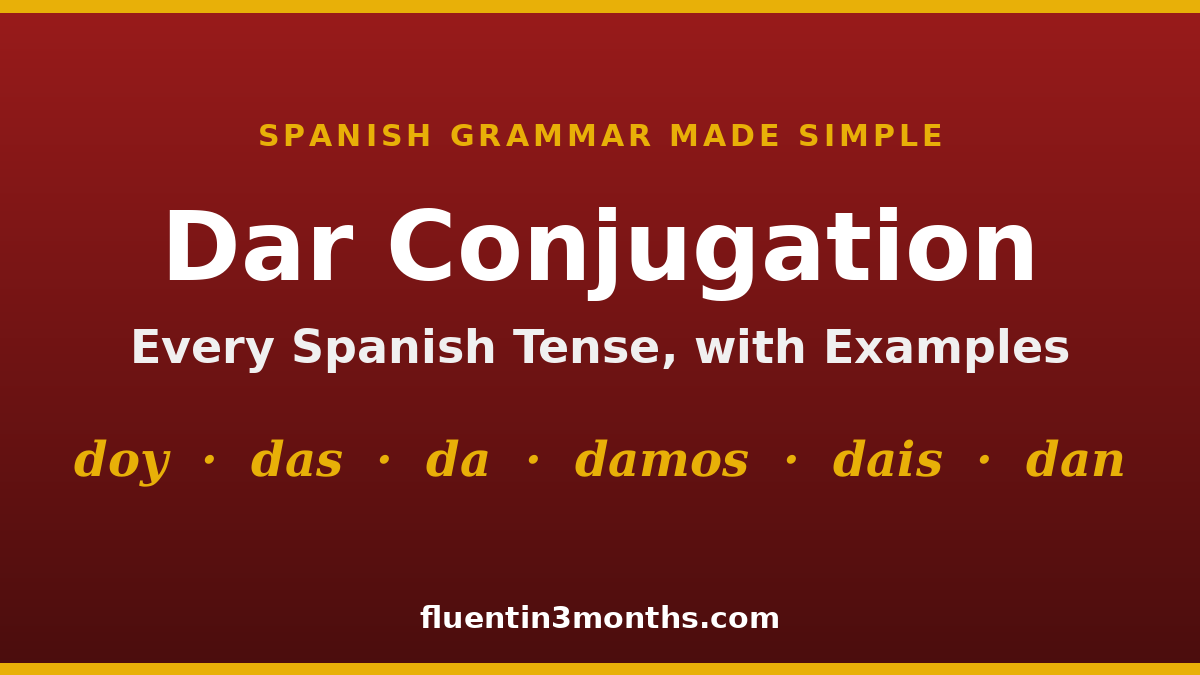
- Present: doy, das, da, damos, dais, dan.
- Preterite: di, diste, dio, dimos, disteis, dieron.
- Imperfect: daba, dabas, daba, dábamos, dabais, daban.
- Future: daré, darás, dará, daremos, daréis, darán.
- Conditional: daría, darías, daría, daríamos, daríais, darían.
In the preterite tense, a notable orthographic detail is the absence of written accents on di and dio. According to the Real Academia Española (RAE), monosyllabic words generally do not carry accents unless they require a tilde to distinguish them from a homonym (diacritic accent). Since 1959, the RAE has clarified that because di and dio are monosyllables without ambiguous counterparts, the accents used in older texts are no longer standard.
Compound Tenses of Dar:
The compound tenses are formed using the auxiliary verb haber combined with the past participle dado. This structure remains consistent across all persons:
- Present Perfect: he dado, has dado, ha dado, hemos dado, habéis dado, han dado.
- Pluperfect: había dado, habías dado, había dado, habíamos dado, habíais dado, habían dado.
- Future Perfect: habré dado, habrás dado, habrá dado, habremos dado, habréis dado, habrán dado.
- Conditional Perfect: habría dado, habrías dado, habría dado, habríamos dado, habríais dado, habrían dado.
The pretérito anterior (hube dado) remains a part of the formal grammatical canon but is increasingly rare in modern spoken and written Spanish, typically reserved for high-level literary or legal contexts.
The Subjunctive Mood and Imperative Commands
The subjunctive mood, used to express doubt, desire, emotion, or hypothetical situations, presents specific challenges for dar. The present subjunctive requires an accent on the forms dé (I/he/she give) to distinguish the verb from the preposition de (of/from). This distinction is vital for written clarity.
Subjunctive Forms:
- Present Subjunctive: dé, des, dé, demos, deis, den.
- Imperfect Subjunctive (-ra): diera, dieras, diera, diéramos, dierais, dieran.
- Imperfect Subjunctive (-se): diese, dieses, diese, diésemos, dieseis, diesen.
The two forms of the imperfect subjunctive are interchangeable, though the -ra suffix is more prevalent in Latin American dialects and informal speech, while the -se suffix is frequently encountered in Peninsular Spanish and formal literature.
Imperative Mood (Commands):
The imperative mood for dar contains a significant irregularity in the informal tú form. The affirmative command is da (Give!), while the negative command is no des (Don’t give!). This shift requires learners to transition between the indicative and subjunctive stems, a common source of error for non-native speakers.
Idiomatic Proliferation and Semantic Versatility
The true utility of dar lies in its idiomatic applications. In many cases, the verb loses its literal meaning of "transferring ownership" and instead functions as a light verb in a phrasal construction.
- Dar un paseo: To take a walk. Here, dar replaces the English "take," emphasizing the execution of an activity.
- Darse cuenta: To realize. This reflexive construction is essential for expressing cognitive shifts or sudden awareness.
- Dar igual: To not matter or to be the same. (e.g., Me da igual – It’s all the same to me).
- Dar a luz: To give birth. A standard medical and social term.
- Dar ganas de: To feel like doing something. (e.g., Me da ganas de comer – I feel like eating).
- Dar la hora: To strike the hour (referring to a clock) or, colloquially, to be the center of attention.
Linguistic analysts note that these idioms are often untranslatable word-for-word. The semantic flexibility of dar allows it to describe physical actions, emotional states, and logical conclusions, making it a "Swiss Army knife" of the Spanish lexicon.
Analysis of Common Pedagogical Errors
Data from language learning platforms indicates several recurring patterns of error among students. The most frequent mistake is the over-regularization of the preterite tense. Students often attempt to apply -ar endings, resulting in incorrect forms like "dó" instead of the correct dio.
Another common pitfall involves the confusion between dé and de. In written examinations, the omission of the tilde on the subjunctive dé is a frequent oversight. Furthermore, learners often struggle with the placement of indirect object pronouns. Because dar inherently involves a recipient, it almost always requires an indirect object pronoun (me, te, le, nos, os, les). For example, "I give the book to him" becomes "Le doy el libro." Forgetting the "le" is a hallmark of the intermediate plateau in Spanish acquisition.
Broader Implications for Language Fluency
Mastering dar is more than a grammatical exercise; it is an entry point into the cultural logic of the Spanish language. The verb’s involvement in expressions of time, weather, and personal feeling (e.g., dar miedo – to frighten) reflects a worldview where many experiences are "given" to the subject rather than "had" by them.
From a journalistic and educational perspective, the study of dar highlights the importance of "high-yield" vocabulary. By focusing on a single, versatile verb, learners can exponentially increase their expressive range. Experts suggest that rather than memorizing obscure vocabulary, students should focus on the "depth" of core verbs like dar, ir, tener, and hacer.
Conclusion: The Path to Mastery
The verb dar stands as a testament to the complexity and beauty of Spanish historical linguistics. While its irregularities may appear daunting, they follow internal patterns that, once understood, provide a clearer view of the language’s structure. For the serious student, the journey from the simple doy to the nuanced hubiera dado represents the broader journey of language acquisition itself—moving from basic utility to sophisticated expression.
As the Spanish-speaking population continues to grow globally, the demand for effective pedagogical strategies for verbs like dar remains high. Current trends in linguistics emphasize the use of "chunks" or "lexical units"—learning darse cuenta as a single unit of meaning rather than three separate words. This method, supported by modern fluency bootcamps and digital resources like Anki and SpanishPod101, ensures that the busy, irregular, and indispensable verb dar remains accessible to the next generation of Hispanophones.
