

The intricate tapestry of human experience is woven from a variety of threads, among the most significant of which are emotions, moods, and attitudes. While often used interchangeably in everyday conversation, these psychological constructs operate on distinct temporal scales and serve different, yet interconnected, functions. A deeper understanding of their differences and interactions is crucial for cultivating greater self-awareness, enhancing emotional regulation, and navigating the complexities of interpersonal relationships. Building upon prior explorations of the distinctions between moods and emotions, this analysis delves into the multifaceted nature of attitudes, revealing how these three fundamental elements shape our perception of ourselves and the world around us.
The Fleeting Intensity of Emotions
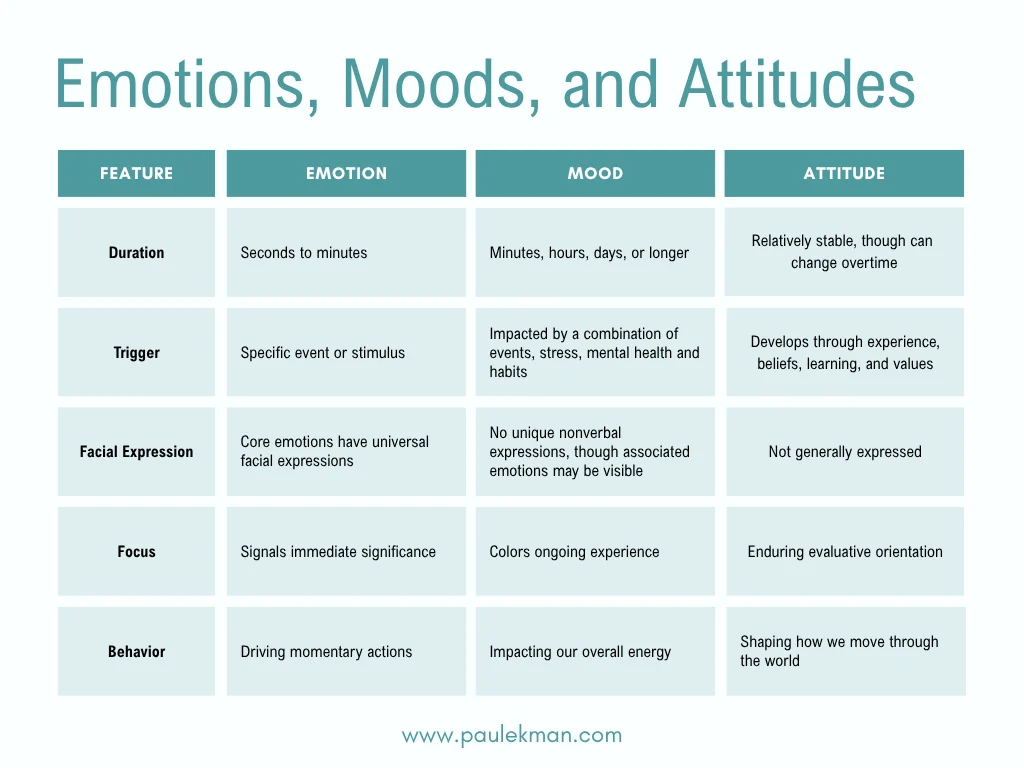
Emotions are defined as automatic appraisal processes, deeply influenced by our evolutionary heritage and shaped by individual life experiences. They are triggered by events deemed significant in relation to our personal goals, needs, or overall well-being. This significant occurrence initiates a cascade of coordinated psychological and physiological changes, preparing the individual for action. By their very nature, emotions are relatively transient, typically lasting from a fraction of a second to several minutes. This brevity is characterized by noticeable bodily changes, including shifts in autonomic nervous system activity, which manifest as physiological responses such as increased heart rate or perspiration, and distinct facial expressions. These rapid, potent responses are designed to facilitate immediate adaptation and reaction to the demands of the present moment. Research by Paul Ekman and his colleagues has identified a set of universal emotions—such as joy, sadness, anger, fear, surprise, and disgust—that are expressed through consistent facial configurations across diverse cultures, underscoring their fundamental biological basis.
The Pervasive Influence of Moods
In contrast to the acute nature of emotions, moods possess a more diffuse and enduring quality. They are affective states that can persist for hours, days, or even longer. A key distinction lies in their trigger: moods often lack a clearly identifiable antecedent event or object. Individuals might wake up experiencing a particular mood, or find themselves gradually slipping into one without a discernible cause. This lack of specificity means moods are not directed towards a particular stimulus but rather create a pervasive emotional backdrop that colors an individual’s overall experience. While distinct facial expressions are less commonly associated with moods compared to acute emotions, subtle indicators such as changes in posture, muscle tension, or overall energy levels can be observable. Moods play a significant role in modulating our susceptibility to certain emotions, influencing how readily they are triggered and the intensity with which they are experienced. For instance, a person in a negative mood might be more prone to interpret neutral events with a critical lens, leading to a heightened likelihood of experiencing negative emotions. Studies in affective science have indicated that mood states can significantly impact cognitive processes, including attention, memory recall, and decision-making, demonstrating their pervasive influence on daily functioning.
The Enduring Framework of Attitudes
Attitudes, unlike emotions and moods, are not ephemeral affective states. Instead, they represent relatively stable evaluations of people, ideas, objects, behaviors, or experiences. Psychologists commonly conceptualize attitudes as comprising three interconnected components: beliefs, emotional associations, and behavioral tendencies. This framework, often referred to as the ABC model of attitudes, posits that:
- Affective component: This refers to the emotional responses and feelings associated with the attitude object. For example, an attitude towards a particular brand might involve positive feelings of trust or excitement.
- Behavioral component: This encompasses the predisposition to act in a certain way towards the attitude object. This could manifest as a tendency to purchase a product, engage in a specific activity, or support a particular policy.
- Cognitive component: This involves the beliefs, knowledge, and thoughts an individual holds about the attitude object. For instance, beliefs about the effectiveness or ethical implications of a product would fall under this component.
Attitudes can be further classified as either explicit, meaning they are consciously held and readily articulated, or implicit, referring to unconscious biases or predispositions that nonetheless influence behavior and thought. For example, an explicit attitude towards public speaking might be the conscious belief that it is a vital skill, coupled with a learned emotional association of anxiety from past experiences, leading to a behavioral tendency to avoid such situations. Implicit attitudes, on the other hand, might exist without conscious awareness but still shape how an individual reacts to certain groups or situations.
While generally more stable than emotions or moods, attitudes are not immutable. They are developed and refined over time through a confluence of factors including repeated emotional experiences, various forms of learning—such as classical and operant conditioning—exposure to social and cultural norms, interpersonal relationships, and personal reflection. Significant new experiences can gradually strengthen, weaken, or fundamentally reshape existing attitudes. Crucially, attitudes are always directed towards a specific entity; one can hold an attitude towards a person, a political policy, a past event, or even towards their own emotional responses. Because attitudes function as an evaluative lens, they significantly influence how new information is processed and how individuals are predisposed to respond, thereby shaping their overall perception of the world.
The Interplay: How They Influence Each Other
The distinct nature of emotions, moods, and attitudes does not preclude their dynamic and continuous interaction. Their interplay is fundamental to understanding the complexities of human psychology.
Moods as Emotional Modulators
A person’s prevailing mood significantly impacts the likelihood and intensity of experienced emotions. An individual in an optimistic or cheerful mood may find it easier to recover from minor frustrations, experiencing them as fleeting setbacks. Conversely, someone in an irritable or anxious mood may react with disproportionate intensity to minor inconveniences, finding their patience quickly eroded. Research suggests that prolonged exposure to a series of acute negative emotions, such as worry or frustration, can coalesce into a more sustained negative mood state, such as anxiety or irritability. This bidirectional relationship highlights how transient emotional experiences can contribute to the formation and maintenance of longer-term mood states, which in turn influence subsequent emotional reactivity.
Attitudes as the Lens for Emotional Experience
Attitudes play a pivotal role in both shaping and being shaped by our emotional landscape. Consider two individuals receiving identical constructive criticism. One, holding a positive attitude towards feedback as a valuable learning opportunity, might experience excitement and motivation. The other, viewing feedback as a personal threat, might experience anxiety and resentment. The external stimulus is the same, but their pre-existing attitudes dictate their cognitive appraisal of the situation, directly influencing the emotions they subsequently feel. This underscores how deeply ingrained evaluative frameworks can color our emotional responses to everyday events.
Attitudes Towards Emotions: The Meta-Attitude
A particularly influential category of attitudes involves our evaluations of emotions themselves. These "meta-attitudes" can range from beliefs that anger is inherently destructive, sadness signifies weakness, fear should always be suppressed, or that joy is always appropriate to express. Such attitudes are typically cultivated over years through familial interactions, cultural norms, educational experiences, and personal histories. Our attitudes towards specific emotions can dictate our willingness to acknowledge, accept, express, or learn from them. These attitudes are closely linked to the concept of "display rules," which are culturally learned norms governing how, when, and to whom emotional expressions are considered appropriate. While certain facial expressions of emotion are universally recognized, the rules for their display vary significantly across cultures, contributing to observable differences in emotional expression worldwide. For instance, a culture that emphasizes stoicism might instill an attitude that displays of sadness are unacceptable, leading individuals to suppress outward expressions of grief, even if the underlying emotion is intensely felt.
Cultivating Emotional Awareness for Enhanced Well-being
At the Paul Ekman Group, the cultivation of emotional awareness is viewed as a foundational skill, commencing with the capacity to observe one’s internal experiences with clarity and impartial curiosity. By developing the ability to identify emotions as they arise, comprehend the influence of prevailing moods, and recognize the underlying attitudes that shape our interpretations, individuals are better equipped to respond to themselves and others with greater wisdom, empathy, and compassion.
The development of these nuanced psychological skills is an ongoing process that requires consistent practice and intentional effort. These capacities can be significantly strengthened over time through dedicated learning and application. For those seeking to deepen their understanding of the science of emotion and enhance their emotional intelligence, the Paul Ekman Group offers a range of research-based resources designed to support this journey. These resources often include training modules and materials grounded in the principles of emotional science, aiming to equip individuals with practical tools for self-understanding and interpersonal effectiveness.
The study of emotions, moods, and attitudes is not merely an academic pursuit; it is a vital component of human flourishing. By dissecting these fundamental aspects of our inner lives, we unlock pathways to more effective self-management, richer interpersonal connections, and a more profound understanding of the human condition. The ongoing exploration of these psychological constructs continues to offer valuable insights into how we navigate our world and interact with those around us, paving the way for more fulfilling and resilient lives.
