


Ten years ago, a groundbreaking initiative was unveiled to the world: the Atlas of Emotions. Born from a singular vision and a profound collaboration between renowned psychologist Dr. Paul Ekman, his daughter Dr. Eve Ekman, and His Holiness the Dalai Lama, the Atlas embarked on an ambitious journey to meticulously chart the vast and intricate landscape of human emotion. Its core objective was to create a framework that was not only scientifically robust but also profoundly accessible, empowering individuals with a deeper understanding of their inner emotional lives. Today, a decade after its inception, this innovative emotional awareness framework continues to exert a significant and far-reaching influence, its impact resonating across diverse spheres, from educational institutions and therapeutic practices to cutting-edge research laboratories and the very fabric of everyday human interaction on a global scale.
The genesis of the Atlas of Emotions lies in Dr. Paul Ekman’s lifelong dedication to understanding the universal nature of emotions. His seminal work, built upon decades of research, sought to identify common ground within the scientific community regarding the fundamental building blocks of human affect. A pivotal step in this endeavor was a comprehensive survey conducted by Dr. Ekman, which engaged nearly 250 leading emotion scientists. This extensive inquiry revealed a striking consensus on the existence and nature of universal emotions, providing a critical foundation upon which the Atlas could be built. This scientific bedrock, combined with sophisticated graphic design and the contemplative wisdom of His Holiness the Dalai Lama, forged a unique interdisciplinary approach that characterized the project from its earliest stages.
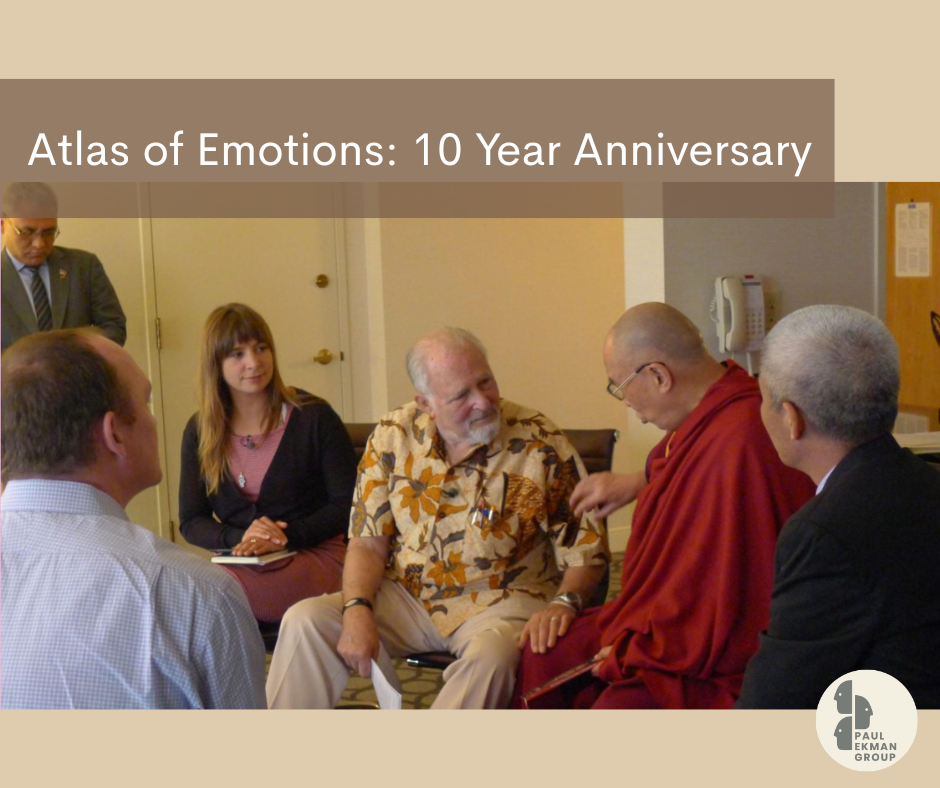
To commemorate this significant ten-year milestone, a rare and insightful glimpse into the collaborative process behind the Atlas has been shared. This previously unseen footage captures a working meeting between Dr. Paul Ekman, Dr. Eve Ekman, and His Holiness the Dalai Lama as they meticulously reviewed the Atlas during its development. This archival material offers a unique window into the intellectual synergy and shared commitment that fueled the project, illustrating the iterative process of refinement and the dedication to achieving clarity and precision in representing emotional states. The footage underscores the project’s commitment to a consensus-driven methodology, where rigorous scientific inquiry met contemplative insight and artistic execution.
The Atlas of Emotions officially launched in 2016, and its innovative approach immediately captured global attention. Prominent media outlets recognized its potential to demystify complex psychological concepts for a broad audience. The New York Times, in a notable feature, highlighted the Atlas’s groundbreaking method of mapping emotions and its accessibility, acknowledging its potential to bridge the gap between academic research and public understanding. This early recognition served as a catalyst, propelling the Atlas into widespread adoption and application across various sectors.
Over the past decade, the Atlas of Emotions has been integrated into a multitude of contexts, demonstrating its versatility and enduring relevance. In educational settings, it has been employed to foster emotional literacy among students, equipping them with the vocabulary and conceptual tools to identify, understand, and manage their emotions. This has translated into improved classroom dynamics, enhanced interpersonal skills, and a more supportive learning environment. Therapists and counselors have leveraged the Atlas as a valuable resource in their practices, facilitating deeper client self-awareness and more effective therapeutic interventions. By providing a shared language and visual framework, the Atlas aids in the exploration of complex emotional experiences, promoting healing and personal growth.
Researchers have also found the Atlas to be an indispensable tool in their ongoing investigations into the human psyche. Its detailed mapping of emotional states provides a standardized framework for studying emotional responses across different cultures, populations, and experimental conditions. This has contributed to a richer and more nuanced understanding of emotional processes, paving the way for new discoveries and advancements in psychological science. Beyond these formal settings, the Atlas has permeated everyday conversations, empowering individuals to articulate their feelings more clearly, navigate interpersonal relationships with greater empathy, and cultivate a more profound sense of emotional intelligence in their daily lives. The framework’s intuitive design and comprehensive scope have made it a trusted companion for those seeking to better understand themselves and the people around them.
The impact of the Atlas can be further appreciated through an analysis of its underlying data and scientific rigor. Dr. Paul Ekman’s research, forming the bedrock of the Atlas, has consistently identified a set of universal facial expressions associated with basic emotions, which are recognized across diverse cultures. These include happiness, sadness, anger, fear, surprise, and disgust. The Atlas, however, expands upon this foundation by mapping a broader spectrum of emotions, including more nuanced states and their interrelationships. It visually represents emotions along dimensions such as pleasantness, activation, and certainty, offering a dynamic and multidimensional understanding. This approach allows users to explore not only discrete emotions but also the gradients and transitions between them, providing a more sophisticated model than simple categorical classifications. The inclusion of pathways between emotions, such as the transition from anger to frustration or from surprise to curiosity, further enhances its utility for understanding emotional flux.
As the Atlas of Emotions celebrates this significant ten-year anniversary, the team is keenly focused on the future and actively seeking input from its global community of users. A direct invitation has been extended for individuals to share their experiences with the Atlas, detailing how it has influenced their perceptions, understanding, or personal changes. This feedback is crucial for shaping the next evolutionary phase of the project. Users are encouraged to contribute their insights through a dedicated feedback form, which will directly inform ongoing development and future initiatives. This participatory approach underscores a commitment to ensuring the Atlas remains a relevant, responsive, and impactful tool for emotional exploration.
The insights gathered from these user contributions will be instrumental in informing the upcoming advancements. The online, interactive Atlas of Emotions is slated for significant updates, promising enhanced features, expanded content, and an even more intuitive user experience. These enhancements are expected to build upon the existing framework, incorporating new research findings and user-driven suggestions to deepen its analytical capabilities and broaden its applicability.
Furthermore, a highly anticipated development is the forthcoming release of an "Atlas of Emotions" book, currently being meticulously developed by Dr. Eve Ekman. This comprehensive work, scheduled for publication in 2027, will serve as a definitive exploration of the Atlas’s principles and applications. It is anticipated to delve deeper into the theoretical underpinnings, present novel case studies, and offer expanded guidance on leveraging the Atlas for personal growth, professional development, and academic research. This book promises to be an essential resource for anyone seeking a profound and comprehensive understanding of the human emotional spectrum, building upon the legacy established by the online Atlas and Dr. Paul Ekman’s foundational research.
The journey of the Atlas of Emotions over the past decade represents a powerful testament to the enduring human quest for self-understanding and connection. From its scientifically grounded origins and collaborative development to its widespread impact and future aspirations, the Atlas continues to illuminate the intricate pathways of our inner lives. As it embarks on its next chapter, the project remains dedicated to empowering individuals and communities with the knowledge and tools to navigate the complexities of emotion, fostering greater well-being and deeper human understanding across the globe. The ongoing commitment to innovation and user engagement ensures that the Atlas of Emotions will continue to evolve, serving as a vital resource for generations to come in their exploration of the human heart.
