

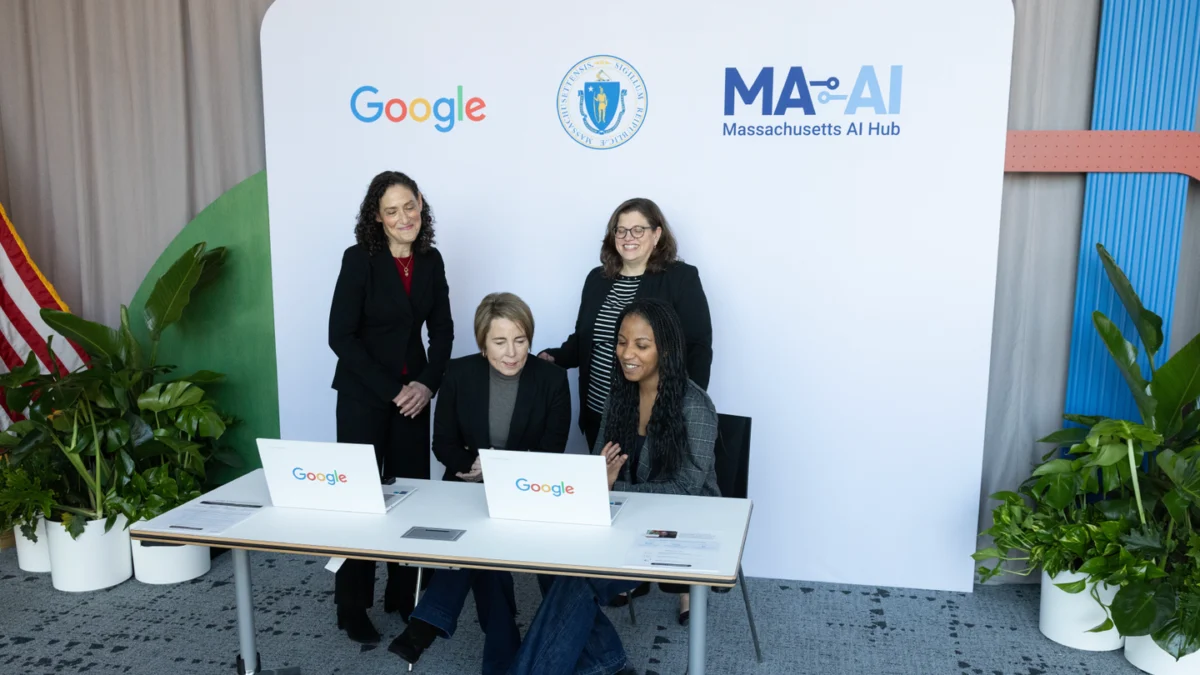
The Commonwealth of Massachusetts has entered into a strategic partnership with Google to provide comprehensive artificial intelligence (AI) and career training to all residents at no cost. Announced by Governor Maura Healey and Google leadership, the initiative integrates the "Grow with Google" program with the Massachusetts AI Hub, a state-led endeavor designed to cement the Bay State’s position as a global leader in the responsible development and adoption of AI technologies. This collaboration aims to bridge the digital divide by offering every resident access to the Google AI Professional Certificate and the broader suite of Google Career Certificates, effectively removing financial barriers to high-growth career paths in the evolving digital economy.
The partnership represents a significant expansion of Massachusetts’ workforce development strategy, focusing on "AI literacy" as a fundamental skill for the modern era. By providing these resources for free, the state and Google are targeting a broad demographic, from students and entry-level job seekers to mid-career professionals looking to pivot into technical roles. This initiative builds on similar successful deployments in Arkansas, Connecticut, Oklahoma, and Virginia, signaling a growing trend of public-private partnerships aimed at addressing the national "AI skills gap."
Strategic Framework of the Massachusetts AI Partnership
The cornerstone of this announcement is the integration of Google’s curriculum into the Massachusetts AI Hub, which is managed by the Massachusetts Technology Collaborative (MassTech). The Hub was established to foster an ecosystem where AI can thrive through research, ethics, and economic application. By partnering with Google, the state is leveraging the private sector’s infrastructure to scale educational opportunities faster than traditional academic curricula might allow.
Residents will have access to two primary educational tracks. The first is the newly launched Google AI Professional Certificate, which is designed to teach learners how to use generative AI tools to automate tasks, improve productivity, and enhance creative workflows. The second is the established Google Career Certificates program, which provides intensive training in fields such as Cybersecurity, Data Analytics, IT Support, Project Management, and UX Design. These certificates are notable for their "industry-recognized" status, often serving as a proxy for a college degree in the eyes of hundreds of major employers, including those within the Google Hiring Partnership.
Chronology of Google’s Educational Expansion and the Massachusetts Tech Strategy
The evolution of this partnership can be traced back to the 2017 launch of "Grow with Google," an initiative aimed at helping people get the skills they need to find a job or grow their business. Over the last seven years, the program has trained over 11 million Americans. However, the rapid emergence of generative AI in late 2022 and 2023 necessitated a shift in the program’s focus.
In early 2024, Governor Maura Healey signed an executive order establishing the Artificial Intelligence Strategic Task Force. This group was charged with identifying the best ways for Massachusetts to lead in AI, focusing on both the economic opportunities and the ethical guardrails required for the technology. The task force identified workforce readiness as a primary pillar, leading to the current collaboration with Google.
Massachusetts has long been a hub for technological innovation, centered largely around the Kendall Square area in Cambridge, where Google maintains a significant corporate presence. The state’s move to partner with Google is a natural progression of a decades-long relationship between the tech giant and the Commonwealth’s academic and economic infrastructure. By late 2024 and early 2025, the state accelerated its efforts to make AI training ubiquitous, leading to this statewide rollout.
Data-Driven Insights: The Economic Necessity of AI Literacy
The push for AI training is backed by significant economic data suggesting a massive shift in the labor market. According to research from the World Economic Forum, AI is expected to transition 40% of all working hours across the global economy. In the United States, a study by LinkedIn recently found that job postings mentioning AI or Generative AI have more than doubled over the past two years, with applications for these roles growing 17% faster than those that do not mention the technology.
In Massachusetts specifically, the demand for tech-literate workers is among the highest in the nation. The state’s economy is heavily weighted toward biotechnology, finance, and higher education—sectors that are being fundamentally reshaped by AI. Data from the Bureau of Labor Statistics suggests that "computer and information technology" occupations are projected to grow much faster than the average for all occupations from 2022 to 2032.
Furthermore, the "cost of entry" for high-level tech training has historically been a barrier for marginalized communities. By offering these certificates at no cost, Massachusetts is addressing the "digital divide." Prior to this partnership, the cost of these certificates on platforms like Coursera typically ranged from $39 to $49 per month. For a six-month course, this represented a significant investment for low-income residents. The state-funded access eliminates this hurdle, potentially diversifying the pipeline of talent entering the Massachusetts tech sector.
Official Responses and Institutional Perspectives
Governor Maura Healey emphasized that the partnership is a proactive measure to ensure that the state’s workforce remains the most competitive in the world. "Massachusetts is the global hub of innovation, and we are committed to ensuring our workers have the skills they need to lead in the AI era," Healey stated during the announcement. She noted that the initiative is not just about technical jobs, but about "equipping every resident with the tools to use AI in their current roles, regardless of the industry."
Google’s leadership expressed a similar commitment to the region. With a large office in Cambridge, Google considers Massachusetts a "home state" for its research and development operations. Representatives from the company noted that the goal of the Google AI Professional Certificate is to demystify the technology, moving it from a niche scientific field to a practical tool for administrative assistants, marketing managers, and small business owners.
The Massachusetts AI Hub, through its director, highlighted that this partnership is part of a "multi-modal" approach to economic development. By combining Google’s technical training with the state’s existing community college system and vocational schools, the Commonwealth is creating a "wrap-around" educational environment where learners can find the specific type of instruction that suits their needs.
Broader Implications for the Workforce and the Education Sector
The implications of this partnership extend beyond simple job training. It represents a shift in how state governments view the role of "lifelong learning." As AI continues to evolve at an exponential rate, the traditional model of a four-year degree followed by a 40-year career without significant retraining is becoming obsolete. The Massachusetts model suggests that states must take an active role in providing continuous, updated technical education.
For the education sector, this move signals a deeper integration of industry-led certifications into the public sphere. There is an ongoing debate among educators regarding the balance between "broad-based liberal arts education" and "specific vocational tech training." The Massachusetts initiative suggests a hybrid future where state-sponsored AI literacy becomes a foundational layer of public service, similar to public libraries or basic internet access.
From an analysis standpoint, the success of this program will likely be measured by the "completion rate" of the certificates and the subsequent "wage growth" of the participants. Critics of online-only training often point to high attrition rates; however, the involvement of the Massachusetts AI Hub may provide the necessary local support and networking opportunities to ensure residents stay engaged with the material.
The Future Outlook for AI in the Bay State
As Massachusetts rolls out this program, other states are expected to watch the results closely. If the initiative leads to a measurable increase in AI adoption among small businesses and a decrease in the "skills gap" for major employers like Mass General Brigham or Fidelity Investments, it could become a national blueprint.
The program also sets the stage for future policy developments. As more residents become AI-literate, the state will likely face new questions regarding AI ethics, data privacy, and the automation of government services. By educating the populace now, Massachusetts is not just preparing a workforce; it is cultivating an informed citizenry capable of navigating the complex social and legal challenges that AI will inevitably bring.
For now, the message from the State House and Google’s Cambridge office is clear: AI is no longer a technology of the future—it is a tool of the present. By making this training accessible to every "Bay Stater," Massachusetts is betting that its greatest economic asset will remain its human capital, empowered by the most advanced tools available. Residents can now visit the Massachusetts AI Hub website to register for the courses, marking the beginning of a new chapter in the state’s long history of educational and technological leadership.
