

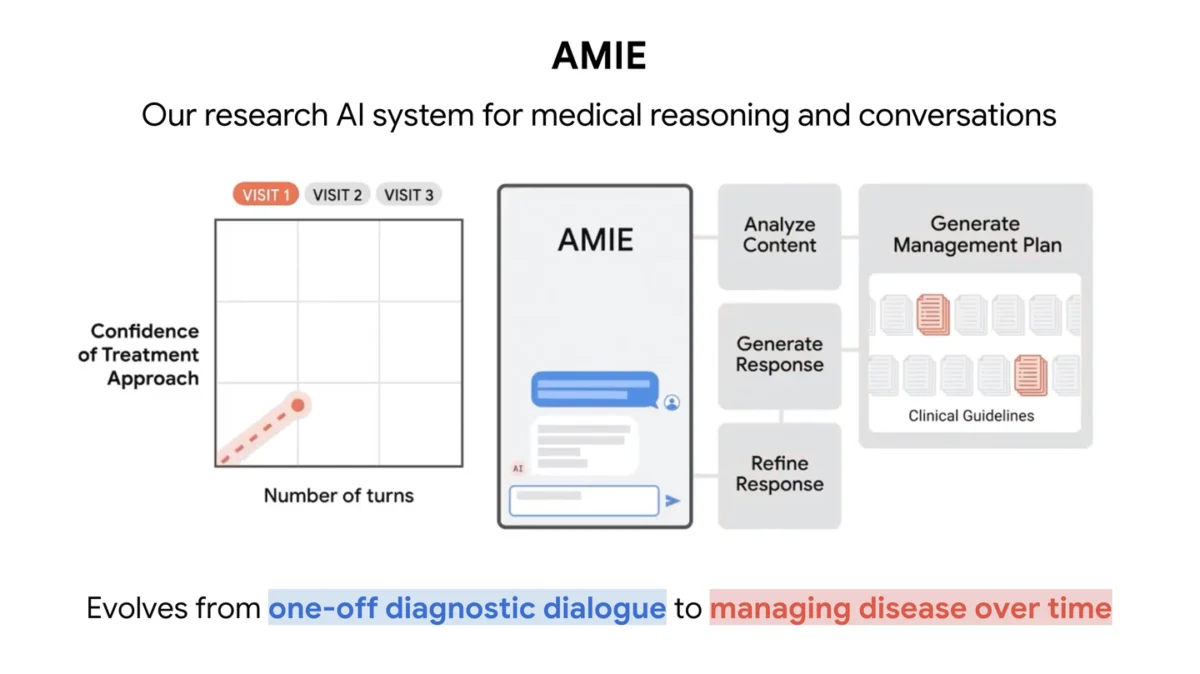
The landscape of digital health has shifted significantly with the publication of new research in the journal Nature, detailing the expanded capabilities of the Articulate Medical Intelligence Explorer, known as AMIE. Developed by Google Research, AMIE has evolved from a system primarily focused on one-off diagnostic conversations into a sophisticated tool capable of longitudinal disease management. This transition addresses one of the most complex challenges in modern medicine: the ongoing oversight of chronic conditions, which requires the continuous tracking of symptoms, the integration of evolving clinical guidelines, and the precise titration of medications over extended periods.
For decades, the medical community has sought technological solutions to alleviate the administrative and cognitive burdens placed on healthcare providers. While early iterations of artificial intelligence in medicine focused on narrow tasks—such as image recognition in radiology or basic symptom checking—the integration of large language models (LLMs) has opened the door to "reasoning agents" that can simulate the nuanced decision-making processes of a physician. The latest findings suggest that AMIE, powered by the long-context capabilities of Google’s Gemini models, may represent a significant leap toward achieving autonomous yet safe medical reasoning in a clinical context.
The Nature Study: Methodology and Comparative Performance
The research published in Nature centers on a blinded study designed to evaluate how well an AI system can manage a patient’s health over time compared to human practitioners. To achieve this, the researchers utilized a cohort of patient actors—individuals trained to present consistent medical histories and symptoms—to interact with both the AMIE system and a group of 21 board-certified primary care physicians.
The study was structured to move beyond the initial "diagnostic" phase. In a typical medical encounter, the diagnosis is merely the starting point. The subsequent "management" phase involves a recursive process of observing how a patient responds to treatment, adjusting dosages based on lab results, and ensuring the care plan remains compliant with the latest "gold standard" medical guidelines.
In the comparative analysis, specialist physicians acted as independent evaluators, reviewing the performance of both the AI and the human doctors without knowing which was which. The results indicated that AMIE matched the human clinicians in overall management reasoning. More notably, the AI scored significantly higher than its human counterparts in two critical areas: plan preciseness and guideline alignment. While human doctors often rely on memory or high-level summaries of clinical protocols, AMIE’s architecture allows it to cross-reference hundreds of pages of authoritative clinical knowledge in real-time, leading to a more rigorous adherence to established medical standards.
Technical Architecture: The Dual-Agent System
The efficacy of AMIE in this study is attributed to its unique dual-agent architecture, which leverages the massive "context window" of the Gemini model family. Managing a disease over months or years involves processing a vast amount of data, including past medical records, pharmacy histories, and multiple consultation transcripts.
The first component of the system is the Empathetic Dialogue Agent. This interface is designed for real-time interaction with patients, focusing on linguistic nuances that build trust and encourage the disclosure of symptoms. In medical practice, the "quality" of a conversation is often as important as the clinical outcome; patients who feel heard are more likely to adhere to treatment plans.
The second component is the Deep-Thinking Management Reasoning Agent. This "back-end" system operates by parsing the patient’s longitudinal data against a massive repository of drug formularies and clinical guidelines. Unlike standard LLMs that may "hallucinate" or provide generic advice, this agent is designed to perform structured reasoning. It identifies contradictions in data, recognizes when a patient’s condition is deviating from the expected recovery path, and suggests specific medication adjustments based on current pharmacological standards.
Chronology of AMIE’s Development and Medical AI Milestones
The journey toward AMIE’s current capabilities is part of a broader timeline of advancements in medical informatics and generative AI.
- 2010s: The Era of Narrow AI: Early medical AI research focused on deep learning for specific diagnostic tasks, such as identifying diabetic retinopathy from retinal scans or detecting skin cancer from photographs.
- 2020–2022: The Rise of LLMs: The introduction of Transformer-based models allowed AI to understand and generate medical text. However, these models were often criticized for a lack of "clinical grounding" and an inability to handle long-term patient histories.
- Early 2023: The Introduction of Med-PaLM: Google introduced Med-PaLM, one of the first LLMs to perform at a "passing" level on U.S. Medical Licensing Examination (USMLE) style questions.
- Late 2023: The Birth of AMIE: AMIE was initially unveiled as a research prototype focused on diagnostic dialogue. Early testing showed it could generate a differential diagnosis comparable to specialists in simulated environments.
- 2024: Longitudinal Management Expansion: The current phase, as detailed in Nature, marks the shift from diagnosis to "Mx" (medical management). This involved training the model on long-context sequences to understand the progression of disease over time.
- Present and Future: Google has now launched a nationwide randomized study to evaluate how these systems function in real-world virtual care settings, moving out of the laboratory and into the lives of actual patients.
Supporting Data and Clinical Implications
The data from the Nature study highlights a persistent issue in global healthcare: the "guideline gap." It is estimated that it can take years for new clinical research to be consistently integrated into the daily practice of primary care doctors, largely due to the sheer volume of new information published every month.
In the study, AMIE’s superior "guideline alignment" suggests that AI could serve as a safety net, ensuring that no matter how busy a clinic is, the treatment plans provided to patients are based on the most recent evidence-based medicine. For example, in the management of chronic conditions like hypertension or Type 2 diabetes, precise medication adjustments (titration) are essential. The study found that AMIE’s recommendations were frequently more granular and closely followed the "step-care" protocols recommended by medical boards than those of the human control group.
Furthermore, the data regarding "plan preciseness" indicates that AI-generated plans were less ambiguous. In a clinical setting, ambiguity in a treatment plan can lead to patient confusion or pharmacist errors. By providing clear, data-backed instructions, AMIE demonstrated a potential to reduce the secondary errors that often plague healthcare systems.
Official Responses and Industry Perspectives
While the results are promising, the medical community remains cautious. Independent experts in bioethics and clinical informatics have noted that while AMIE performs well in simulations with patient actors, the "real world" presents variables that are difficult to model.
"The transition from a controlled study with actors to a diverse, real-world population is the ultimate test for any medical AI," noted a source familiar with the research. "In the real world, patients have comorbidities, social determinants of health, and inconsistent adherence to medication that a simulated environment might not fully capture."
Google Research has echoed this sentiment, emphasizing that AMIE is currently a "best-in-class research AI system" and not yet a replacement for human doctors. The company’s stated goal is to provide a "supportive tool" that handles the data-heavy aspects of disease management, thereby "giving physicians more time to spend with patients." This "human-in-the-loop" philosophy is central to the current regulatory discourse surrounding AI in healthcare, where the AI provides the analysis and the physician provides the final validation and the "human touch."
Broader Impact on Global Healthcare Systems
The implications of a functional, longitudinal medical AI are global in scope. Many regions, particularly in the Global South, face a critical shortage of primary care physicians and specialists. A system like AMIE could potentially democratize access to high-quality medical reasoning, providing frontline health workers with a "specialist in their pocket" to help manage complex chronic diseases in underserved populations.
In developed economies, the impact may be felt most in the fight against physician burnout. The administrative burden of tracking patient data and updating records is a leading cause of career dissatisfaction among doctors. By automating the parsing of guidelines and the initial drafting of management plans, AMIE could reclaim hours of a physician’s day.
As Google moves forward with its nationwide randomized study, the focus will shift to "feasibility" and "safety." This includes assessing how patients feel about interacting with an AI for their long-term care and ensuring that the system remains unbiased across different demographic groups. The publication in Nature serves as a foundational proof-of-concept, suggesting that the future of medicine may not just be about finding out what is wrong with a patient, but about having a persistent, intelligent partner to help them get—and stay—well.
