

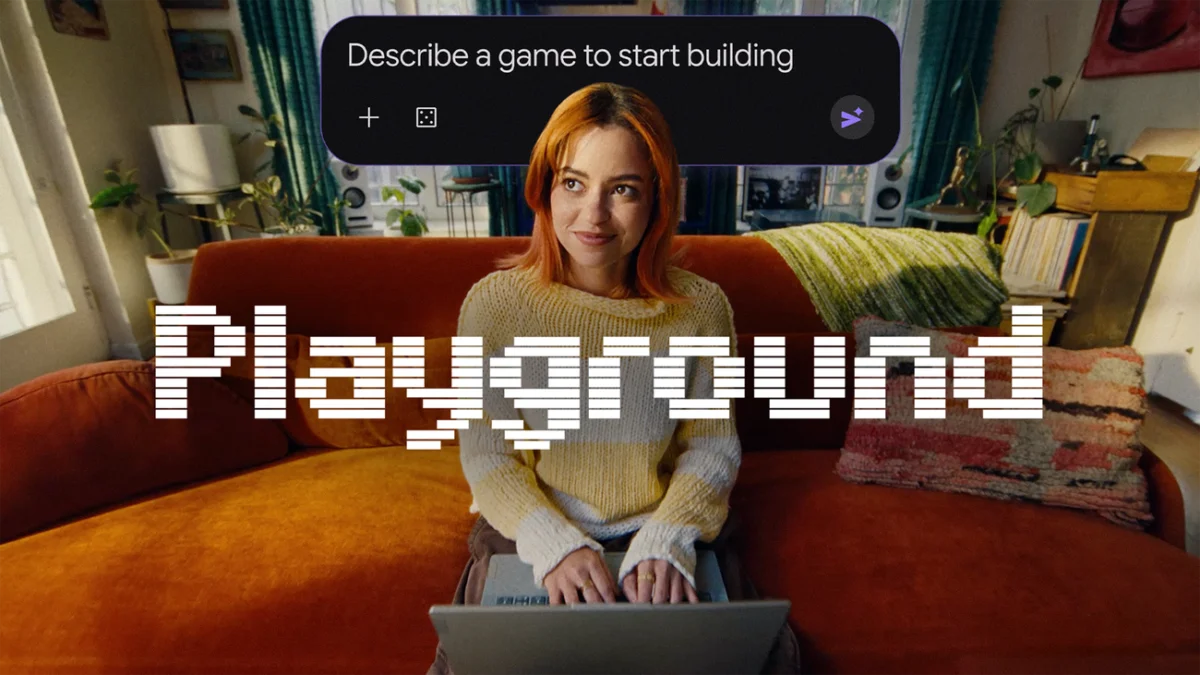
Google has officially announced the launch of Playground, a new experimental gaming platform that leverages generative artificial intelligence to allow users to design, play, and share custom video games without requiring traditional coding knowledge. Developed by the Google AI Innovation and Research team, the platform aims to democratize game development by replacing complex programming languages and engine-specific technical skills with a natural language conversational interface. Maryam Karimzadehgan, a Software Engineer within Google’s AI Innovation and Research division, detailed the launch as a significant step in making creative expression more accessible to the general public.
By utilizing text-to-game technology, Playground enables users to construct digital environments, define physics, and establish gameplay rules through simple descriptive prompts. This move represents a strategic pivot for Google in the gaming sector, focusing on user-generated content (UGC) and browser-based accessibility rather than the high-end cloud streaming infrastructure previously emphasized by projects like the now-defunct Google Stadia.
The Evolution of Game Creation and the AI Shift
Historically, the barrier to entry for game development has been exceptionally high. Professional-grade engines such as Unity, Unreal Engine, and Godot require years of study to master, involving a deep understanding of C#, C++, or specialized scripting languages, alongside expertise in 3D modeling, animation, and logic flow. While platforms like Roblox and Minecraft have successfully lowered these barriers for younger audiences, they still often require a foundational understanding of "if-then" logic and platform-specific tools.
Playground seeks to eliminate these prerequisites. The platform operates on a conversational model where the user acts as a director. By typing instructions—such as "create a cozy platformer where a sloth jumps across city rooftops"—the AI interprets the intent, generates the visual assets, establishes the collision physics, and sets the win/loss conditions. This shift from "building" to "describing" aligns with broader industry trends where generative AI is being integrated into creative workflows, from graphic design to film production.
Technical Capabilities and the Conversational Interface
The core of the Playground experience is its "conversational interface," which allows for iterative design. Users are not limited to a single prompt; they can refine their creations in real-time. According to the announcement, creators can start with a blank canvas or utilize "starter prompts" to jumpstart their ideas.
Once a base game is generated, the AI remains responsive to further commands. A creator might ask to "make the gravity lower," "change the character to a robot," or "add a leaderboard for high scores." This immediate feedback loop allows for rapid prototyping, a process that usually takes days or weeks in traditional development environments. The underlying technology manages the complexities of the game loop, asset rendering, and state management, presenting the user with a functional, playable product within seconds.
Community Integration and Social Dynamics
Playground is designed as a social ecosystem rather than a localized software tool. Because the platform is browser-based, games are instantly playable on a variety of devices, including smartphones, tablets, and laptops, without the need for downloads or specialized hardware. This cross-platform compatibility is essential for the viral potential of user-generated games.
The platform includes several social and competitive features:
- Playground Explore Gallery: A centralized hub where users can discover games created by the community. The gallery uses an algorithm based on player ratings and activity to surface high-quality and trending content.
- Social Sharing: Creators can generate shareable links to send their games directly to friends or family, bypassing traditional app store distribution hurdles.
- Play Games Profiles: Integration with Google Play Games allows users to claim custom handles, follow their favorite creators, and compete on global leaderboards.
- Multiplayer Support: Select genres within Playground support real-time multiplayer functionality, allowing for collaborative or competitive play.
Strategic Partnership with Unity and the "Unity Spark" Integration
One of the most significant aspects of the Playground announcement is the upcoming integration with Unity Spark. Unity, a world leader in game engine technology, powers a vast majority of the world’s mobile and indie games. The collaboration between Google and Unity aims to provide a "graduation path" for creators who start on Playground but wish to expand their concepts into more professional, high-fidelity experiences.
Unity Spark will unlock robust mechanics and high-fidelity 3D capabilities that go beyond the initial scope of the experimental Playground AI. This integration will utilize the Unity runtime, ensuring that games can scale in complexity while maintaining performance. According to Google, this partnership creates an ecosystem where a project can begin as a simple text prompt and eventually evolve into a sophisticated, immersive 3D world. Unity Spark is currently in a testing phase, with a closed beta expected to launch in the near future.
Content Safety and AI Moderation Protocols
As with any platform centered on user-generated content, safety and moderation are primary concerns. Google has implemented a multi-layered screening process to ensure that published games adhere to its Community Guidelines. Every game submitted to the public Explore gallery undergoes an automated safety screening to filter out inappropriate content, hate speech, or malicious code.
In addition to automated systems, Playground incorporates user reporting tools, allowing the community to flag content that may have bypassed initial screenings. This "safety-first" approach is critical for Google, particularly as the platform targets a broad demographic and relies on generative AI, which has historically faced challenges regarding "hallucinations" or the generation of unintended content.
Market Context: The Growth of UGC and AI in Gaming
The launch of Playground comes at a time when the user-generated content market is seeing unprecedented growth. According to industry data, platforms like Roblox have seen their daily active user counts swell into the tens of millions, with a significant portion of the platform’s value derived from content created by its own players. By 2030, the global video game market is projected to exceed $600 billion, with UGC expected to be a primary driver of that valuation.
Google’s entry into this space with an AI-native approach positions it to compete with established players by offering a lower barrier to entry. While Roblox requires users to learn the Luau scripting language, Playground requires only literacy. This could potentially tap into an older demographic of "non-gamers" or "creative hobbyists" who have ideas but lack the time or inclination to learn technical development.
Furthermore, the tiered access model—rolling out based on Google AI subscriptions—suggests a new monetization strategy for Google’s artificial intelligence services. By bundling Playground creation access with Gemini or other Google One AI tiers, Google is creating a value proposition that extends beyond simple chatbots or productivity tools into the realm of entertainment and creative software.
Chronology and Availability
The development of Playground follows years of research within Google’s AI labs. While the company has experimented with AI-generated art (Imagen) and text (Gemini), Playground represents one of its most ambitious attempts to synchronize multiple AI disciplines—logic, physics, art, and sound—into a single, cohesive user experience.
As of the launch date, Playground is available to users in the United States who are 18 years of age or older. The platform is accessible at playground.google. Access to the creation tools is being rolled out in stages, with priority given to those with existing Google AI subscriptions. Google has indicated that the platform will continue to evolve based on user feedback and play data during this experimental phase.
Broader Implications for the Gaming Industry
The introduction of Playground may signal a paradigm shift in how digital media is consumed and produced. If text-to-game technology matures, it could lead to the "democratization of play," where games are no longer static products purchased from a storefront, but fluid experiences generated on-demand to suit a specific user’s preferences.
For the professional gaming industry, tools like Playground and Unity Spark could serve as powerful prototyping assets. Developers could use AI to quickly test mechanics or level layouts before committing resources to full-scale production. However, the rise of AI-generated games also raises questions about intellectual property, the value of human-led design, and the potential for an oversaturated market of "low-effort" content.
As Playground moves from its initial launch into broader availability, its success will likely depend on the quality of the AI’s output and the robustness of the community it builds. By bridging the gap between professional game engines like Unity and the intuitive nature of conversational AI, Google is betting on a future where anyone with an idea can become a game creator.
