

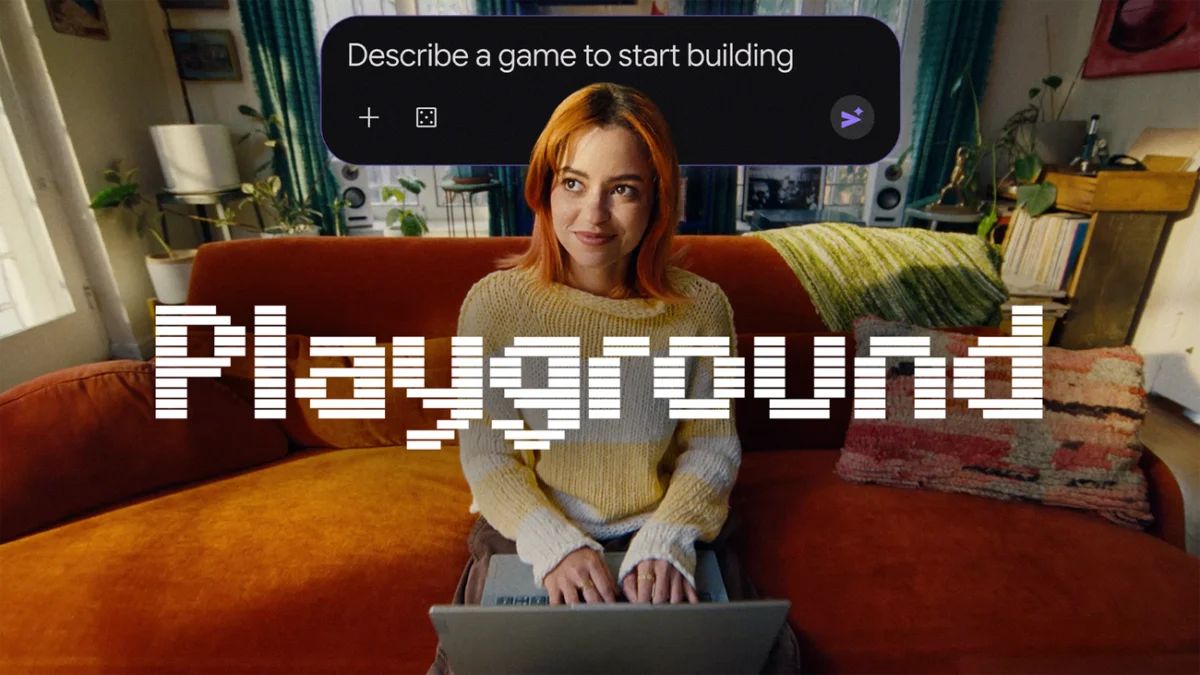
Google’s AI Innovation + Research division has officially announced the launch of Playground, a pioneering experimental platform designed to bridge the gap between imagination and digital execution. By leveraging advanced generative artificial intelligence, the platform allows users to conceive, build, and share interactive games through a conversational interface, effectively removing the traditional requirement for proficiency in coding or complex game engines. This launch marks a significant shift in the landscape of user-generated content, positioning Google at the forefront of a movement to democratize game development for a global audience.
The initiative is led by Maryam Karimzadehgan, a Software Engineer within Google’s AI Innovation + Research team, who emphasizes that while gaming is one of the world’s most expressive creative outlets, the technical barriers to entry have historically sidelined millions of potential creators. Playground seeks to dismantle these barriers by providing a "blank canvas" where the primary tool for development is natural language. Through this approach, the complexities of physics engines, character logic, and environmental design are abstracted into intuitive, prompt-based commands.
The Evolution of Game Creation: From Syntax to Semantics
Historically, creating a video game required a multidisciplinary set of skills, including mathematics, logic-based programming in languages such as C++ or C#, and proficiency in specialized software like Unreal Engine or Unity. Even "no-code" or "low-code" platforms like Roblox or Scratch require a fundamental understanding of conditional logic and structural hierarchy. Playground represents a paradigm shift by moving the interface from syntax—where specific code must be written correctly—to semantics, where the AI interprets the intent behind a user’s description.
The core of the Playground experience is its conversational interface. Users can initiate a project by describing a concept, such as a "cozy ube latte-themed platformer" or a "high-speed racing game set on Mars." The AI then generates the foundational assets and mechanics. From that point, creators can refine their work in real-time. If a user decides the gravity is too high or the protagonist should move faster, they simply type the request. This iterative process allows for rapid prototyping, a phase that usually takes professional developers weeks or months, to occur in seconds.
Technical Architecture and User Experience
Playground is built as a browser-based application, ensuring high accessibility across various hardware configurations, including smartphones, tablets, and laptops. This cross-device compatibility is achieved through modern web technologies that allow for sophisticated rendering without the need for high-end local processing power. By hosting the computational heavy lifting on Google’s cloud infrastructure, the platform ensures that the user experience remains fluid regardless of the device’s local specifications.
The platform includes several key features designed to foster a robust ecosystem:
- Guided Support and Remixing: Users are not forced to start from scratch. Playground offers starter prompts and guided templates that help novice creators understand the possibilities of the engine. Furthermore, users can "remix" existing games, taking a community-created project and altering its rules or aesthetics to create something new.
- Real-Time Testing: The transition between "edit mode" and "play mode" is instantaneous. This immediate feedback loop is critical for game design, allowing creators to feel the impact of their changes to physics or character movement immediately.
- Social and Competitive Integration: To encourage longevity, Playground incorporates social features such as shareable links, in-game leaderboards, and multiplayer capabilities for specific genres. Users can establish a Play Games profile to track their progress, follow favorite creators, and compete for high scores within the community.
Chronology of Development and Strategic Timing
The release of Playground is the culmination of several years of research into generative AI and its application in interactive media. Google has long experimented with the intersection of AI and creativity, beginning with projects like "Quick, Draw!" and "AutoDraw," which used neural networks to interpret and enhance human sketches. In recent years, the focus shifted toward more complex structures, including the generation of music (MusicLM) and video (Sora-like internal models).
Playground enters the market at a time when the gaming industry is undergoing a massive transformation. According to market research, the global gaming market is valued at over $180 billion, with user-generated content (UGC) platforms like Roblox and Minecraft seeing unprecedented growth. By launching Playground, Google is moving to capture the "long tail" of the creator economy—individuals who have ideas but lack the technical training to realize them.
The launch timeline follows a phased approach:
- Initial Research Phase: Focused on the integration of Large Language Models (LLMs) with 2D and 3D physics engines.
- Internal Testing: Google’s AI Innovation + Research team refined the prompt-to-logic translation layers.
- Public Launch (Today): Available to users in the United States aged 18 and older.
- Integration Phase (Upcoming): The introduction of Unity Spark to bridge the gap between casual and professional development.
The Unity Spark Partnership: Scaling Creativity
One of the most significant aspects of the Playground announcement is the upcoming integration with Unity Spark. Unity is currently the most widely used game engine in the world, powering a vast majority of mobile games and a significant portion of the indie and VR markets. The partnership between Google and Unity aims to provide a clear "growth path" for creators.
While Playground is designed for accessibility and rapid creation, Unity Spark will unlock professional-grade capabilities. This includes high-fidelity 3D graphics, robust scripting flexibility, and the use of the Unity runtime. This tiered ecosystem allows a user to start with a simple text prompt in Playground and, as their skills and ambitions grow, transition their project into a more sophisticated environment without losing the ease of AI-assisted development. Unity Spark is currently in a closed testing phase, with a beta expected to be announced in the near future.
Safety, Moderation, and Community Standards
As with any platform that utilizes generative AI and hosts user-generated content, safety is a paramount concern. Google has implemented a multi-layered screening process to ensure that Playground remains a welcoming environment. Every game published to the "Explore" gallery undergoes an automated safety screening aligned with Google’s Community Guidelines. These screenings are designed to filter out hate speech, explicit content, and other violations of service.
In addition to automated tools, the platform relies on community-driven moderation. Users have the ability to report games that they find inappropriate, which triggers a manual review by moderation teams. By balancing AI-driven oversight with human reporting, Google aims to mitigate the risks associated with the unpredictable nature of generative content.
Broader Impact and Industry Implications
The introduction of Playground is likely to have far-reaching implications for the gaming industry and the field of education. In an educational context, Playground serves as a powerful tool for teaching game design principles—such as balance, pacing, and narrative—without the steep learning curve of coding. It allows students to focus on the "why" of game design rather than the "how" of syntax.
From an industry perspective, Playground challenges the current gatekeeping of game development. It suggests a future where the role of the "game developer" may shift from being a programmer to being a "director" or "prompt engineer." This could lead to an explosion of niche, highly personal games that would never have been commercially viable under traditional development models.
Furthermore, the tiered access model—where creation capabilities are linked to Google AI subscriptions—indicates a new revenue strategy for tech giants. By bundling creative tools with AI subscriptions (such as Gemini Advanced), Google is creating an integrated ecosystem where AI is not just a search tool, but a comprehensive engine for production.
Looking Ahead: The Future of Playground
As Playground rolls out to the U.S. market, the focus will remain on community feedback and the refinement of the AI’s interpretive accuracy. The team at Google AI Innovation + Research has indicated that the platform will continue to evolve, with new genres, assets, and logic capabilities being added based on how the community interacts with the tool.
The ultimate goal of Playground is to ignite "everyday creativity." By turning the act of game creation into a conversation, Google is betting on a future where the next great gaming hit might not come from a multi-million dollar studio, but from a single person with a compelling idea and a text box. For now, the platform stands as a bold experiment in the potential of human-AI collaboration, redefining what it means to "play" in the digital age.
