

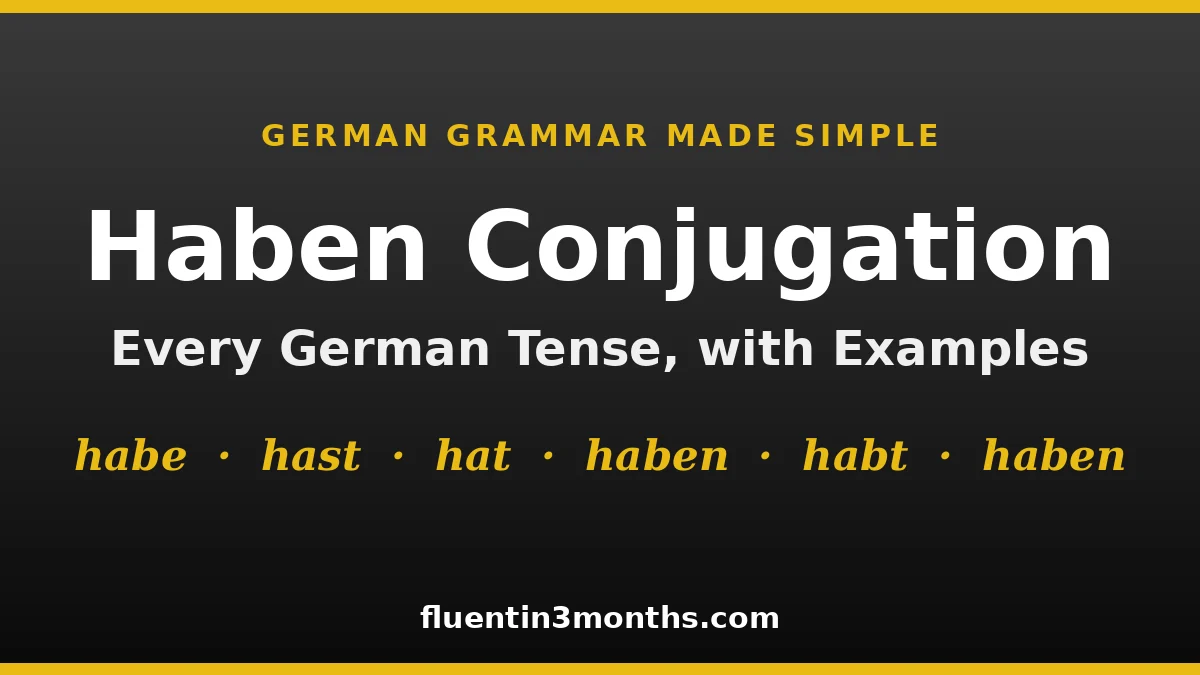
The German verb haben, primarily translated as "to have," represents one of the most critical structural pillars within the Germanic linguistic framework. Far from being a mere indicator of possession, haben serves as the dominant auxiliary verb required for the construction of the Perfekt (present perfect) tense, which is the standard mode of communication for describing past events in spoken German. For linguists and language practitioners alike, the mastery of haben is considered a prerequisite for achieving functional fluency, as it provides the syntactic gateway to the majority of the language’s verbal actions.
The Functional Significance of Haben in Modern German
In contemporary German syntax, haben performs three distinct roles: as a transitive verb denoting possession, as an auxiliary verb for compound tenses, and as a component in various idiomatic expressions where English would typically employ the verb "to be." Statistical analyses of German word frequency consistently place haben within the top ten most utilized words, underscoring its ubiquity across both formal literature and daily vernacular.
As a transitive verb, haben follows the standard accusative case requirement, meaning the object possessed must take the accusative form. However, its role as an auxiliary is where its true utility lies. In the German Perfekt tense, most verbs pair with haben to form the past participle. While its counterpart, sein (to be), is reserved for verbs of motion or change of state, haben remains the default auxiliary for approximately 80% of all German verbs, including all transitive verbs and reflexive verbs.
Historical Evolution and Phonological Contraction
The irregularity of haben in the present tense—specifically the forms du hast (you have) and er/sie/es hat (he/she/it has)—is the result of centuries of linguistic "smoothing." Etymologists note that in Old High German, the verb maintained a more consistent stem. Over time, high-frequency usage led to the elision of the medial "b" consonant in the second and third person singular.
This phenomenon is not unique to German; a parallel evolution occurred in the English cognate "have," where "haves" and "haveth" eventually contracted into "has." This phonetic erosion is a hallmark of high-frequency verbs in Indo-European languages, where ease of articulation takes precedence over morphological regularity.
Linguistic Data: Conjugation Frameworks
To understand the mechanical application of haben, it is necessary to examine its conjugation across various moods and tenses. The following data sets outline the morphological shifts required for accurate usage.
Table 1: The Present Tense (Präsens) and Simple Past (Präteritum)
The Präteritum is the simple past form, used extensively in written narratives, journalism, and formal reports. Unlike most verbs, haben is frequently used in the Präteritum even in spoken conversation to avoid the clunkiness of the compound Perfekt.
| Pronoun | Präsens (Present) | Präteritum (Simple Past) |
|---|---|---|
| ich (I) | habe | hatte |
| du (you, informal) | hast | hattest |
| er/sie/es (he/she/it) | hat | hatte |
| wir (we) | haben | hatten |
| ihr (you all) | habt | hattet |
| sie/Sie (they/you formal) | haben | hatten |
Table 2: Compound Tenses and Participles
The construction of the Perfekt, Plusquamperfekt (Pluperfect), and Futur (Future) tenses requires the use of the past participle, gehabt.
| Tense | Construction Method | Example (1st Person Singular) |
|---|---|---|
| Perfekt | Present haben + gehabt | ich habe gehabt |
| Plusquamperfekt | Past haben + gehabt | ich hatte gehabt |
| Futur I | werden + haben | ich werde haben |
| Futur II | werden + gehabt + haben | ich werde gehabt haben |
Linguistic observation suggests that while the Perfekt of haben (e.g., ich habe gehabt) is grammatically correct, native speakers exhibit a strong preference for the Präteritum (ich hatte) in nearly all contexts to maintain brevity.
The Haben-Sein Dichotomy in Auxiliary Selection
A primary challenge for learners of German is the selection between haben and sein when constructing the past tense. This distinction is governed by specific semantic and syntactic rules.
- Haben Selection: Used for all transitive verbs (verbs that take a direct object), all reflexive verbs, and most intransitive verbs that describe a state or a duration of time (e.g., schlafen – to sleep, arbeiten – to work).
- Sein Selection: Reserved for intransitive verbs that indicate a change of location (e.g., gehen – to go, kommen – to come) or a change of condition (e.g., sterben – to die, aufwachen – to wake up). Additionally, the verbs sein and bleiben (to stay) always take sein as their auxiliary.
Data from educational assessments indicate that errors in auxiliary selection are among the most common mistakes made by intermediate learners, often due to interference from English, which uses "have" almost exclusively for the perfect tense.
The Konjunktiv Mood: Hypotheticals and Social Etiquette
The Konjunktiv II form of haben, hätte, serves a vital role in both hypothetical reasoning and social protocol. In German culture, directness is often balanced with formal politeness in commercial and service-oriented interactions.
The phrase "Ich hätte gern…" (I would like…) is the standard polite formula for ordering in restaurants or requesting assistance in retail environments. Grammatically, this is the subjunctive form of "to have," functioning as a softer, more indirect version of the imperative or the blunt "Ich will" (I want).
| Pronoun | Konjunktiv II (Hypothetical/Polite) |
|---|---|
| ich | hätte |
| du | hättest |
| er/sie/es | hätte |
| wir | hätten |
| ihr | hättet |
| sie/Sie | hätten |
In addition to politeness, the Konjunktiv II is used to express "unreal" conditions in the past. For instance, "Wenn ich Zeit gehabt hätte…" (If I had had time…) demonstrates the complex stacking of haben as both a subjunctive auxiliary and a past participle.
Idiomatic Deviations from English Norms
A significant point of divergence between German and English lies in the expression of physical and emotional states. While English utilizes the verb "to be" (e.g., I am hungry), German employs haben to describe the "possession" of these states.
Key idiomatic applications include:
- Hunger haben: To be hungry (literally: to have hunger).
- Durst haben: To be thirsty (literally: to have thirst).
- Angst haben: To be afraid (literally: to have fear).
- Recht haben: To be right (literally: to have right).
- Zeit haben: To have time/be free.
Crucially, German does not use haben for age. The statement "Ich bin 25 Jahre alt" (I am 25 years old) aligns with English but contrasts with Romance languages like French (avoir 25 ans) or Spanish (tener 25 años). This distinction is a frequent point of confusion for multilingual students.
Morphological Classification: The Mixed Verb Theory
Modern German grammarians often classify haben as a "mixed verb." This category describes verbs that exhibit characteristics of both "weak" (regular) and "strong" (irregular) verbs.
Haben is considered weak because it uses the dental suffix -te in the past tense (hatte) and the -t suffix in the past participle (gehabt). However, it is considered irregular or "mixed" because the vowel or the stem itself undergoes a change (the loss of the ‘b’ and the modification of the stem in the subjunctive hätte). Understanding this classification helps advanced students predict the behavior of other mixed verbs like wissen (to know) or bringen (to bring).
Educational Implications and Proficiency Standards
According to the Common European Framework of Reference for Languages (CEFR), the correct conjugation of haben in the present tense is a requirement for A1 (Beginner) proficiency. By the B1 (Intermediate) level, students are expected to use haben correctly as an auxiliary in the Perfekt and Plusquamperfekt, and to employ the Konjunktiv II for polite requests.
Linguistic experts argue that the early and rigorous study of haben reduces the cognitive load on students as they progress to more complex verbs. Because haben provides the framework for the past tense of almost every other verb, a student who has mastered haben has essentially mastered the past tense of the entire language, barring the specific exceptions that require sein.
Broader Impact on Germanic Linguistics
The study of haben is more than an exercise in rote memorization; it is an exploration of the structural logic of the German language. Its versatility reflects the German preference for clear auxiliary-based tense systems. Furthermore, the verb’s ability to transition from a literal meaning of possession to a grammatical marker of time illustrates the fluid nature of semantic evolution.
As globalization continues to foster interest in German as a language of commerce, science, and philosophy, the technical nuances of verbs like haben remain a central focus of pedagogical development. By analyzing the verb through the lenses of history, phonetics, and syntax, it becomes clear that haben is not merely a word, but the very engine of German verbal expression. In summary, the mastery of haben is the definitive milestone that separates the casual learner from the proficient speaker.
