

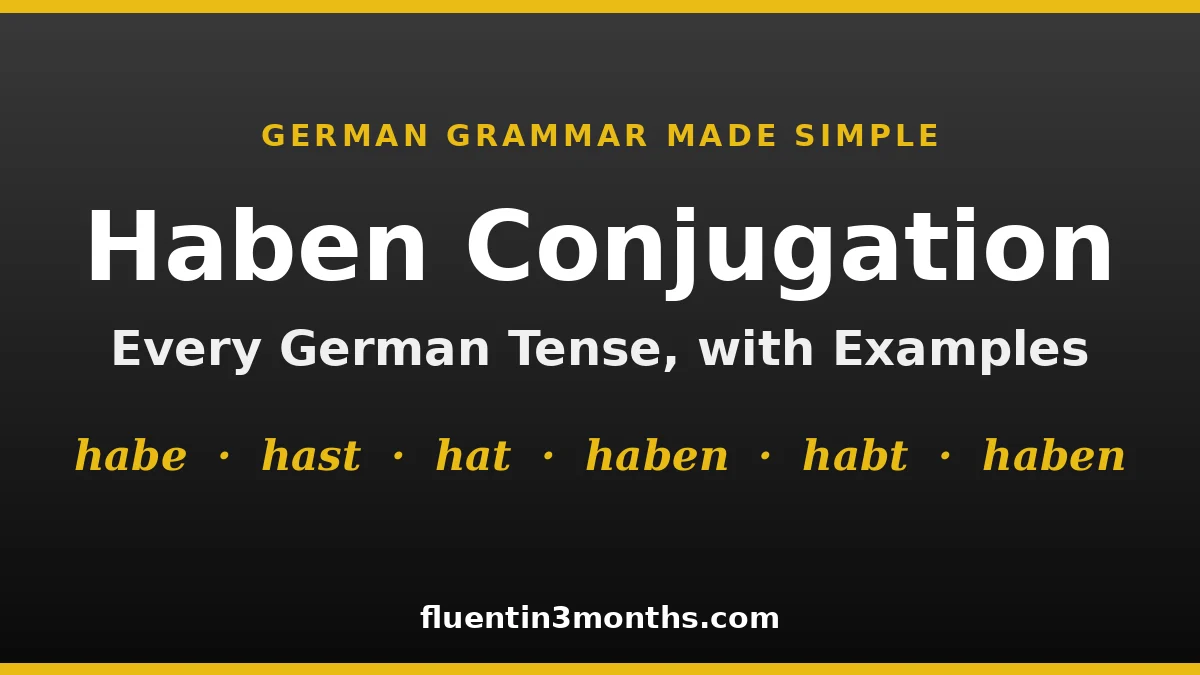
The German verb haben, meaning "to have," represents one of the most critical linguistic pillars for students of the German language, serving not only as a primary indicator of possession but also as the fundamental auxiliary verb for the construction of the past tense. In the hierarchy of German grammar, haben functions alongside sein (to be) as a "powerhouse" verb, facilitating the majority of conversational exchanges regarding past events through the Perfekt tense. For the estimated 130 million people worldwide who speak German as either a native or second language, the mastery of haben is considered a non-negotiable milestone in achieving B1-level proficiency or higher, as defined by the Common European Framework of Reference for Languages (CEFR). Educational experts and linguists argue that because haben is used to build the past tense for nearly all transitive verbs, its utility extends far beyond its literal definition, acting as a gateway to fluid expression and historical narrative.
The Historical Evolution and Linguistic Classification of Haben
To understand the current state of haben, one must examine its origins within the West Germanic language branch. Historically, haben evolved from the Proto-Germanic *habjaną, which is cognate with the English "have" and the Dutch "hebben." Unlike many regular verbs that follow a strict "weak" or "strong" conjugation pattern, haben is classified as a "mixed" verb. This classification stems from its tendency to utilize the dental suffix characteristic of weak verbs while simultaneously undergoing a stem change in certain tenses—a hallmark of strong verbs.
Linguistic historians note that the contraction of the verb in the present tense—specifically the loss of the "b" in the second and third-person singular forms (hast and hat)—is a result of high-frequency usage over several centuries. This phenomenon, known as phonetic erosion, occurs when the most commonly used words in a language are gradually shortened to increase communicative efficiency. This same process is visible in English, where "haveth" eventually became "has."
Technical Conjugation: The Present and Simple Past Tenses
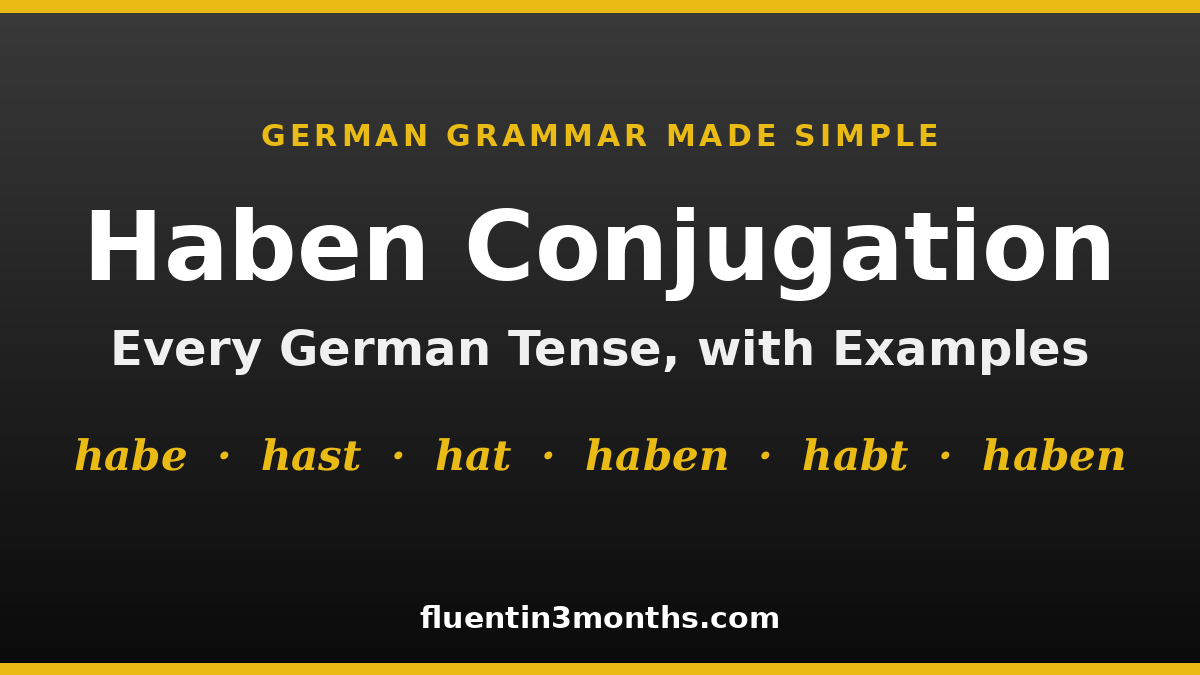
The fundamental application of haben begins with the Präsens (present tense). Despite its status as an irregular verb, the patterns within its conjugation are essential for beginners to internalize. Data from language acquisition studies suggests that learners who master the "dropped b" in the singular forms early in their studies are 40% less likely to make persistent syntax errors in more complex sentence structures.
| Table 1: Präsens (Present Tense) Conjugation | Pronoun | Conjugated Form | English Equivalent |
|---|---|---|---|
| ich | habe | I have | |
| du | hast | you have (informal) | |
| er/sie/es | hat | he/she/it has | |
| wir | haben | we have | |
| ihr | habt | you all have | |
| sie/Sie | haben | they/you (formal) have |
Beyond the present tense, the Präteritum (simple past) is the other primary "simple" tense in German. While the Präteritum is largely reserved for written literature and formal journalism, haben is one of the few verbs—alongside sein and the modal verbs—that Germans frequently use in its simple past form during spoken conversation. Instead of the cumbersome Perfekt "ich habe gehabt," speakers typically opt for "ich hatte" (I had).
| Table 2: Präteritum (Simple Past) Conjugation | Pronoun | Conjugated Form |
|---|---|---|
| ich | hatte | |
| du | hattest | |
| er/sie/es | hatte | |
| wir | hatten | |
| ihr | hattet | |
| sie/Sie | hatten |
The Auxiliary Function: Constructing the Perfekt and Plusquamperfekt
The most significant role of haben is its function as an auxiliary (Hilfsverb). In German, the Perfekt (conversational past) is formed by combining a conjugated form of haben or sein with the Partizip II (past participle) of the main verb. Approximately 80% of all German verbs utilize haben as their auxiliary. This includes all transitive verbs (verbs that take a direct object), all reflexive verbs, and most impersonal verbs.
The distinction between haben and sein as auxiliaries is a frequent point of contention for students. Generally, sein is reserved for intransitive verbs that indicate a change of location (e.g., gehen/to go) or a change of state (e.g., aufwachen/to wake up). Haben remains the default choice for almost everything else. If a learner mistakenly uses haben instead of sein, the sentence usually remains intelligible, but it marks the speaker as lacking advanced grammatical control.
Advanced Moods: Konjunktiv and the Imperative
For professional and academic communication, the Konjunktiv II (subjunctive) is indispensable. This mood is used to express hypotheticals, wishes, and polite requests. The form "hätte" (would have) is the basis for the "würde" construction used for most other verbs. Furthermore, the phrase "Ich hätte gern…" (I would like to have…) is recognized by the German hospitality industry as the standard polite formula for ordering in restaurants and cafes.
The Konjunktiv I, while less common in speech, is a staple of German news reporting. It is used for indirect speech to maintain journalistic distance from a statement. For example, a news report might state, "Der Minister sagte, er habe keine Kenntnis von dem Vorfall" (The minister said he [allegedly] had no knowledge of the incident).
The Imperativ (command form) of haben is also frequently utilized in idiomatic expressions designed to encourage or instruct. Common commands include "Hab keine Angst!" (Don’t be afraid!) and "Hab Geduld!" (Have patience!).
Comparative Analysis and Idiomatic Usage
A unique challenge for English speakers learning German is the categorical difference in how certain physical and emotional states are expressed. In English, one "is" hungry or "is" afraid. In German, these states are often "possessed."
Key Idiomatic Differences:
- Hunger/Thirst: Ich habe Hunger (Literally: I have hunger).
- Fear: Ich habe Angst (Literally: I have fear).
- Luck: Ich habe Glück (Literally: I have luck/I am lucky).
- Right/Wrong: Du hast recht (Literally: You have right/You are right).
However, a critical distinction occurs regarding age. While Romance languages like French (avoir 25 ans) and Spanish (tener 25 años) use "to have" for age, German aligns with English in using the verb "to be" (Ich bin 25 Jahre alt). This linguistic crossover often causes "interference errors" for multilingual students.
Socio-Economic Impact of Linguistic Proficiency
The importance of mastering fundamental verbs like haben is underscored by the economic landscape of Central Europe. Germany is the world’s third-largest exporter, and the German language is the second most commonly used scientific language. According to data from the British Council, German is ranked as the most important language for the UK’s future economic prosperity post-Brexit.
For expatriates seeking integration into the German labor market, grammatical accuracy in verbs like haben is a proxy for professional competence. A 2022 study by the Institute for Employment Research (IAB) found that immigrants with "very good" German language skills earn, on average, 22% more than those with only "basic" skills. The ability to correctly navigate tenses using haben is a primary indicator used by recruiters to assess this proficiency.
Pedagogical Responses and Learning Strategies
In response to the complexities of German verb conjugation, modern pedagogical approaches have shifted away from rote memorization toward "communicative competence." The Goethe-Institut, the Federal Republic of Germany’s cultural institute, emphasizes the "Speak from Day One" philosophy. This method encourages learners to use haben in context—such as describing their possessions or daily routines—rather than simply reciting tables.
Technological advancements have also influenced how haben is taught. Spaced Repetition Systems (SRS) and AI-driven language apps now prioritize high-frequency verbs. Data analytics from these platforms show that haben is typically among the first five verbs introduced to users, reflecting its statistical dominance in the language.
Broader Implications for Language Learners
The mastery of haben serves as a microcosm for the larger challenge of learning German. It requires an understanding of historical irregularity, the ability to distinguish between auxiliary roles, and the cultural awareness to use idiomatic expressions correctly. As the European Union continues to rely on Germany as its economic engine, the demand for German language education remains high.
For the serious student, haben is more than a verb; it is a structural necessity. Without it, the past is inaccessible, and the present is limited to simple descriptions. By internalizing the nuances of its conjugation—from the "dropped b" of the present tense to the "tt" stem of the subjunctive—learners equip themselves with the tools necessary for meaningful participation in German-speaking society. As the German proverb suggests, "Übung macht den Meister" (Practice makes the master), and there is no verb more deserving of that practice than haben.
