

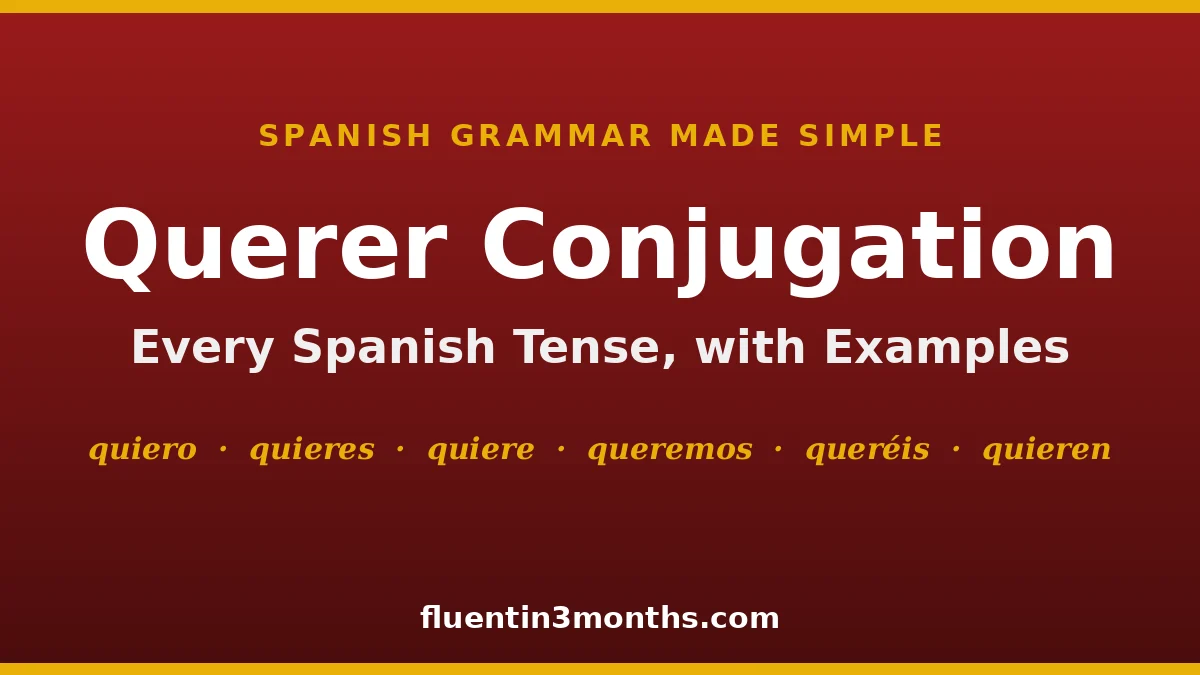
The Spanish verb querer represents one of the most fundamental linguistic pillars for students of the Romance languages, serving as the primary vehicle for expressing desire, intent, and various degrees of affection. Classified as an irregular, stem-changing verb, its utility spans from the most basic transactional interactions, such as ordering food in a restaurant, to the complex emotional landscapes of interpersonal relationships. Understanding the mechanics of querer is not merely an exercise in rote memorization but a necessary step in achieving functional fluency in a language spoken by over 500 million people globally.
The Etymological Evolution of Querer
The history of the verb querer is rooted in the Latin verb quaerere, which primarily meant "to seek," "to look for," or "to inquire." Over centuries of linguistic evolution on the Iberian Peninsula, the meaning shifted from the act of seeking to the internal state of desiring what one seeks. This etymological lineage remains visible in English cognates such as "query," "question," and "inquiry."
In Old Spanish, the verb began to take on its modern dual identity. By the Golden Age of Spanish literature, writers like Miguel de Cervantes utilized querer to convey both the pursuit of an objective and the emotional bond between characters. This semantic duality—wanting an object versus loving a person—is a distinctive feature of Spanish that requires learners to rely heavily on context to determine the speaker’s intent.
Structural Mechanics: The Stem-Changing Irregularity
Querer is categorized as an "e to ie" stem-changing verb. In linguistic terms, this is a form of diphthongization where the stressed vowel of the root expands into two vowels. This change occurs in all present tense forms except for the "nosotros" (we) and "vosotros" (you all, informal Spain) forms, where the stress shifts to the ending rather than the stem.
Beyond the present tense, querer exhibits a "strong" irregular preterite. Unlike regular "-er" verbs that follow a predictable pattern in the past tense, the stem of querer changes entirely to "quis-" in the preterite. This shift is not merely orthographic but reflects deep-seated phonetic shifts in the transition from Vulgar Latin to Castilian Spanish. This "quis-" stem also serves as the foundation for the imperfect subjunctive, making it a critical component for advanced grammatical construction.
Chronology of Conjugation: From Present to Future
To master querer, one must navigate its forms across the indicative, subjunctive, and imperative moods. Below is a comprehensive breakdown of the simple tenses within the indicative mood, which is used to state facts and certainties.
The Indicative Mood: Simple Tenses
The present tense is the most frequently used form of querer. It is the gateway to expressing immediate needs.
- Yo quiero (I want)
- Tú quieres (You want)
- Él/Ella/Usted quiere (He/She/You want)
- Nosotros queremos (We want)
- Vosotros queréis (You all want)
- Ellos/Ellas/Ustedes quieren (They/You all want)
The preterite tense is used for completed actions in the past. In the case of querer, it often implies a specific "attempt" or a "refusal" when used in the negative.
- Yo quise (I wanted/tried)
- Tú quisiste (You wanted/tried)
- Él/Ella/Usted quiso (He/She/You wanted/tried)
- Nosotros quisimos (We wanted/tried)
- Vosotros quisisteis (You all wanted/tried)
- Ellos/Ellas/Ustedes quisieron (They/You all wanted/tried)
The imperfect tense describes ongoing or habitual desires in the past, providing background context to a story.
- Yo quería (I used to want/was wanting)
- Tú querías
- Él/Ella/Usted quería
- Nosotros queríamos
- Vosotros queríais
- Ellos/Ellas/Ustedes querían
The future and conditional tenses of querer are also irregular, as they drop the "e" from the infinitive ending and add a "r," resulting in a double "rr."
- Future: Yo querré, Tú querrás, Él querrá…
- Conditional: Yo querría, Tú querrías, Él querría…
The Subjunctive Mood: Desires and Politeness
The subjunctive mood is essential for expressing subjectivity, doubt, or polite requests. The present subjunctive (quiera, quieras, quiera…) is often triggered by verbs of influence or emotion. However, the imperfect subjunctive form "quisiera" occupies a unique place in Spanish social etiquette.
While "quiero" (I want) is grammatically correct, it can often sound blunt or demanding in service-oriented environments. Linguistic experts and cultural advisors suggest the use of "quisiera" (I would like) to soften requests. This usage effectively functions as a polite conditional, despite its technical classification as a past subjunctive.
Comparative Analysis: Te Quiero versus Te Amo
One of the most nuanced aspects of the verb querer is its application in expressing affection. The distinction between "te quiero" and "te amo" is a frequent point of confusion for non-native speakers.
Data from linguistic surveys across Spanish-speaking regions indicate that "te quiero" is the more versatile and common expression of love. It is used between friends, family members, and romantic partners. In many cultures, particularly in Spain, "te quiero" is the standard way to say "I love you" to a spouse or partner.
In contrast, "te amo" is often reserved for profound, intense, or poetic romantic love. In Latin American media, such as telenovelas, "te amo" is used frequently for dramatic effect. However, in daily life in Mexico, Colombia, or Argentina, "te quiero" remains the predominant choice for expressing sincere affection. Choosing the wrong term can occasionally lead to social awkwardness—using "te amo" too early in a relationship might be perceived as overly intense, while using "te quiero" in a highly formal romantic declaration might seem insufficiently passionate to some.
Statistical Prevalence and Educational Importance
According to the Real Academia Española (RAE) and various frequency dictionaries of Spanish, querer consistently ranks among the top 50 most frequently used verbs in the language. In the Corpus de Referencia del Español Actual (CREA), which tracks word usage across thousands of documents, the various forms of querer appear with a high degree of regularity in both oral and written mediums.
From a pedagogical standpoint, the American Council on the Teaching of Foreign Languages (ACTFL) and the Common European Framework of Reference for Languages (CEFR) emphasize the early introduction of querer. At the A1 and A2 levels (beginner), students prioritize the present indicative to facilitate basic survival Spanish. By the B1 and B2 levels (intermediate), the focus shifts to the "quis-" stem past tenses and the subjunctive, allowing learners to express hypothetical desires and complex social interactions.
Common Linguistic Errors and Corrective Measures
Analysis of learner corpora reveals several recurring mistakes associated with the conjugation of querer.
- Orthographic Confusion: Students frequently misspell the third-person singular preterite "quiso" as "quizo." In Spanish, the "s" is maintained from the "quis-" stem; "quizo" is not a valid word in the Spanish lexicon.
- Stem-Change Overextension: Beginners often apply the "ie" change to the "nosotros" and "vosotros" forms (e.g., "quieremos" instead of "queremos"). It is vital to remember that these forms remain regular in the present tense.
- Double ‘R’ Neglect: In the future and conditional tenses, learners often forget the second ‘r’ (e.g., "queré" instead of "querré"). This distinction is crucial because "queré" could be confused with a regional imperative or a mispronounced infinitive.
Broader Implications for Communication
The mastery of querer extends beyond grammar into the realm of cultural competence. The ability to navigate the verb’s different moods allows a speaker to modulate their tone from assertive to deferential. Furthermore, the verb plays a critical role in idiomatic expressions that do not translate literally into English. For instance, "sin querer" means "unintentionally" or "by accident," and "querer decir" is the standard way to say "to mean."
As global connectivity increases, the demand for nuanced Spanish communication grows in sectors such as international business, healthcare, and diplomacy. Professionals in these fields must understand that a phrase like "El gobierno quiso implementar la reforma" (The government tried to implement the reform) carries a different weight than "El gobierno quería implementar la reforma" (The government wanted to implement the reform—implying it was a background intention).
Conclusion: The Path to Fluency
The verb querer is more than a vocabulary word; it is a versatile tool that reflects the history, social norms, and emotional depth of the Spanish-speaking world. By understanding its irregular patterns, its etymological roots, and its regional nuances, learners can move past simple translation and begin to communicate with the precision and empathy of a native speaker. Whether used to ask for a cup of coffee or to declare a lifelong commitment, querer remains the heartbeat of Spanish expression. Systematic practice, combined with an awareness of the "te quiero" versus "te amo" distinction and the polite "quisiera," provides a solid foundation for any student aiming for high-level proficiency in the language.
