

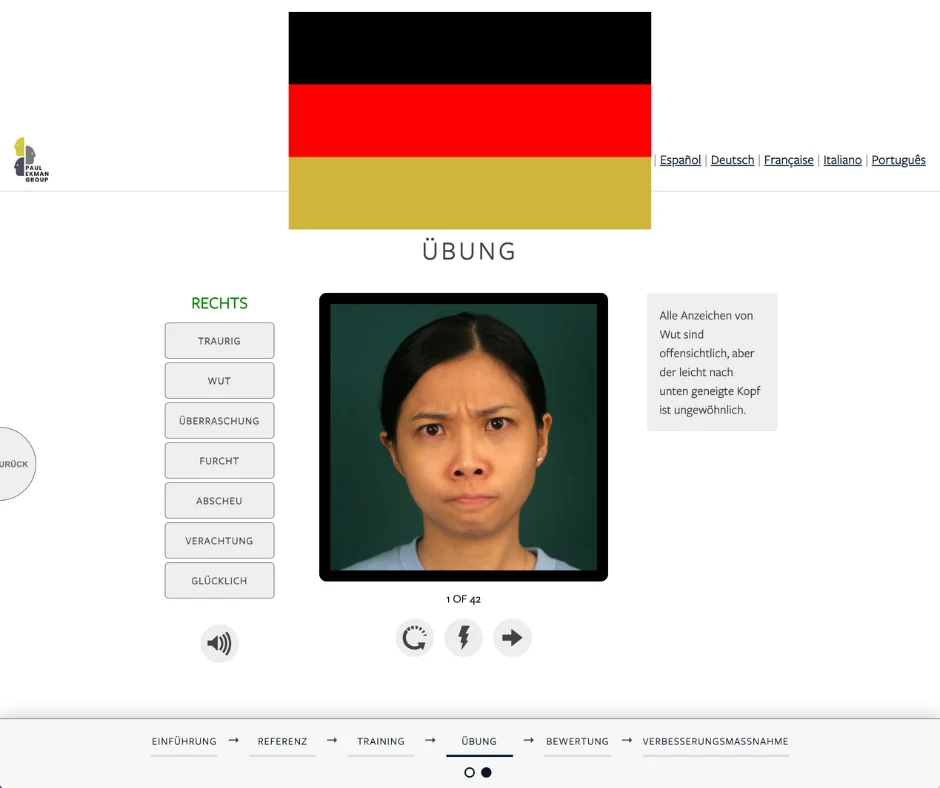
The Paul Ekman Group, a leader in the science of emotions and micro-expression analysis, has announced a significant expansion of its acclaimed online training tools, making its scientifically-validated programs accessible to a broader global audience. Effective immediately, users can now access the comprehensive micro-expression training modules in German, French, and Italian, in addition to the previously available English, Spanish, and Portuguese. This strategic rollout represents a pivotal step in the organization’s mission to democratize the understanding of human emotions and nonverbal communication across diverse linguistic communities.
The Science of Micro-Expressions and Their Significance
Micro-expressions are fleeting, involuntary facial movements that reveal a person’s true emotions. These subtle shifts, often lasting less than a second, can betray concealed feelings and provide invaluable insights into authentic emotional states, even when individuals attempt to mask their true sentiments. Dr. Paul Ekman, a pioneering psychologist and emeritus professor at the University of California, San Francisco, has dedicated decades to researching these universal facial expressions of emotion. His groundbreaking work, which began in the 1960s, established that certain basic emotions—anger, fear, sadness, joy, surprise, disgust, and contempt—are expressed through universally recognizable facial patterns across cultures.
The ability to accurately detect and interpret these micro-expressions is a critical component of emotional intelligence. It enhances empathy, improves interpersonal communication, and can be instrumental in high-stakes situations. Professionals in fields such as law enforcement, security, psychotherapy, education, human resources, and business leadership have found the training to be transformative. By understanding micro-expressions, individuals can better gauge deception, build stronger rapport, de-escalate conflicts, and make more informed decisions. The Paul Ekman Group’s training methodology is rooted in rigorous scientific research, providing participants with the tools to recognize these subtle cues with a high degree of accuracy.
A Strategic Expansion Driven by Global Demand
The expansion into German, French, and Italian markets is a direct response to growing international demand for accessible, high-quality emotional intelligence training. For years, the Paul Ekman Group has offered its suite of online tools, including the widely respected "Micro Expression Training Tool" (METT), the "Emotional Skills Training" (EST), and the "Facial Emotion Identification Training" (FEIT), primarily in English. While Spanish and Portuguese translations were previously introduced, the addition of these three major European languages marks a substantial leap forward in the organization’s commitment to global inclusivity.
"Our mission at the Paul Ekman Group is to empower individuals worldwide to better understand themselves and others through training in emotional awareness," stated a spokesperson for the Paul Ekman Group in a press release accompanying the announcement. "With these new translations, we are making our scientifically-grounded emotional training more accessible than ever before. We are facilitating it for individuals, educators, professionals, and organizations across Europe and beyond to learn micro-expression recognition online, in their own language."
The decision to prioritize German, French, and Italian was likely influenced by the significant number of speakers of these languages, as well as their economic and cultural influence in global affairs. Germany boasts the largest economy in Europe, and German is a widely spoken language across Central Europe. France and Italy are also major cultural and economic hubs, with a strong presence in international business and diplomacy. By offering training in these languages, the Paul Ekman Group is strategically positioning itself to serve a vast and engaged audience.
Unveiling the Enhanced Training Packages
All seven of the core micro-expression training tools, which are bundled within the Paul Ekman Group’s three comprehensive training packages, have undergone meticulous translation. This includes the foundational METT, which guides users through identifying the seven universal emotions as expressed through micro-expressions. The EST focuses on developing a broader range of emotional skills, while the FEIT hones the ability to identify emotions from static facial images.
Users initiating any micro-expression course will be prompted to select their preferred language at the outset. This intuitive interface ensures a seamless learning experience, allowing individuals to engage with the complex material without the barrier of a foreign language. The translated content retains the scientific rigor and pedagogical effectiveness of the original English versions, ensuring that learners receive the same high-quality instruction.
The Paul Ekman Group has been at the forefront of developing digital tools for emotion recognition training since the early days of online learning. The METT, for instance, has evolved significantly over the years, incorporating advanced algorithms and user feedback to optimize the learning process. Its design typically involves presenting brief video clips of individuals exhibiting micro-expressions, followed by questions that test the user’s ability to identify the emotion displayed. The training progresses through various levels of difficulty, gradually increasing the challenge and refining the user’s observational skills.
The Broader Implications for Global Emotional Intelligence
The availability of micro-expression training in multiple languages has profound implications for the advancement of emotional intelligence on a global scale. In an increasingly interconnected world, the ability to understand and navigate diverse emotional landscapes is paramount. This expansion directly addresses the need for cross-cultural emotional competence.
For international organizations, the ability for their employees across different linguistic backgrounds to access this training can lead to more cohesive and effective teams. Misunderstandings arising from differing emotional communication styles can be minimized, fostering better collaboration and reducing workplace friction. In fields like international diplomacy and conflict resolution, a shared understanding of universal emotional cues, facilitated by accessible training, could prove invaluable.
Moreover, the expansion democratizes access to knowledge that was once primarily confined to academic circles or available only in English. This empowers individuals in non-English speaking countries to acquire sophisticated skills that can enhance their personal and professional lives, potentially leveling the playing field in various sectors. For instance, law enforcement agencies in Germany, France, or Italy can now train their officers to better identify deception or distress in suspects and victims, leading to more effective investigations and improved public safety. Similarly, educators can leverage this training to better understand the emotional states of their students, creating more supportive and effective learning environments.
A Commitment to Universal Understanding
Dr. Ekman’s foundational research emphasized the universality of basic emotions and their facial expressions, a concept that underpins the entire training program. The expansion into new languages is a logical extension of this principle, aiming to make the recognition of these universal cues accessible to everyone, regardless of their native tongue.
"The work of Dr. Ekman has always been based on the universality of emotions and facial expressions," the press release stated. "With tools and resources already used in over 230 countries, these new language translations are another step in our ongoing effort to make emotional awareness and deception detection skills globally available."
This commitment to global accessibility is not merely about translation; it’s about fostering a shared language of emotions that transcends linguistic barriers. By providing the same high-quality training in multiple languages, the Paul Ekman Group is facilitating a more profound understanding of human connection and empathy across diverse cultures. The organization anticipates that these additions will significantly improve access for individuals whose primary language is not English, Spanish, or Portuguese, thereby broadening the reach and impact of their vital work.
Future Outlook and User Engagement
The Paul Ekman Group has indicated that this expansion is not an endpoint but rather a continuation of their global strategy. The organization is actively exploring the development of training modules in additional languages based on user interest and market demand. Individuals who wish to see their native language added to the training platforms are encouraged to provide feedback directly to the company.
"We are actively working to expand our offerings into more languages," the release continued. "If you would like to see a language added, please share your input with us here [mailto:[email protected]]." This open channel for communication underscores the company’s dedication to serving its global community and adapting its offerings to meet evolving needs.
The announcement serves as a significant milestone for the Paul Ekman Group and for the field of emotional intelligence training worldwide. By removing language barriers, the organization is empowering a new generation of individuals to develop a deeper understanding of human emotions, ultimately contributing to a more empathetic and perceptive global society. The availability of these comprehensive tools in German, French, and Italian is expected to drive significant uptake and further solidify the Paul Ekman Group’s position as a leading authority in the science of emotions. The message is clear: the universal language of emotions is now more accessible than ever, inviting individuals from all linguistic backgrounds to embark on a journey of enhanced emotional understanding.
