


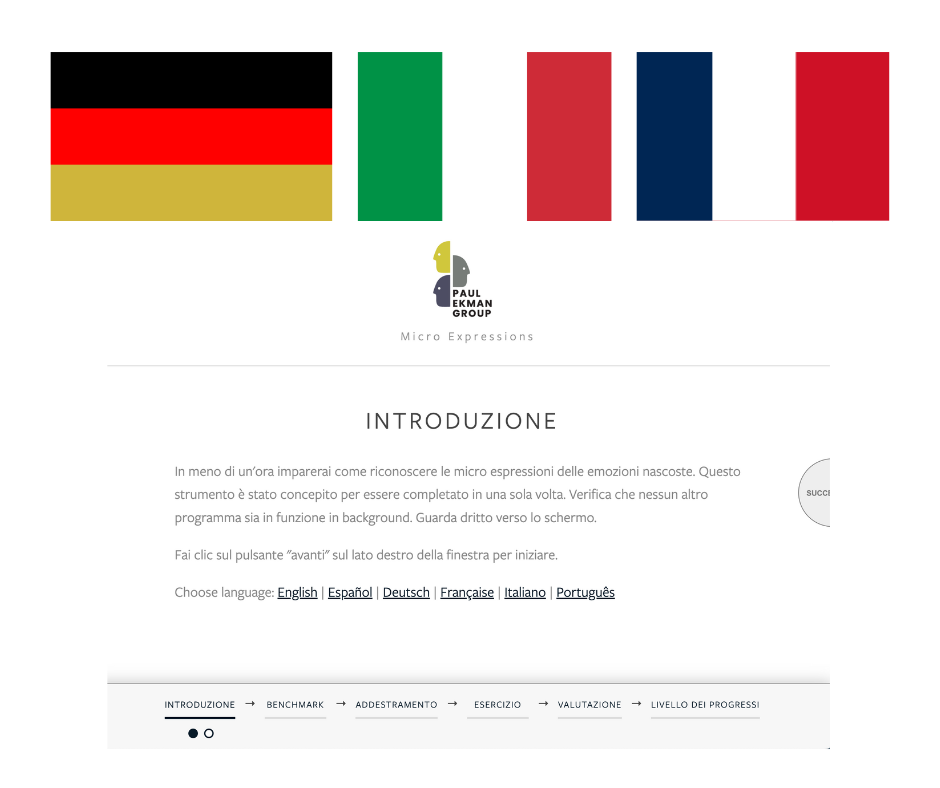
The Paul Ekman Group, a leading organization dedicated to the science of emotions and facial expressions, has announced a significant expansion of its online micro expression training tools, now offering comprehensive courses in Italian, French, and German. This strategic move aims to enhance the accessibility of its renowned science-based emotional intelligence training for a wider global audience, particularly across Europe. The newly translated modules cover all seven core micro expression training tools previously available in English, Spanish, and Portuguese, marking a crucial step in the organization’s mission to democratize emotional awareness and deception detection skills worldwide.
Broadening Global Reach in Emotional Intelligence
The introduction of Italian, French, and German language options signifies a deliberate effort by the Paul Ekman Group to overcome linguistic barriers and make its cutting-edge training accessible to individuals and organizations that may not be proficient in English or other currently supported languages. This initiative directly supports the organization’s foundational mission: to empower individuals to better understand themselves and others by cultivating advanced emotional awareness. The availability of these new language versions is expected to particularly benefit educators, professionals in law enforcement and mental health, corporate leaders, and anyone seeking to deepen their understanding of human emotions and interpersonal dynamics.
Micro expressions, defined as fleeting, involuntary facial movements that betray a person’s true emotional state, are often undetectable to the untrained eye. Dr. Paul Ekman, a pioneering psychologist and co-founder of the Paul Ekman Group, has dedicated decades of research to identifying, classifying, and teaching the recognition of these subtle yet powerful emotional cues. His work, based on extensive cross-cultural studies, has established the universality of certain basic emotions and their corresponding facial expressions, providing a robust scientific foundation for the training programs. The ability to accurately perceive micro expressions can be transformative, offering profound insights into sincerity, deception, and underlying emotional states in a variety of critical contexts, from high-stakes negotiations to everyday social interactions.
A Timeline of Accessibility: From Foundational Research to Global Platforms
The journey to making micro expression training widely accessible began with Dr. Ekman’s seminal research in the latter half of the 20th century. His groundbreaking work in the 1960s and 1970s, particularly his studies with Wallace Friesen, identified universal facial expressions for happiness, sadness, anger, fear, surprise, disgust, and contempt. This foundational research, published in prestigious academic journals, laid the groundwork for understanding the biological underpinnings of human emotion and its expression.
In the decades that followed, Dr. Ekman and his colleagues developed methodologies and tools to teach others to recognize these expressions. The advent of digital technology in the late 20th and early 21st centuries provided new avenues for disseminating this knowledge. The Paul Ekman Group was established to leverage these advancements, creating online training platforms that could reach a global audience.
The initial online training tools were primarily offered in English. Recognizing the vast potential for impact in non-English speaking regions, the organization embarked on a strategic translation initiative. The introduction of Spanish and Portuguese language options was an early and significant step in this direction, paving the way for further linguistic expansion. The recent launch of Italian, French, and German versions represents a culmination of sustained effort and investment in linguistic localization, bringing the total number of languages offered to five. This expansion is not merely a matter of translation; it involves adapting the learning experience to ensure cultural nuances are respected and the scientific integrity of the content is maintained.
What the Training Entails: A Deep Dive into Emotional Literacy
The Paul Ekman Group’s online micro expression training packages are designed to be comprehensive and engaging. Users are guided through a rigorous curriculum that includes:
- Instructional Modules: Detailed explanations of the seven universal emotions and their corresponding micro expressions, supported by scientific research and expert insights.
- Visual Recognition Exercises: Interactive challenges where learners are presented with short video clips of individuals displaying micro expressions. The goal is to identify the emotion being expressed and the duration of the expression.
- Progress Tracking: The platform allows users to monitor their improvement over time, with detailed statistics on accuracy and speed.
- Reinforcement Tools: Features designed to solidify learning and ensure retention of the skills acquired.
All seven core online micro expression training tools are now fully translated. This means that learners in Italy, France, and Germany can access the same depth of content and the same rigorous training methodology as their English-speaking counterparts. The user experience is designed for seamless navigation, with participants prompted to select their preferred language at the outset of each course. This thoughtful approach ensures that the learning experience is as intuitive and effective as possible, regardless of the user’s native tongue. The training packages are categorized into distinct levels, catering to a range of learning objectives, from introductory awareness to advanced application in professional settings.
The Profound Implications of Enhanced Emotional Awareness
The ability to recognize micro expressions extends far beyond mere academic curiosity. It has tangible benefits across numerous professional fields and personal relationships.
- Law Enforcement and Security: For law enforcement officers, intelligence analysts, and security personnel, the ability to detect deception or hidden emotions can be critical in investigations, interrogations, and risk assessments. Understanding a subject’s true emotional state can lead to more effective communication and better decision-making in high-pressure situations. According to various studies on deception detection, even slight improvements in accuracy can have significant implications in preventing crime and ensuring public safety. For instance, research published in journals like Law and Human Behavior has explored the effectiveness of training in identifying non-verbal cues associated with deception.
- Healthcare and Mental Health: Therapists, counselors, and medical professionals can leverage micro expression recognition to build stronger rapport with patients, understand underlying emotional distress, and provide more empathetic and effective care. Accurately reading a patient’s emotional state, especially when they may be hesitant to express it verbally, can be crucial for diagnosis and treatment. The American Psychological Association has highlighted the importance of non-verbal communication in therapeutic settings, underscoring the value of tools that enhance this skill.
- Business and Leadership: In the corporate world, leaders, sales professionals, and human resources managers can use these skills to improve negotiation outcomes, enhance team dynamics, and foster a more emotionally intelligent workplace. Understanding the subtle emotional signals of clients, colleagues, and employees can lead to more effective communication, conflict resolution, and stronger interpersonal relationships. A 2020 report by Deloitte on the future of work emphasized the growing importance of emotional intelligence and empathy in leadership roles.
- Education: Educators can use their understanding of micro expressions to better gauge student engagement, identify signs of distress or confusion, and create a more supportive learning environment. This can be particularly valuable for students who may struggle to articulate their feelings or academic challenges verbally.
The core benefit lies in the enhancement of emotional intelligence, a critical skill for navigating the complexities of human interaction. By improving the ability to read and understand emotions with greater accuracy and insight, individuals can respond with greater empathy and effectiveness, fostering stronger connections and achieving better outcomes in all facets of life.
A Commitment to Global Scientific Dissemination
The Paul Ekman Group’s commitment to making emotion science accessible is deeply rooted in Dr. Ekman’s philosophy. His research consistently underscored the universality of core human emotions, suggesting that while cultural display rules might vary, the underlying emotional experience and its facial manifestations share a common biological basis. This global perspective has guided the organization’s expansion strategy.
With existing reach into over 230 countries through its online platforms, the addition of Italian, French, and German is another significant stride. It demonstrates a proactive approach to inclusivity, ensuring that individuals whose primary language is not English, Spanish, or Portuguese have the opportunity to acquire these valuable skills. This expansion aligns with a broader trend in online education towards greater localization and personalized learning experiences, acknowledging that effective learning often occurs best when delivered in one’s native language.
Future Prospects and Community Engagement
The Paul Ekman Group has expressed its ongoing dedication to expanding its multilingual offerings. The organization is actively exploring the development of additional language translations and has invited its global community to provide input on future language priorities. A direct channel for feedback, such as the provided email address ([email protected]), allows interested individuals to suggest languages they would like to see incorporated into the training programs. This collaborative approach ensures that the organization remains responsive to the needs of its diverse user base.
The recent expansion serves as a testament to the enduring relevance of Dr. Ekman’s work and the growing global demand for advanced emotional intelligence training. By embracing linguistic diversity, the Paul Ekman Group is not only broadening its market reach but also fulfilling a critical educational need, empowering individuals worldwide to better understand the complexities of human emotion and interaction, irrespective of their linguistic background. The organization’s concluding message emphasizes a shared journey, welcoming all participants to continue their learning and development within a global community united by the pursuit of emotional understanding.
