

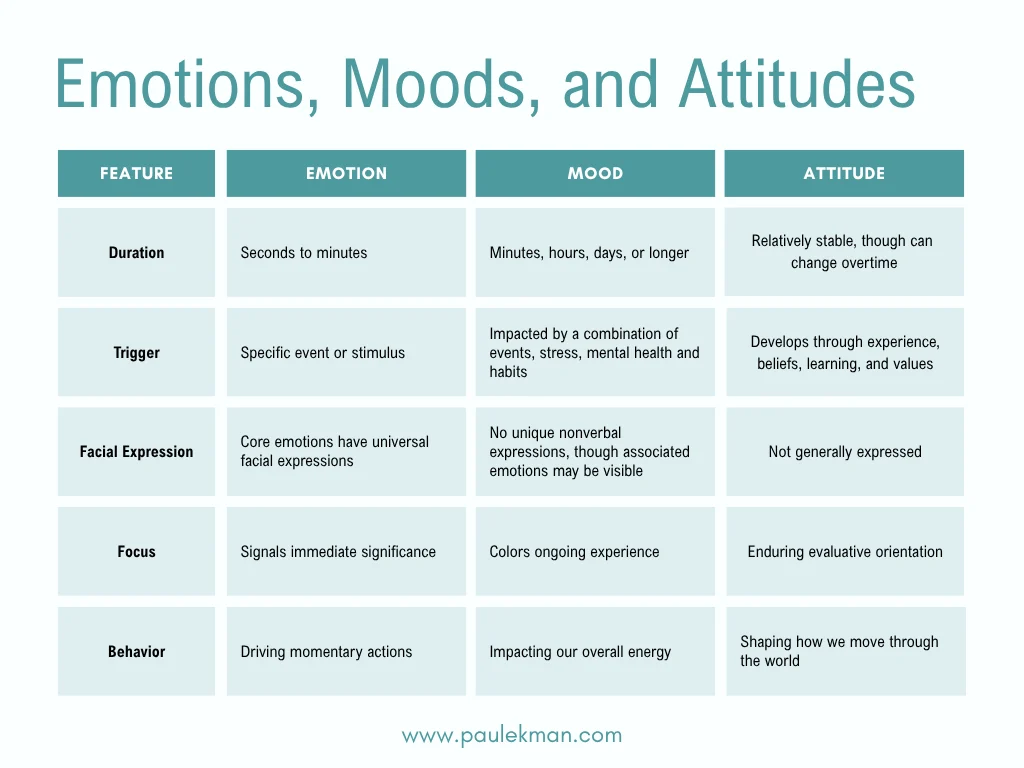
The intricate tapestry of human consciousness is woven from a complex interplay of emotions, moods, and attitudes. While often used interchangeably in casual conversation, these distinct psychological constructs operate on different timescales and serve unique functions, profoundly shaping our perception of ourselves and the world around us. Understanding their individual characteristics and their dynamic interactions is crucial for fostering greater emotional awareness, enhancing self-regulation, and navigating the complexities of human behavior with increased insight and empathy. This exploration delves into the core definitions of emotions, moods, and attitudes, examining how they influence each other and offering practical implications for personal and interpersonal growth.
The Fleeting Intensity of Emotions
Emotions are the immediate, often involuntary, responses to events that hold significance for our goals, needs, or well-being. They are a product of both our evolutionary heritage, equipping us with rapid appraisal mechanisms, and our unique personal experiences, which color our interpretations. When a stimulus is perceived as relevant—whether it signals opportunity, threat, loss, or gain—an emotion is triggered. This triggering initiates a cascade of coordinated psychological and physiological changes designed to prepare us for action.
Scientifically, emotions are characterized by their brevity, typically lasting from fractions of a second to several minutes. This rapid onset and offset are adaptive, allowing us to quickly orient ourselves to changing circumstances. The physiological changes associated with emotions are diverse and observable. They can include alterations in heart rate, breathing patterns, muscle tension, and the secretion of hormones like adrenaline. Crucially, emotions are also frequently accompanied by distinct facial expressions, a universal language that communicates our internal state to others. For instance, research by Dr. Paul Ekman has identified several universal facial expressions—such as happiness, sadness, anger, fear, surprise, and disgust—that are recognized across diverse cultures, underscoring the deeply ingrained biological basis of our emotional responses. These expressions serve as vital signals in social interactions, conveying immediate intentions and facilitating rapid social coordination.
The function of emotions is multifaceted. They serve as internal alarm systems, alerting us to potential dangers and opportunities. They motivate us to approach rewarding experiences and avoid harmful ones. Furthermore, emotions play a significant role in learning and memory, imprinting significant events with affective tags that influence future behavior. For example, a fear response to a dangerous situation not only prompts immediate escape but also creates a strong memory that discourages future encounters with similar stimuli.
The Pervasive Influence of Moods
In contrast to the sharp, focused nature of emotions, moods are more diffuse and enduring affective states. They can persist for hours, days, or even longer, casting a pervasive emotional hue over our daily experiences. A key distinguishing feature of moods is their often-unclear origin. Unlike emotions, which are typically tied to a specific event or object, moods can emerge without any readily identifiable trigger. We might wake up feeling "off" or find ourselves gradually slipping into a state of low spirits for no apparent reason. This lack of a specific antecedent makes moods more challenging to manage, as the target of the feeling is not immediately apparent.
While emotions often manifest in distinct facial expressions, moods typically do not elicit such clear visual cues. Instead, their presence might be subtly indicated through changes in posture, energy levels, or generalized muscle tension. For instance, someone in a generally irritable mood might exhibit a subtle furrowing of the brow or a tendency to sigh more frequently, even when not reacting to a specific provocation.
Moods function as an emotional backdrop, influencing how we perceive and react to the world. A positive mood can make us more optimistic, more likely to interpret ambiguous situations favorably, and more resilient in the face of minor setbacks. Conversely, a negative mood can bias our perceptions, leading us to focus on threats, interpret neutral events negatively, and experience emotions more intensely and for longer durations. Research in affective science suggests that moods can prime us for certain emotional responses. For instance, someone in an anxious mood may be more prone to experiencing fear when faced with uncertainty, while someone in a cheerful mood might find it easier to feel joy or amusement. This suggests that moods act as a sort of attentional filter, shaping what information we notice and how we process it.
The Enduring Framework of Attitudes
Attitudes represent a more stable and enduring aspect of our psychological landscape. Unlike emotions and moods, which are transient feeling states, attitudes are relatively fixed evaluations of people, ideas, objects, behaviors, or experiences. They are not emotions themselves but rather learned predispositions to respond in a particular way towards something. Psychologists commonly describe attitudes as comprising three interconnected components, often referred to as the ABC model:
- Affective Component: This refers to the emotional associations we have with the attitude object. For example, a positive attitude towards dogs might involve feelings of warmth, affection, and happiness when interacting with them.
- Behavioral Component: This encompasses our tendencies to act in certain ways towards the attitude object. A positive attitude towards exercise might manifest as a consistent habit of going to the gym or participating in sports.
- Cognitive Component: This includes the beliefs, thoughts, and knowledge we hold about the attitude object. For instance, a positive attitude towards recycling might be based on the belief that it conserves natural resources and reduces pollution.
Attitudes can also be categorized as either explicit or implicit. Explicit attitudes are those we are consciously aware of and can readily report, such as our stated preference for a particular political candidate. Implicit attitudes, on the other hand, are unconscious biases or associations that can influence our behavior without our direct awareness. These can be particularly influential in areas like intergroup relations or decision-making.
The development of attitudes is a complex process, shaped by a confluence of factors. Repeated emotional experiences play a significant role; positive or negative encounters with an object or person can gradually form our evaluative stance. Learning, through mechanisms like classical and operant conditioning, also contributes. For example, if a child consistently receives praise for sharing (positive reinforcement), they may develop a positive attitude towards sharing. Social and cultural norms, as well as our relationships with others, also profoundly influence attitude formation. Our families, peers, and broader societal messages all convey implicit and explicit messages about what is desirable, acceptable, or objectionable. Personal reflection and critical thinking can also lead to the modification or strengthening of existing attitudes.
While generally more stable than emotions or moods, attitudes are not immutable. They can be strengthened, weakened, or gradually reshaped over time through new experiences, exposure to contradictory information, or conscious effort. Importantly, attitudes, unlike moods, are always directed toward a specific target. We possess attitudes about specific individuals, abstract concepts, political policies, or even our own emotional experiences. Because they act as an evaluative lens, attitudes significantly influence how we interpret incoming information, what we pay attention to, and how we are predisposed to respond. This evaluative function makes attitudes powerful determinants of our behavior and our overall worldview.
The Dynamic Interplay: How They Influence Each Other
The distinct nature of emotions, moods, and attitudes does not imply they operate in isolation. Instead, they are in constant, dynamic interaction, each influencing the others in profound ways.
Moods as Emotional Amplifiers and Dampeners
Our prevailing mood significantly impacts the likelihood and intensity of emotional responses. An individual experiencing an upbeat or positive mood may find it easier to bounce back from minor frustrations or disappointments. Their mood acts as a buffer, mitigating the intensity and duration of negative emotions. Conversely, someone in an irritable or anxious mood is more likely to react disproportionately to minor stressors. Small setbacks might trigger strong feelings of anger or distress, and these emotions can, in turn, further entrench the negative mood, creating a self-perpetuating cycle. This phenomenon highlights how moods can set the stage for emotional experiences, influencing our susceptibility to particular feelings and the magnitude of our reactions. Furthermore, a series of intense, short-lived emotions, such as repeated instances of worry or frustration, can coalesce over time to form a more persistent, generalized mood state of anxiety or irritability.
Attitudes as Lenses for Emotional Interpretation
Attitudes play a critical role in shaping how we interpret events and, consequently, the emotions we experience. Consider two individuals receiving identical constructive criticism. Person A, holding a positive attitude towards feedback as a tool for growth, might feel motivated and even excited by the opportunity to improve. Their attitude frames the feedback as a valuable resource, leading to emotions of engagement and optimism. Person B, conversely, may harbor a negative attitude towards feedback, viewing it as a personal threat or an indication of inadequacy. This attitude leads them to interpret the same feedback through a lens of defensiveness and anxiety, evoking emotions of annoyance, resentment, or fear. In this scenario, the external event is identical, but the pre-existing attitudes of the individuals dictate their internal emotional response. This demonstrates how our deeply held beliefs and evaluations act as filters, coloring our perception of reality and guiding our emotional reactions.
The Meta-Attitude: Our Stance on Emotions Themselves
A particularly significant type of attitude is our attitude toward emotions themselves. These "meta-attitudes" are formed over years through family upbringing, cultural conditioning, educational experiences, and personal history. For example, some individuals may develop the belief that anger is inherently dangerous and should be suppressed, while others might see sadness as a sign of weakness that should be hidden. Conversely, some may view joy as something to be openly expressed and shared.
These attitudes towards specific emotions profoundly influence our willingness to acknowledge, accept, express, and learn from our internal experiences. If we believe that certain emotions are unacceptable or shameful, we are less likely to pay attention to them, understand their underlying causes, or utilize them as valuable sources of information. This can lead to emotional repression, which has been linked to various psychological and physical health issues.
Furthermore, these attitudes are closely tied to the concept of "display rules"—sociocultural norms that dictate how, when, and to whom emotional expressions are considered appropriate. While certain facial expressions of emotion are universally recognized, the rules governing their expression vary significantly across cultures. For instance, in some cultures, overt displays of sadness might be encouraged, while in others, stoicism is valued. Understanding these display rules, which are themselves shaped by our attitudes, is crucial for navigating cross-cultural communication and appreciating the diversity of human emotional expression. The ability to recognize universal emotional signals while understanding culturally specific display rules is a hallmark of sophisticated emotional intelligence.
Cultivating Emotional Awareness for a Richer Life
At the Paul Ekman Group, the foundational principle is that genuine emotional awareness begins with cultivating a clear and curious observational stance towards our internal experiences. By actively learning to identify and label our emotions as they arise, understanding the subtle yet pervasive influence of our moods, and becoming conscious of the attitudes that shape our interpretations, we equip ourselves to respond to ourselves and others with greater wisdom, compassion, and effectiveness.
The development of these skills is not an instantaneous event but rather an ongoing practice that strengthens over time with consistent effort. Through mindful observation, self-reflection, and deliberate engagement with our emotional lives, we can build a more robust capacity for emotional regulation and interpersonal understanding.
For those seeking to deepen their expertise in the science of emotion and enhance their emotional intelligence, the Paul Ekman Group offers a range of research-based resources designed to support this journey. These resources aim to provide individuals with the tools and knowledge necessary to navigate their inner worlds with greater clarity and to foster more meaningful and resilient connections with those around them. By understanding the nuanced interplay of emotions, moods, and attitudes, individuals can unlock a more profound and informed experience of being human.
