

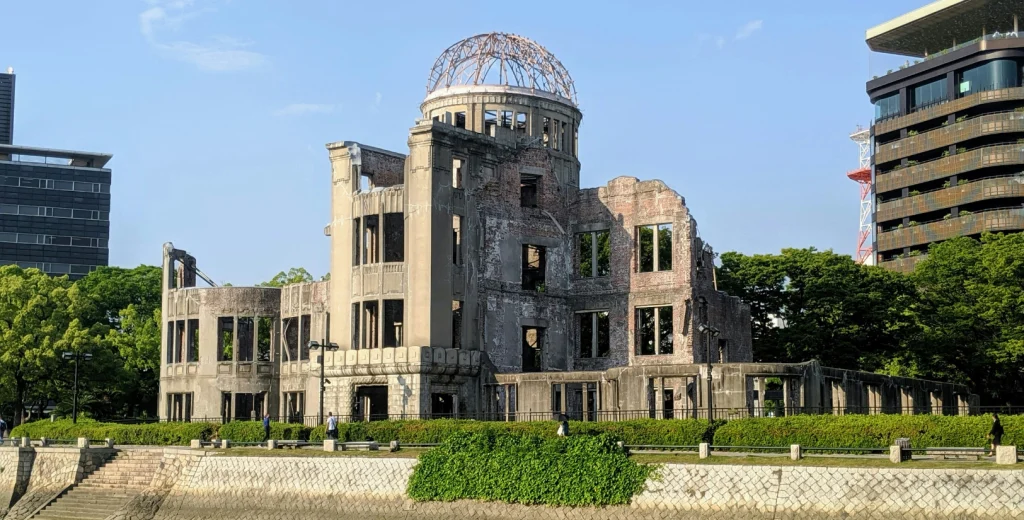
The intersection of historical trauma and modern leadership development took center stage in the latest installment of the Anecdotally Speaking podcast, where hosts Mark and Shawn utilized the harrowing lived experience of Tsutomu Yamaguchi to explore the psychological mechanisms of resilience. Episode 284 of the series, produced by Anecdote International, examines how the internal narratives individuals construct about their lives—whether viewed through the lens of misfortune or miraculous survival—directly dictate their capacity for leadership, decision-making, and professional integrity. By dissecting the events of August 1945, the program highlights a fundamental truth in organizational communication: while facts remain static, the meaning derived from those facts is a powerful tool for navigating institutional change and personal adversity.
The Dual Atomic Survival of Tsutomu Yamaguchi
Tsutomu Yamaguchi, a 29-year-old naval engineer for Mitsubishi Heavy Industries, occupies a unique and somber position in modern history. In the summer of 1945, Yamaguchi was nearing the end of a three-month business trip to Hiroshima. On the morning of August 6, 1945, as he prepared to leave the city to return to his family in Nagasaki, the United States B-29 bomber Enola Gay dropped the "Little Boy" atomic bomb.
At approximately 8:15 a.m., Yamaguchi was walking toward the Mitsubishi shipyard when he witnessed a blinding flash of light. Despite being roughly three kilometers from the hypocenter, the blast was sufficient to rupture his eardrums, cause temporary blindness, and inflict serious thermal burns across the left side of his upper body. The city of Hiroshima was instantaneously transformed into a wasteland, with an estimated 70,000 to 80,000 people killed in the initial explosion.
Yamaguchi’s survival of the first nuclear attack in history was statistically improbable. However, the ensuing 72 hours would defy the laws of probability even further. After spending a restless night in an air-raid shelter amid the ruins of Hiroshima, Yamaguchi navigated the fire-ravaged streets to reach the railway station, which miraculously remained partially functional. He boarded a train filled with the wounded and dying, arriving in his hometown of Nagasaki on August 8.
On the morning of August 9, despite his extensive bandages and severe physical trauma, Yamaguchi reported to the Mitsubishi office in Nagasaki to brief his supervisor on the devastation he had witnessed in Hiroshima. Historical records and Yamaguchi’s own accounts indicate that his superior was skeptical, questioning how a single bomb could level an entire city. As Yamaguchi was attempting to describe the "blinding flash," the second atomic bomb, "Fat Man," was detonated over Nagasaki. Once again, Yamaguchi was approximately three kilometers from the blast center. He survived a second time, shielded by the office’s reinforced walls, though his bandages were blown off and he suffered a new wave of radiation exposure.
Chronology of the 1945 Atomic Bombings and Yamaguchi’s Experience
To understand the magnitude of the narrative discussed in the podcast, it is essential to review the compressed timeline of the events that ended World War II:
- August 6, 1945 (8:15 AM): The first atomic bomb is dropped on Hiroshima. Tsutomu Yamaguchi is injured but survives.
- August 7, 1945: Yamaguchi seeks refuge and begins his journey toward the railway station.
- August 8, 1945: Yamaguchi arrives in Nagasaki and receives basic medical treatment at a local hospital.
- August 9, 1945 (11:02 AM): The second atomic bomb is dropped on Nagasaki while Yamaguchi is in his office. He survives again.
- August 15, 1945: Emperor Hirohito announces the unconditional surrender of Japan.
- Post-1945: Yamaguchi undergoes a long recovery from radiation sickness and burns, eventually returning to work for Mitsubishi as a translator and teacher.
- 2009: The Japanese government officially recognizes Yamaguchi as a nijyuu hibakusha (double atomic bomb survivor), the only person to receive such official status, though others are believed to have shared the experience.
Supporting Data on the Atomic Blasts
The scale of the events Yamaguchi survived is documented through extensive historical and scientific data. The Hiroshima bomb, a uranium-235 gravity bomb, had an explosive yield of approximately 15 kilotons of TNT. The Nagasaki bomb, a plutonium-239 implosion-type device, was more powerful, yielding approximately 21 kilotons.
Total casualties from the two bombings are estimated between 129,000 and 226,000 people, the majority of whom were civilians. Those who survived within the immediate radius of the blasts, known as hibakusha, faced long-term health consequences, including increased rates of leukemia, various forms of cancer, and chronic respiratory issues. Yamaguchi himself lived to the age of 93, passing away in 2010 from stomach cancer, a longevity that remains a subject of medical interest given his double exposure to high-level ionizing radiation.
The Narrative Frame: Luck vs. Misfortune
In Episode 284, Mark and Shawn pivot from the historical facts to the psychological application of the story. They pose a critical question: Was Tsutomu Yamaguchi the unluckiest man in history for being present at both bombings, or the luckiest man for surviving both?

This distinction is not merely academic; it serves as a metaphor for leadership resilience. The podcast explores the concept of "meaning-making," a psychological process where individuals interpret life events to form a coherent self-narrative. In a corporate context, how a leader frames a setback—as a catastrophic failure or a unique learning opportunity—determines the organization’s ability to recover.
Research in narrative psychology suggests that individuals who utilize "redemptive sequences"—narratives where a negative event leads to a positive outcome—exhibit higher levels of mental well-being and persistence. By framing Yamaguchi’s story as one of incredible luck and survival, leaders can illustrate the importance of maintaining a "survivor mindset" even when external circumstances are dire.
Implications for Leadership and Organizational Communication
The discussion in Anecdotally Speaking extends beyond personal resilience into the realm of professional integrity and decision-making. A significant portion of the episode is dedicated to how leaders communicate difficult decisions.
Authenticity in Communicating Unpopular Decisions
Leaders are often tasked with implementing strategies or policies they did not personally design or may not entirely agree with. The podcast suggests that storytelling is a bridge to maintaining authenticity in these moments. By sharing the "story" behind the decision—the constraints, the data, and the long-term vision—leaders can foster audience participation in meaning-making. This transparency allows employees to understand the "why" even if the "what" is unpalatable.
The Technique of Foreshadowing
The hosts also examine "foreshadowing" as a storytelling device. In Yamaguchi’s case, his conversation with his boss in Nagasaki serves as a grim foreshadowing of the second blast. In a business setting, leaders can use foreshadowing to prepare teams for upcoming market shifts or organizational changes. By planting the seeds of change early through narrative, leaders reduce the "shock" of the eventual event, much like the structural cues in a well-told story prepare the audience for a climax.
Official Recognition and Global Impact
For decades, Yamaguchi was a "single survivor" in the eyes of the law, having only registered his presence in Nagasaki. It was not until 2009, a year before his death, that the Japanese government officially acknowledged his presence in Hiroshima as well. This recognition was more than symbolic; it provided a sense of closure to a man who had spent his later years advocating for nuclear disarmament.
Yamaguchi’s story gained international prominence in the mid-2000s, leading to a documentary titled Twice Survived: The Doubly Atomic Bombed of Hiroshima and Nagasaki, which was screened at the United Nations. His life became a testament to the human spirit’s endurance and a cautionary tale regarding the use of weapons of mass destruction.
Broader Implications for the Modern Workforce
Anecdote International, the organization behind the podcast, specializes in using storytelling to "bring humanity back to the workforce." The analysis of the Yamaguchi story aligns with their broader mission of equipping leaders with the tools to handle complex human emotions in a corporate environment.
In an era of rapid technological change and economic volatility, the ability to construct a resilient narrative is a vital skill. Organizations that foster a culture of storytelling allow employees to process trauma and change more effectively. The story of Tsutomu Yamaguchi serves as the ultimate "story bank" entry for leaders looking to discuss resilience, the importance of perspective, and the reality that while we cannot control external "flashes" of crisis, we have total control over the story we tell about them afterward.
By examining the facts of Yamaguchi’s life alongside the storytelling techniques discussed by Mark and Shawn, Episode 284 provides a framework for leaders to improve their decision-making and communication. The episode reinforces that the most effective leaders are those who can find meaning in the ruins and guide their teams toward a narrative of survival and growth.
