

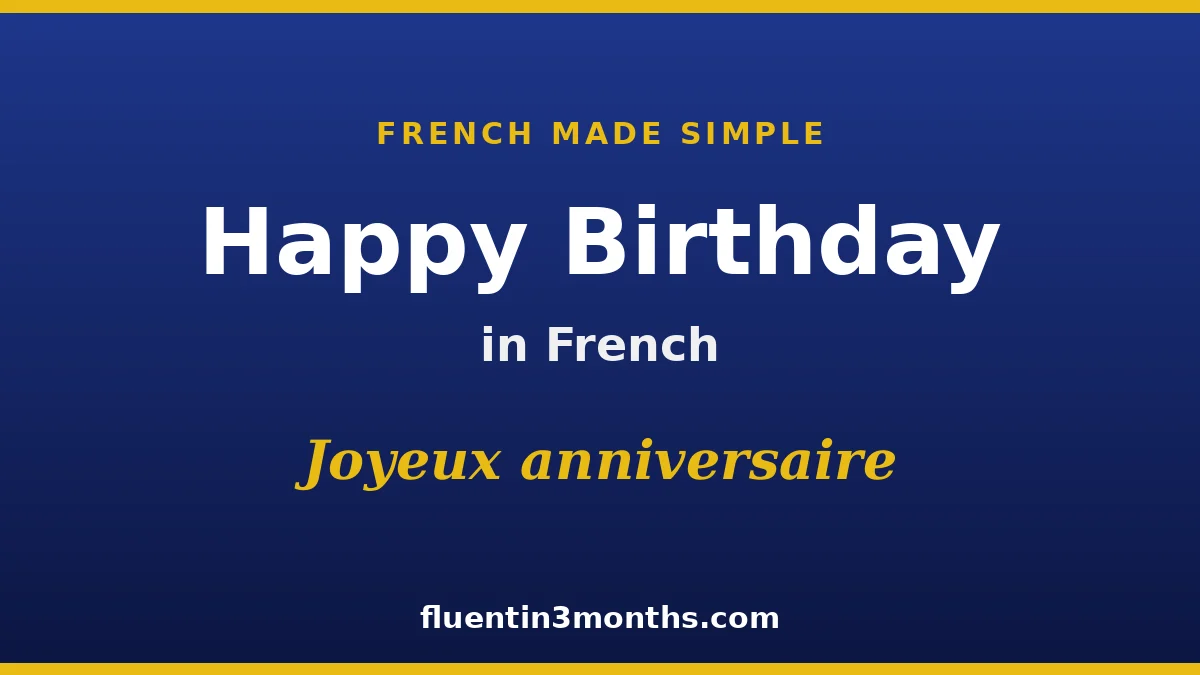
The act of celebrating a birth anniversary in the French-speaking world involves a sophisticated blend of linguistic precision, regional variations, and deeply rooted social customs that differ significantly from Anglophone traditions. While the English language predominantly relies on the singular phrase "Happy Birthday," the Francophone world employs a variety of expressions tailored to geographical location, level of formality, and the specific nature of the relationship between the speaker and the recipient. The primary phrases used across the majority of French-speaking territories are Joyeux anniversaire and Bon anniversaire, both of which serve as the standard for formal and informal greetings. However, beneath these common expressions lies a complex web of cultural nuances that dictate everything from the timing of the message to the physical gestures that accompany the greeting.
The Linguistic Framework of French Birthday Greetings
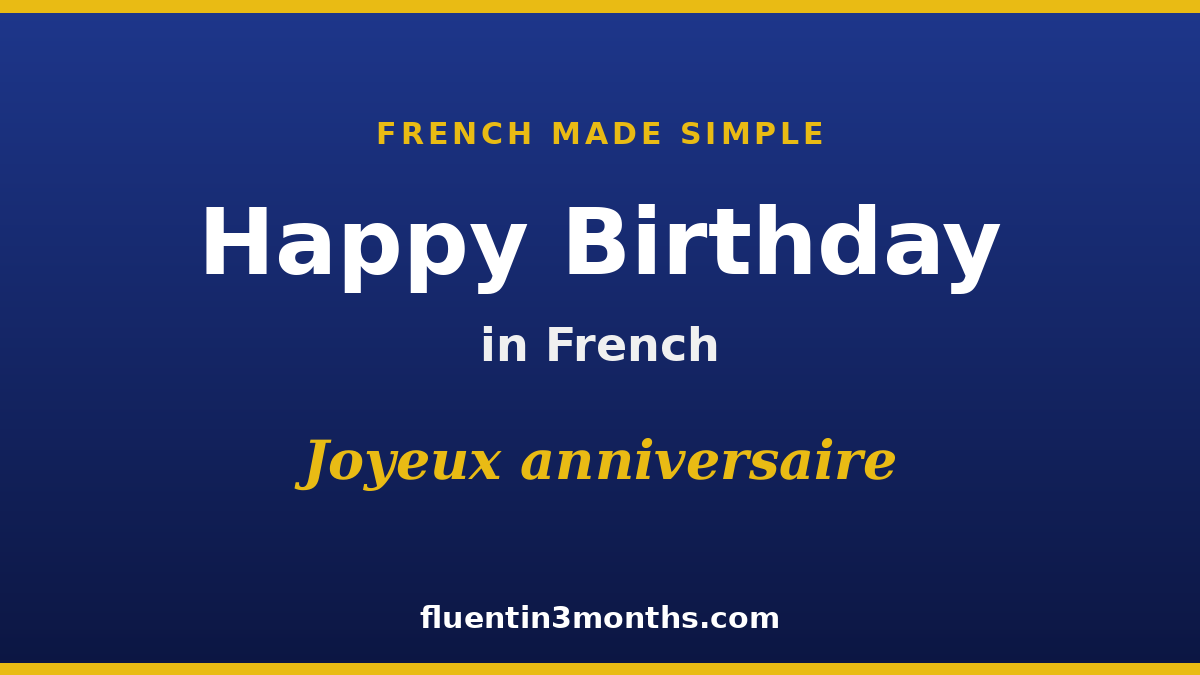
In standard French, the most widely recognized greeting is Joyeux anniversaire. This phrase is constructed from the adjective "joyeux," meaning joyful or happy, and the masculine noun "anniversaire." Because "anniversaire" begins with a vowel, the final "x" in "joyeux" is pronounced as a "z" sound, a linguistic phenomenon known as liaison. This ensures a fluid transition between words, a hallmark of the French phonetic system. An equally acceptable and frequent alternative is Bon anniversaire, where the adjective "bon" (good) undergoes a similar liaison, with the "n" carrying over to the start of the following word.
While these two phrases are often used interchangeably, linguistic experts note that the choice between them can sometimes reflect subtle stylistic preferences. Neither phrase inherently dictates a level of formality; rather, the surrounding context and the use of pronouns—specifically the distinction between the informal "tu" and the formal "vous"—determine the social register of the interaction. In digital communications and among younger demographics, the noun "anniversaire" is frequently truncated to "anniv," resulting in the casual "Joyeux anniv." This abbreviation mirrors the English "b-day" and is strictly reserved for informal settings, such as text messaging or social media posts among close peers.
Regional Divergence and the Quebecois Distinction
One of the most critical distinctions in Francophone birthday etiquette is the geographical divide between European French and Canadian French, particularly in Quebec. In Quebec and other French-speaking regions of Canada, the standard greeting is Bonne fête. While this literally translates to "Good party" or "Happy feast," it is the official and most common way to wish someone a happy birthday in North American French contexts. The Office québécois de la langue française (OQLF) recognizes "fête" as a synonym for "anniversaire" within the Canadian lexicon.
Conversely, in France and most of Europe, using Bonne fête on someone’s birthday can lead to confusion. In these regions, a "fête" refers to a person’s "name day"—the day on the liturgical calendar associated with the saint after whom they were named. While the importance of name days has waned in secular circles, the tradition persists in many families. Therefore, wishing a Parisian "Bonne fête" on their birthday might prompt them to check the calendar to see if it is indeed their Saint’s day, rather than acknowledging their birth anniversary. This regional variation underscores the importance of cultural literacy when navigating the Francophone world.
Historical Context and the Evolution of Celebration
The history of birthday celebrations in France is intertwined with the broader European transition from religious to secular commemorations. For centuries, the "fête" or name day held more weight than the actual date of birth, as it linked the individual to a patron saint and the community of the Church. It was not until the 19th and early 20th centuries that the celebration of the individual birth date became a widespread social norm across all classes of French society.
The musical component of French birthdays also reflects a blend of indigenous and imported influences. The most common birthday song in France uses the melody of the American "Happy Birthday to You," with the lyrics translated to "Joyeux anniversaire, heureux anniversaire, tous nos vœux sont sincères, joyeux anniversaire." However, a distinctively French alternative exists in the form of the song "Bon anniversaire," composed by Louiguy and Jacques Larue and popularized by André Claveau in the 1950s. This song features a unique melody and more elaborate lyrics, often reserved for more formal or traditional family gatherings.
Sociocultural Norms and Workplace Etiquette
French birthday customs involve several practices that may seem counterintuitive to those accustomed to British or American norms. One of the most notable differences is the responsibility of the birthday individual regarding treats and refreshments. In many French workplaces and schools, it is the person celebrating the birthday who is expected to provide "le gâteau" (the cake) or a selection of pastries for their colleagues or classmates. This practice, often referred to as "arroser son anniversaire" (literally, "to water one’s birthday"), shifts the burden of hospitality onto the person being honored.
Physical greetings also play a significant role in the celebration. The tradition of "la bise"—exchanging kisses on the cheeks—is a common way to greet the birthday person among friends and family. The number of kisses varies by region, typically ranging from two to four. However, in professional settings, a firm handshake remains the standard. It is generally advised for outsiders to observe the behavior of the host or the group before initiating physical contact, as personal boundaries and regional habits vary.
Furthermore, there is a lingering superstition among some French speakers regarding "early" birthday wishes. It is often considered bad luck to wish someone a happy birthday or to celebrate the event before the actual date. If a celebration must take place on a weekend prior to a weekday birthday, guests may wait until the clock strikes midnight or simply focus on the gathering itself rather than the formal greeting.
Statistical Overview of the Francophone World
The importance of mastering these nuances is highlighted by the scale of the Francophone population. According to data from the Organisation internationale de la Francophonie (OIF), there are approximately 321 million French speakers worldwide as of 2022. French is the official language in 29 countries and is the fifth most spoken language globally.
| Region | Primary Birthday Greeting | Cultural Note |
|---|---|---|
| France | Joyeux anniversaire | Focus on the specific birth date; "Bonne fête" is for name days. |
| Quebec (Canada) | Bonne fête | "Fête" is the standard term for birthday; very common in North America. |
| Belgium/Switzerland | Joyeux anniversaire | Generally follows European French norms with minor local dialect shifts. |
| West Africa | Joyeux anniversaire | Often accompanied by large communal meals and religious blessings. |
The OIF reports that the number of French speakers is projected to reach over 700 million by 2050, largely driven by demographic growth in Africa. This expansion suggests that the linguistic variations of celebrations will continue to diversify, making the understanding of regional "French-speaking" etiquette increasingly vital for international diplomacy, business, and social integration.
Formal Correspondence and Written Well-Wishes
When moving beyond spoken greetings to written messages in cards or formal emails, the French language offers a variety of "formules de politesse" (polite formulas). For a formal or professional context, one might write: "Je vous souhaite un très joyeux anniversaire et une année pleine de succès." (I wish you a very happy birthday and a year full of success).
For closer relationships, the language becomes more emotive. Phrases such as "Je pense fort à toi en ce jour spécial" (I am thinking of you fondly on this special day) or "Que ce nouvel âge t’apporte beaucoup de bonheur" (May this new age bring you much happiness) are common. The use of "santé" (health) is also a frequent theme in French well-wishes, reflecting a cultural emphasis on well-being and longevity.
Analysis of Linguistic Implications
The choice between "tu" and "vous" in birthday greetings serves as a microcosm of the broader French social hierarchy. Addressing someone with "Joyeux anniversaire, [Name]" is safe among peers, but in a formal setting, "Je vous souhaite un bon anniversaire" maintains the necessary professional distance. Experts in sociolinguistics argue that these choices are not merely grammatical but are essential tools for navigating social "face" and respect.
The persistence of regionalisms like the Quebecois "Bonne fête" also serves as a point of cultural pride and identity. In a globalized world where English often acts as a leveling force, the maintenance of distinct regional phrases allows Francophone communities to preserve their unique historical trajectories and cultural heritage.
Conclusion
Understanding how to navigate a birthday in French requires more than just memorizing a translation; it requires an appreciation for the rhythm of the language and the traditions of its people. Whether it is ensuring the correct liaison in "Joyeux anniversaire," remembering to bring a cake to a French office, or correctly identifying when to use "Bonne fête" in Montreal, these small details facilitate deeper social connections. As the Francophone world continues to grow and evolve, these traditions remain a steadfast way for individuals to honor the passage of time and the importance of the individual within the community. For the language learner, mastering these nuances is a significant step toward true cultural fluency, allowing them to participate fully in the joys and celebrations of French-speaking life.
