


The roar of the crowd, the tension of a final round, and the agonizingly slow journey of a golf ball toward the hole – these elements combine to create compelling drama, as witnessed during the recent BMW Championship. While the physical act of sinking a putt may seem straightforward, new research suggests that the psychological stakes, particularly the fear of loss, can significantly influence even the most seasoned professionals. This phenomenon, rooted in behavioral economics and eloquently explored in a seminal study, offers profound insights not only into the minds of elite athletes but also into decision-making processes across various aspects of life.
The BMW Championship Drama: A Case Study in Pressure
This past Sunday, the final round of the BMW Championship delivered a thrilling display of professional golf, culminating in a victory for Wyndham Clark. Clark began the day with a commanding five-shot lead, a position many would deem comfortable. However, the unpredictable nature of professional golf, amplified by intense pressure and the psychological weight of a major tournament, quickly reshaped the narrative. As the competition progressed to the back nine, Clark’s substantial lead evaporated, showcasing the inherent volatility of the sport. Moments of perceived vulnerability for Clark were met with both the strategic play of his competitors and, crucially, a spectacular three-birdie finish that ultimately secured his hard-fought three-shot victory. This dramatic shift in fortune, from perceived dominance to a hard-won triumph, served as a powerful real-world illustration of psychological principles at play.
Unpacking the Research: The Birdie vs. Par Putt Phenomenon
The intricate dynamics observed in the BMW Championship’s final round brought to mind pioneering research that delves into the subtle psychological forces influencing golfers. In 2011, economists Devin Pope and Maurice Schweitzer published their influential paper, "Is Tiger Woods Loss Averse? Persistent Bias in the Face of Experience, Competition, and High Stakes," in the prestigious American Economic Review. Their study, a monumental undertaking, analyzed over 2.5 million PGA Tour putts taken by 421 golfers across a five-year period (2004-2009). Leveraging precise ShotLink data, which meticulously records every aspect of a player’s performance, Pope and Schweitzer unearthed a startling statistical anomaly.
Their findings revealed that professional golfers were consistently 2 to 4 percentage points more likely to successfully make a par putt than a comparable birdie putt. This discrepancy is particularly striking when one considers the identical nature of the physical challenge. The distance of the putt, the lie of the ball, the green conditions, and the golfer’s skill level were, in essence, the same. Yet, the outcome differed based on the putt’s implication: securing par versus achieving a birdie.
The Science of Loss Aversion
The driving force behind this observed bias is a well-documented psychological principle known as "loss aversion." Pioneered by Nobel laureate Daniel Kahneman and his long-time collaborator Amos Tversky, loss aversion posits that the psychological impact of a loss is significantly greater than the pleasure derived from an equivalent gain. In simpler terms, humans tend to feel the pain of losing something more intensely than the joy of gaining something of the same value. This principle is deeply embedded in our decision-making frameworks and influences our choices even when we are unaware of its subtle power.
In the context of golf, this translates to a distinct psychological experience when standing over a putt. A birdie putt represents an opportunity for gain – an extra stroke under par. While missing this putt is undesirable, it does not necessarily result in a negative score relative to par if the subsequent putt is made. The golfer still has the opportunity to achieve par.
Conversely, a par putt carries a different emotional weight. Missing a par putt results in a loss – a stroke added to the score relative to par. The golfer has failed to maintain their current standing on the course. While on the scorecard, each stroke is numerically equivalent, the psychological perception in the moment of execution can be vastly different. This subtle yet potent difference in perceived outcome appears to exert an influence on the performance of even the world’s most accomplished golfers.
The Evolving Impact of Pressure and Competition
Intriguingly, Pope and Schweitzer’s research also illuminated how the psychological landscape shifts throughout a tournament. They observed that the difference in putting success between par and birdie putts decreased as a tournament progressed. In the first round, the disparity was approximately 3.8 percentage points, narrowing to 2.1 percentage points by the final round. While the phenomenon never entirely disappeared, this reduction suggests an adaptation to the mounting pressure and stakes.
The researchers attributed this decline in the loss aversion effect to a shift in golfers’ psychological focus. In the early rounds, players are primarily concerned with their score relative to the course’s par. However, as the tournament enters its final stages, their primary concern often becomes their score relative to the scores of their competitors. This heightened awareness of the competitive field can overshadow the immediate concern of losing a stroke relative to par, as the ultimate goal becomes outperforming other players.
This finding is particularly noteworthy. Professional golfers possess an extraordinary level of experience, dedicate countless hours to practice, compete under immense scrutiny, and have potentially millions of dollars riding on their performance. Despite these formidable advantages, they remain susceptible to fundamental human psychological biases. This underscores the pervasive nature of loss aversion, affecting individuals even at the pinnacle of their profession.
Broader Implications: Scarcity Beyond the Sales Pitch
The lessons derived from the golf course extend far beyond the greens. The concept of scarcity, often associated with marketing tactics like "limited time offers" or "only a few left," has a broader, more nuanced interpretation. As Brian Ahearn, Chief Influence Officer at Influence PEOPLE and a faculty member at the Cialdini Institute, frequently emphasizes, scarcity can also manifest as the mere possibility of losing something one already possesses.
For the golfer, the putt for par represents the avoidance of losing a stroke they currently have. For consumers, the fear of missing out on a desirable product or service, even if not an immediate necessity, can be a powerful motivator. This fear of loss can often drive decision-making more profoundly than the prospect of an equivalent gain. The underlying psychological mechanism is the same: the potent aversion to experiencing a negative outcome.
Ethical Influence and Self-Awareness
Understanding these psychological drivers is crucial for effective and ethical influence. The goal is not to exploit individuals’ fears of loss through manipulation. Instead, it is about recognizing how people naturally make decisions and then communicating relevant information truthfully and transparently. By understanding the power of loss aversion, individuals and organizations can frame their messages more effectively, ensuring clarity and impact without resorting to deceptive practices.
For individuals navigating their own important decisions, a critical self-reflection is warranted. The question to ask is not simply "What do I want to gain?" but also, "Am I being driven by a genuine desire, or am I reacting more strongly due to an underlying fear of losing something?" This introspection can reveal the true motivations behind choices and lead to more considered and ultimately, more satisfying outcomes. The difference between pursuing a gain and avoiding a loss can be far more significant than initially perceived, impacting everything from financial investments to career choices.
A Question for the Golfing Community
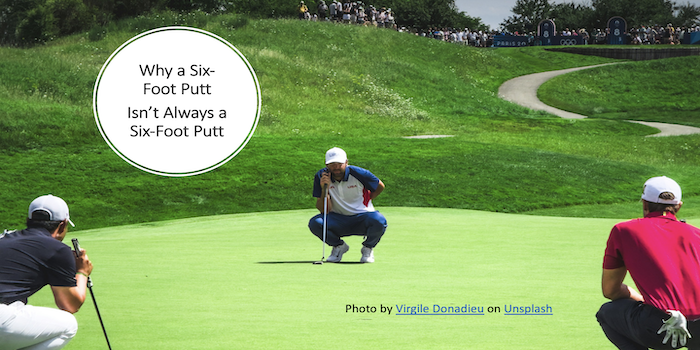
The psychological nuances of putting remain a fascinating area of study. For those who play the game, the question lingers: does the experience of standing over a six-foot putt for birdie truly feel different from standing over an identical six-foot putt for par? The research suggests it does, and this subtle psychological distinction can, indeed, make all the difference.
The implications of this research are far-reaching, offering a lens through which to view decision-making in various professional arenas, from business negotiations to athletic competitions. By acknowledging the powerful influence of loss aversion, we can foster greater self-awareness and engage in more ethical and effective communication, ultimately leading to better outcomes for all involved.
