


The dramatic conclusion of the BMW Championship this past Sunday, where Wyndham Clark navigated a shifting five-shot lead to secure a three-shot victory, offers a compelling entry point into a fascinating area of behavioral economics: loss aversion. While Clark’s triumph was a testament to skill and mental fortitude under pressure, the very nature of professional golf, and indeed many high-stakes endeavors, is subtly shaped by a fundamental human psychological bias. This article delves into the research illuminating how the prospect of losing a stroke can impact performance, even among the world’s elite, and explores the broader implications of this bias in decision-making.
The BMW Championship: A Study in Shifting Fortunes
The final round of the BMW Championship, a pivotal event in the FedExCup Playoffs, provided a thrilling spectacle for golf enthusiasts. For many, including this author and his wife Jane, who are avid followers of the major championships and PGA Tour events, the tournament offered a familiar blend of anticipation and tension. This year’s edition, however, presented a particularly potent case study in the psychological dynamics of competitive golf.
Wyndham Clark, having entered Sunday with a commanding five-stroke advantage, faced immense pressure as his lead began to erode on the back nine. The narrative shifted from a potential coronation to a nail-biting contest as competitors closed the gap. Ultimately, a combination of strategic play, crucial putts, and perhaps a touch of fortune allowed Clark to secure his victory. The drama of his win, the ebb and flow of momentum, and the critical putts made and missed, served as a potent reminder of deeper psychological forces at play.
The Six-Foot Putt: More Than Just Distance?
The question of whether a six-foot putt is simply a six-foot putt, physically speaking, is a matter of geometry. However, research from the realm of behavioral economics suggests that psychologically, the context surrounding that putt can significantly alter its perceived importance and, consequently, the golfer’s performance.
In 2011, a landmark study by economists Devin Pope and Maurice Schweitzer, titled "Is Tiger Woods Loss Averse? Persistent Bias in the Face of Experience, Competition, and High Stakes," was published in the American Economic Review. This research delved into the intricacies of professional golf putting, leveraging precise data from the PGA Tour’s ShotLink system.
Unpacking the Data: 2.5 Million Putts Under the Microscope
Pope and Schweitzer’s analysis was extensive, encompassing over 2.5 million putts executed by 421 professional golfers across a five-year period, from 2004 to 2009. This vast dataset allowed for a granular examination of putting performance under various conditions. The study’s findings were striking and counterintuitive to a purely rational economic model: professional golfers were found to be approximately 2 to 4 percentage points more likely to make a par putt compared to a comparable birdie putt.
This statistical anomaly, occurring under identical physical conditions – the same golfer, the same distance, and similar situational pressures – points towards a psychological factor at play. The distinction between a putt for par and a putt for birdie, though seemingly minor in terms of stroke value on the scorecard, appears to trigger a different cognitive response.
The Core of the Phenomenon: Loss Aversion
The researchers attributed this observed difference to the psychological principle of "loss aversion." Developed by Nobel laureate Daniel Kahneman and his long-time collaborator Amos Tversky, loss aversion posits that the psychological impact of a loss is significantly greater than the psychological impact of an equivalent gain. In simpler terms, people tend to feel the pain of losing something more intensely than the pleasure of gaining something of equal value.
In the context of golf:
- Birdie Putt: Standing over a putt intended to achieve a birdie (one stroke under par), the golfer is presented with an opportunity for a gain. If the putt is missed, but the subsequent putt for par is made, the outcome is still par. The potential loss is not a stroke off the scorecard but rather the missed opportunity for a better score.
- Par Putt: Conversely, standing over a putt to secure par carries a different psychological weight. A miss on this putt results in a direct loss of a stroke on the scorecard, potentially leading to a bogey.
While objectively each stroke holds the same value on the scoreboard, the immediate psychological framing of "gaining a stroke" versus "losing a stroke" appears to influence the golfer’s decision-making and execution at critical moments. This subtle, yet statistically significant, difference highlights the profound impact of framing on performance, even for athletes who have dedicated their lives to mastering their craft.
Evolution of the Bias: Tournament Progression
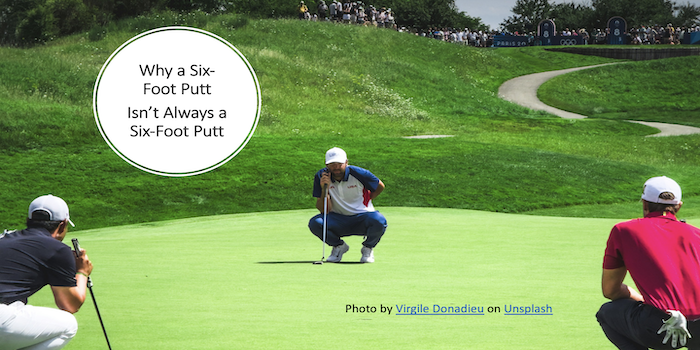
Intriguingly, Pope and Schweitzer’s research also revealed a dynamic aspect to this bias. The difference in putting success between par and birdie putts, while persistent, decreased as tournaments progressed. The gap narrowed from approximately 3.8 percentage points in the first round to 2.1 percentage points in the final round. However, the phenomenon never entirely disappeared, suggesting its deep-rooted nature.
The researchers posited that this reduction in the loss aversion effect during later rounds could be attributed to a shift in a golfer’s focus. In the early stages of a tournament, golfers may be more attuned to their score relative to par. As the competition intensifies and the final round approaches, their attention often shifts to their standing relative to other players on the leaderboard. The desire to outperform competitors can, to some extent, mitigate the personal sting of missing a putt for birdie versus the more immediate threat of losing a stroke to par.
Implications Beyond the Fairway
The findings from Pope and Schweitzer’s study carry significant implications far beyond the golf course. The fact that highly experienced professionals, competing under immense pressure with substantial financial stakes, are susceptible to loss aversion underscores its pervasive influence on human behavior.
This research challenges simplistic notions of decision-making as purely rational. It demonstrates that even individuals with extensive practice, rigorous training, and significant experience can be swayed by the psychological framing of choices.
The principle of loss aversion is closely aligned with Robert Cialdini’s well-established principle of scarcity. While scarcity is often associated with external factors – such as a salesperson highlighting limited stock or a website announcing a rapidly expiring sale – the research on golf reveals an internal form of scarcity: the potential loss of a valuable stroke. In this scenario, the golfer’s intense desire to avoid losing a stroke can be a more powerful motivator than the prospect of gaining one.
Understanding Ethical Influence: Awareness and Truthful Communication
The profound impact of loss aversion on decision-making offers valuable insights into the dynamics of ethical influence. The goal, as Brian Ahearn, Chief Influence Officer at Influence PEOPLE and faculty member at the Cialdini Institute, emphasizes, is not to manipulate individuals by exploiting their fear of loss. Instead, it is about cultivating an awareness of how people naturally make decisions and then communicating relevant information truthfully and effectively.
This awareness allows for more impactful and ethical communication. For instance, when presenting options, understanding that people react more strongly to potential losses can inform how information is framed. This does not imply fabricating threats or creating false urgency. Rather, it suggests that highlighting what could be lost – whether it’s a valuable opportunity, a current advantage, or a desired outcome – can be a powerful motivator when done authentically.
A Call to Self-Reflection
The lessons from the golf course extend to our everyday lives and professional interactions. The next time an important decision arises, it is beneficial to engage in a moment of self-reflection:
- Am I pursuing something I genuinely desire, or am I primarily reacting to the fear of losing something I already possess?
- Is the perceived urgency driven by an authentic scarcity of opportunity, or by an amplified fear of a potential negative outcome?
Recognizing the influence of loss aversion can lead to more considered and deliberate choices. It encourages us to distinguish between genuine opportunities and the psychological pull of avoiding perceived deficits. The distinction can be far more significant than we might initially realize, shaping our actions and ultimately our outcomes.
A Question for the Golfers
For those who play golf, the question posed by the research is a direct one: Do you experience a tangible difference in your mindset and execution when standing over a six-foot putt for birdie versus a six-foot putt for par? Anecdotal evidence from golfers often suggests a heightened sense of pressure and a more cautious approach when the putt is for par, reinforcing the psychological distinction illuminated by the data.
The BMW Championship, with its high-stakes drama and clutch performances, serves as a vivid illustration of how even the most skilled individuals are influenced by the subtle yet powerful currents of human psychology. Understanding principles like loss aversion allows us to better comprehend our own decision-making processes and to communicate with greater clarity and ethical effectiveness. As the game of golf itself demonstrates, sometimes the most significant challenges are not physical, but deeply rooted in the landscape of the human mind.
