

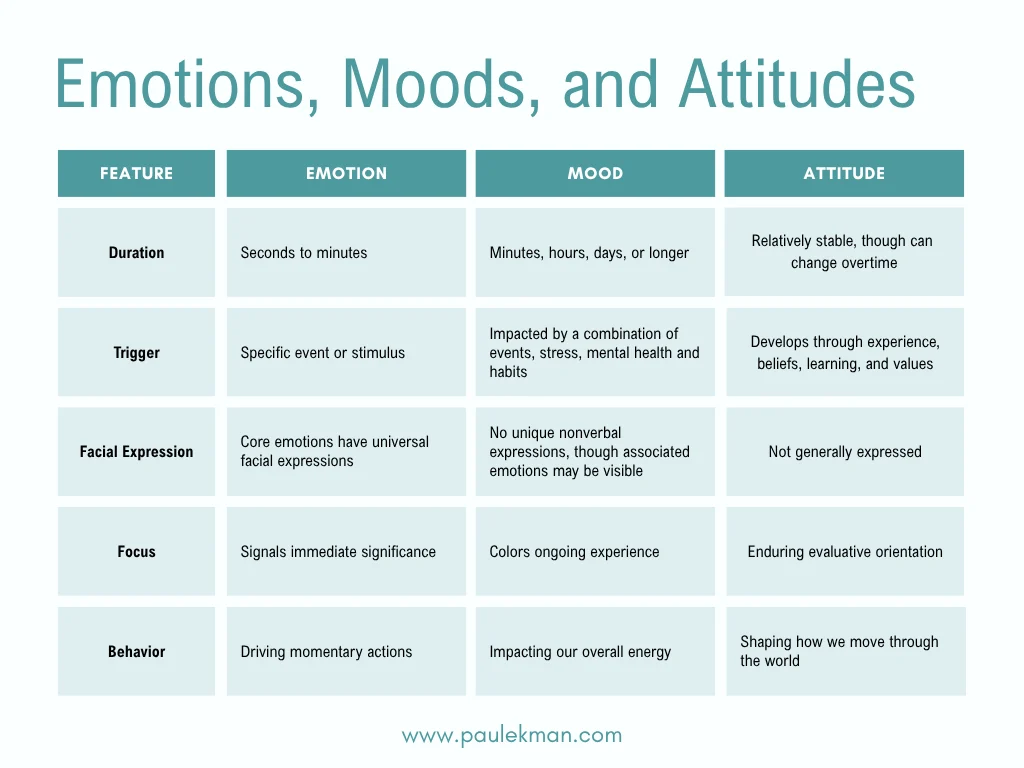
Building upon previous discussions that delineated the distinctions between moods and emotions, this comprehensive exploration expands the discourse to encompass a third crucial psychological construct: attitudes. These three interconnected elements—emotions, moods, and attitudes—collectively sculpt our subjective experience of ourselves and the world around us. While they operate on varying temporal scales and fulfill distinct psychological functions, grasping their intricate interplay can significantly enhance emotional awareness, refine emotional regulation strategies, and foster a more profound understanding of our habitual patterns of thought and behavior.
The Fleeting Nature of Emotions
Emotions are fundamentally an automatic appraisal process, deeply influenced by both our evolutionary heritage and the sum of our individual life experiences. They are typically triggered by events that hold significant meaning in relation to our goals, needs, or overall well-being. Upon their activation, emotions initiate a cascade of coordinated psychological and physiological changes designed to prepare us for action. By their very nature, emotions are relatively brief, often transient states, with durations ranging from mere fractions of a second to several minutes. This rapid onset and short lifespan are characterized by pervasive bodily changes, encompassing alterations in physiological functions, such as heart rate and respiration, and distinct facial expressions. These immediate, often involuntary, responses serve to alert us to situations requiring urgent attention and facilitate adaptive reactions. Research by Paul Ekman, a pioneer in the study of emotions, has identified universal facial expressions associated with core emotions like happiness, sadness, anger, fear, surprise, and disgust, underscoring a biological basis for these immediate affective responses.
The Lingering Influence of Moods
In contrast to the fleeting intensity of emotions, moods possess a more pervasive and enduring quality. Moods are described as diffuse affective states that can persist for hours, days, or even longer. A key differentiator from emotions is that moods often lack a clearly identifiable trigger or specific object of focus. We may awaken in a particular mood, or find ourselves gradually slipping into one without a discernible external cause. Unlike the distinct facial manifestations often associated with emotions, moods typically do not elicit such pronounced outward expressions. However, subtle indicators such as shifts in muscle tension, posture, or energy levels can betray a prevailing mood. Rather than being a direct response to a singular situation, moods function more as an emotional backdrop, subtly coloring our perception of the world. They can influence the ease with which specific emotions are triggered, shape our interpretations of events and social interactions, and consequently impact our cognitive processes throughout the day. Studies in affective science have indicated that prolonged exposure to stressors can contribute to the development of negative mood states, which in turn can exacerbate susceptibility to experiencing negative emotions.
The Enduring Framework of Attitudes
Attitudes, unlike emotions and moods, are not transient emotional states themselves. Instead, they represent relatively stable and enduring evaluations of people, ideas, objects, behaviors, or experiences. Psychologists commonly conceptualize attitudes as comprising a tripartite structure, often referred to as the ABC model: Affect (emotional associations), Behavior (tendencies to act in certain ways), and Cognition (beliefs and thoughts). For instance, an individual’s attitude towards public speaking might encompass beliefs such as "It’s a crucial skill for career advancement" (Cognition), emotional memories of past positive or negative speaking experiences (Affect), and a behavioral inclination to either actively seek opportunities to speak or to rigorously avoid them (Behavior). Attitudes can be further categorized as explicit, meaning they are consciously held and readily articulated, or implicit, representing unconscious biases or predispositions that nonetheless exert influence on our thoughts and actions. Research in social psychology has demonstrated that implicit attitudes, often measured through techniques like the Implicit Association Test (IAT), can predict behavior even when they contradict explicit beliefs, highlighting their significant, albeit subconscious, impact.
While generally more stable than emotions or moods, attitudes are not immutable. They are cultivated over time through a confluence of factors including repeated emotional experiences, learned associations (via classical and operant conditioning), prevailing social and cultural norms, interpersonal relationships, and introspective reflection. New experiences possess the capacity to either reinforce existing attitudes, diminish their intensity, or gradually reshape them. Crucially, attitudes are always directed toward a specific target—be it a person, an object, a policy, an event, or even one’s own emotional responses. Because attitudes function as evaluative lenses, they significantly influence how we interpret new information and how we tend to respond to various stimuli, thereby shaping our overall experience of the world.
The Dynamic Interplay: How They Influence One Another
Despite their distinct conceptualizations, emotions, moods, and attitudes are in a perpetual state of interaction, dynamically influencing each other.
The Synergy of Mood and Emotion
Our prevailing mood significantly modulates the likelihood of experiencing specific emotions and the intensity with which they are felt. For example, an individual in an generally upbeat mood may find it easier to recover from transient moments of frustration, experiencing less prolonged negative impact. Conversely, someone in an irritable mood might react with disproportionate intensity to minor setbacks. The accumulation of a series of short-lived, intense emotional episodes, such as periods of worry or frustration, can coalesce to form a more prolonged post-condition, manifesting as an anxious or irritable mood. This feedback loop underscores how transient emotional experiences can contribute to the formation and maintenance of broader affective states. Scientific literature on mood congruence suggests that individuals in a positive mood are more likely to recall positive memories and interpret ambiguous information favorably, while those in a negative mood exhibit the opposite pattern.
Attitudes as Mediators and Influences
Attitudes serve as both a shaper of and a recipient of our emotional experiences. Consider two individuals receiving identical constructive feedback. One, holding a positive attitude towards feedback as a valuable learning opportunity, might experience excitement and a motivation to improve. The other, viewing feedback as a personal threat, may experience anxiety and annoyance. The objective situation remains constant, but their pre-existing attitudes dictate their subjective evaluation and, consequently, the emotional responses they elicit. This illustrates how attitudes act as filters, predisposing individuals to interpret events in ways that align with their established beliefs and values. Furthermore, attitudes themselves are often imbued with emotional components, creating a strong affective link that reinforces their stability.
The Critical Role of Attitudes Towards Emotions
A particularly significant category of attitudes is our stance toward emotions themselves. We may develop beliefs that anger is inherently destructive, sadness signifies weakness, fear necessitates suppression, or joy should always be exuberantly expressed. These attitudes are frequently forged over years through family upbringing, cultural conditioning, educational experiences, and personal histories. Our attitudes toward emotions profoundly influence our willingness to acknowledge, accept, express, and learn from them. These internalized beliefs also intersect with the concept of "display rules," which are socially learned norms governing the appropriateness of emotional expression in specific contexts and toward particular individuals. While certain facial expressions of emotion are considered universal across human populations, display rules often exhibit considerable cultural variation, leading to observable differences in emotional expression worldwide. For instance, in some cultures, overt displays of grief are accepted and even encouraged, while in others, a more stoic demeanor is expected.
Cultivating Deeper Emotional Awareness
At the Paul Ekman Group, a core tenet is that cultivating robust emotional awareness begins with the practice of observing one’s internal experiences with enhanced clarity and a spirit of curiosity. By diligently recognizing our emotions, comprehending the moods that influence their emergence, and becoming cognizant of the attitudes that shape our interpretations, we are empowered to respond to ourselves and to others with greater wisdom and compassion. The development of these invaluable skills is an ongoing process that requires dedicated practice and can be significantly strengthened over time.
For individuals seeking to further explore the scientific underpinnings of emotion and enhance their emotional intelligence, the Paul Ekman Group offers a range of research-based resources. These include workshops and online courses designed to provide practical tools and theoretical frameworks for understanding and managing emotions. The organization also publishes a wealth of articles and research findings on its website, delving into topics such as universal emotions, facial expressions, and the science of empathy. These resources aim to equip individuals with the knowledge and skills necessary to navigate the complexities of their inner world and foster more effective interpersonal relationships. By fostering a deeper understanding of these fundamental psychological constructs, individuals can embark on a journey toward greater self-mastery and more meaningful connections with others.
