

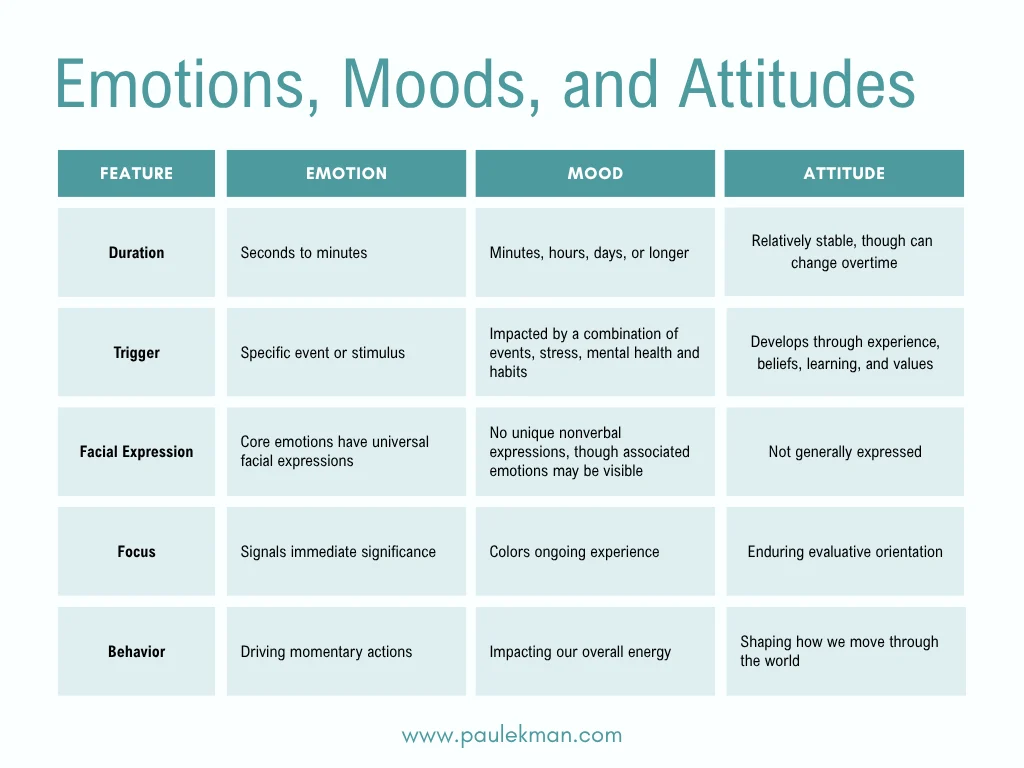
The intricate tapestry of human experience is woven from threads of emotion, mood, and attitude, concepts often conflated yet distinct in their psychological function and temporal impact. Building upon foundational distinctions between moods and emotions, this exploration delves into the multifaceted nature of attitudes, examining how these three core psychological constructs interact to shape our perceptions, reactions, and overall engagement with the world. Understanding these dynamics is paramount for cultivating deeper self-awareness, enhancing emotional regulation, and fostering more insightful interpretations of our cognitive and behavioral patterns.
The Fleeting Intensity of Emotions
Emotions are rapid, automatic appraisal processes, deeply rooted in our evolutionary heritage and shaped by individual life experiences. They are triggered by events perceived as significant in relation to our personal goals, needs, or overall well-being. When a stimulus aligns with or threatens these fundamental aspects of our existence, a cascade of coordinated psychological and physiological changes ensues. These changes are designed to prepare us for immediate action or response.
By their very nature, emotions are transient, typically lasting from mere fractions of a second to a few minutes. This brevity is a critical characteristic, allowing for swift adaptation to evolving circumstances. The physiological manifestations of emotions are profound and observable, encompassing alterations in heart rate, respiration, hormonal release, and, crucially, distinct facial expressions. Research, notably the work pioneered by Paul Ekman, has identified universal facial expressions associated with core emotions such as joy, sadness, anger, fear, surprise, and disgust, suggesting a biological undergirding for these fundamental affective states. These expressions serve as powerful communication signals, conveying our internal state to others and influencing social interactions. The speed and intensity of emotional responses are vital for survival, enabling rapid detection of threats and opportunities. For instance, a sudden surge of fear, accompanied by a widening of the eyes and a gasp, signals immediate danger and prompts a fight-or-flight response.
The Pervasive Influence of Moods
In contrast to the sharp, focused nature of emotions, moods represent more diffuse and enduring affective states. They can persist for hours, days, or even longer, creating a pervasive emotional backdrop against which daily life unfolds. A key distinction lies in their triggers: moods often lack a clearly identifiable, specific event or object. An individual might wake up feeling "down" or "upbeat" without a concrete reason, or find themselves gradually slipping into a particular mood over the course of a day. This lack of a precise origin makes moods more elusive and challenging to pinpoint than emotions.
While emotions are characterized by distinct physiological changes and facial expressions, moods typically do not elicit such pronounced outward signals. However, subtle indicators may be present, such as changes in posture, muscle tension, or overall energy levels. A person in a low mood might exhibit slumped shoulders and a slower gait, while someone in a more energetic mood might appear more animated and engaged.
The primary function of moods is not to prepare for an immediate, specific action, but rather to influence the overall tenor of our experience. They act as a filter, affecting the ease with which certain emotions are triggered and shaping how we interpret events, social interactions, and even our own thoughts. For example, a person in an irritable mood is more likely to perceive minor inconveniences as significant annoyances and react with disproportionate anger. Conversely, someone in a cheerful mood might be more forgiving and optimistic, finding the silver lining in challenging situations. This pervasive influence means that moods can significantly impact decision-making, productivity, and interpersonal relationships over extended periods.
The Enduring Framework of Attitudes
Attitudes, unlike emotions and moods, are not primarily emotional states. Instead, they are relatively stable evaluations or judgments about people, ideas, objects, behaviors, or experiences. These evaluations are formed over time and are composed of three interconnected components, often described by the ABC model of attitudes:
- Affective Component: This refers to the emotional associations or feelings linked to the attitude object. For instance, an attitude towards a particular food might involve feelings of pleasure or disgust.
- Behavioral Component: This encompasses the tendency to act in a certain way towards the attitude object. An attitude of liking a specific brand of car might lead to a predisposition to purchase that brand.
- Cognitive Component: This involves the beliefs, thoughts, and knowledge one holds about the attitude object. An attitude towards environmental protection might be based on beliefs about climate change and its consequences.
Attitudes can be further categorized as explicit or implicit. Explicit attitudes are those we are consciously aware of and can readily report, such as our stated preference for a political candidate. Implicit attitudes, on the other hand, are unconscious biases or preferences that, despite a lack of conscious awareness, can significantly influence our behavior and judgments. For example, implicit biases regarding certain demographic groups can lead to differential treatment, even when individuals consciously believe they are acting impartially.
The development of attitudes is a dynamic process, influenced by a confluence of factors. Repeated emotional experiences, learning through classical and operant conditioning, observation of others, social and cultural norms, and personal reflection all contribute to shaping our evaluative frameworks. While attitudes are generally more enduring than emotions or moods, they are not immutable. New experiences, persuasive communication, and deliberate self-reflection can gradually strengthen, weaken, or even fundamentally reshape them.
Crucially, attitudes are always directed towards a specific target. We hold attitudes about public speaking, environmental policies, specific individuals, or even our own emotional responses. Because attitudes act as an evaluative lens, they profoundly influence how we interpret new information, assess situations, and anticipate outcomes. They provide a framework for making sense of the world and guiding our actions within it.
The Interplay: A Dynamic Ecosystem of Influence
While emotions, moods, and attitudes are distinct psychological constructs, they exist in a constant state of dynamic interaction, influencing and being influenced by one another in a complex feedback loop.
Moods as Emotional Catalysts
The prevailing mood significantly impacts the likelihood and intensity of emotional responses. An individual in an upbeat or positive mood is often more resilient to minor frustrations; they may experience a brief flicker of annoyance but quickly return to their baseline state. Conversely, someone in an irritable or negative mood is more susceptible to triggering emotions like anger or resentment in response to even minor setbacks. The cumulative effect of a series of short-lived, intense emotions—such as prolonged worry or frustration—can coalesce into a more persistent, generalized mood state, such as anxiety or irritability. This highlights how transient emotional experiences can, over time, contribute to the formation and maintenance of broader mood patterns.
Attitudes as Interpreters of Experience
Attitudes play a pivotal role in mediating our emotional responses to events. Consider two individuals receiving identical constructive criticism on a project. Person A, who holds a positive attitude towards feedback as a growth opportunity, may experience feelings of motivation and engagement, viewing the feedback as a chance to improve. Person B, however, harboring an attitude that views feedback as a personal threat or indictment of their capabilities, might experience anxiety, defensiveness, and annoyance. The external stimulus is the same, but their pre-existing attitudes dictate how they interpret the situation and, consequently, the emotions they experience. This demonstrates how our evaluative frameworks can amplify or dampen emotional reactions, shaping our subjective experience of reality.
Attitudes Towards Emotions: A Meta-Layer of Influence
A particularly significant area of interaction involves our attitudes toward emotions themselves. These "meta-attitudes" reflect our beliefs about the validity, appropriateness, and value of different emotional states. For example, an individual might hold the attitude that anger is inherently dangerous and destructive, or that sadness signifies weakness, or that fear should always be suppressed. Conversely, they might believe that joy should be openly expressed or that vulnerability is a sign of strength.
These attitudes are often cultivated over years through familial upbringing, cultural conditioning, educational experiences, and personal history. They profoundly influence how we engage with our own emotional lives. If we hold a negative attitude towards sadness, we may be less inclined to acknowledge, explore, or seek support when experiencing it, potentially leading to emotional suppression. Conversely, a positive attitude towards emotional expression might foster greater openness and a willingness to learn from our feelings.
These attitudes also intersect with the concept of "display rules"—socially learned norms that dictate how, when, and to whom emotional expressions are appropriate. While the facial expressions of universal emotions are biologically ingrained, the cultural and social contexts in which they are displayed vary significantly. For instance, in some cultures, overt displays of grief are expected and encouraged, while in others, stoicism is valued. Our attitudes towards emotions, shaped by these display rules, influence our willingness to express them, thus impacting cross-cultural communication and understanding.
Cultivating Emotional Intelligence: A Path Forward
At the Paul Ekman Group, a core tenet is that the journey toward enhanced emotional intelligence begins with the cultivation of clear and curious observation of our internal experiences. By developing the capacity to recognize and label our emotions accurately, to understand the pervasive influence of our moods, and to become aware of the attitudes that shape our interpretations, individuals can foster more adaptive and compassionate responses to themselves and to others.
The development of these critical skills is an ongoing process that requires consistent practice. Through dedicated effort, these capacities can be significantly strengthened over time. For those seeking to deepen their understanding of the science of emotion and enhance their emotional awareness, the Paul Ekman Group offers a suite of research-based resources designed to support this personal growth. These resources are grounded in decades of scientific inquiry into human emotion, providing practical tools and insights for navigating the complexities of our inner lives and interpersonal relationships. By mastering these distinctions, individuals can build a more robust foundation for emotional resilience, effective communication, and a richer, more nuanced experience of the world.
