

The acquisition of numerical literacy in the Turkish language serves as a fundamental pillar for international residents, investors, and tourists seeking to navigate the Republic of Turkey’s domestic landscape. Whether facilitating commercial transactions in the Grand Bazaar, exchanging contact information within the burgeoning tech sectors of Istanbul and Ankara, or managing daily logistics such as timekeeping and transportation, a command of Turkish numbers is indispensable. As Turkey continues to position itself as a bridge between Occident and Orient, the linguistic architecture of its counting system reflects a logical, mathematical precision that facilitates rapid learning for those familiar with the Latin alphabet and the decimal system.
The Historical Evolution of Turkish Numerals
To understand the modern Turkish numerical system, one must look to the radical linguistic shifts of the early 20th century. Prior to the 1928 "Letter Reform" (Harf Devrimi) led by Mustafa Kemal Atatürk, the Ottoman Empire utilized a Perso-Arabic script. Numbers were often written using the Abjad system or Arabic numerals in their Eastern forms. The transition to the Latin-based Turkish alphabet not only modernized the nation’s literacy rates but also standardized the way numbers were written and spoken, aligning Turkish mathematical notation with international Western standards.
This transition was part of a broader effort to secularize and streamline the state’s administrative functions. Today, Turkish numbers are written using Arabic numerals (1, 2, 3…), but their phonetic expression remains deeply rooted in Turkic linguistic heritage. Unlike some European languages that feature irregular counting patterns (such as the French "soixante-dix" for seventy), the Turkish system is strictly additive and highly consistent, making it one of the most accessible numerical systems for foreign learners.
The Foundational Building Blocks: 1 through 10
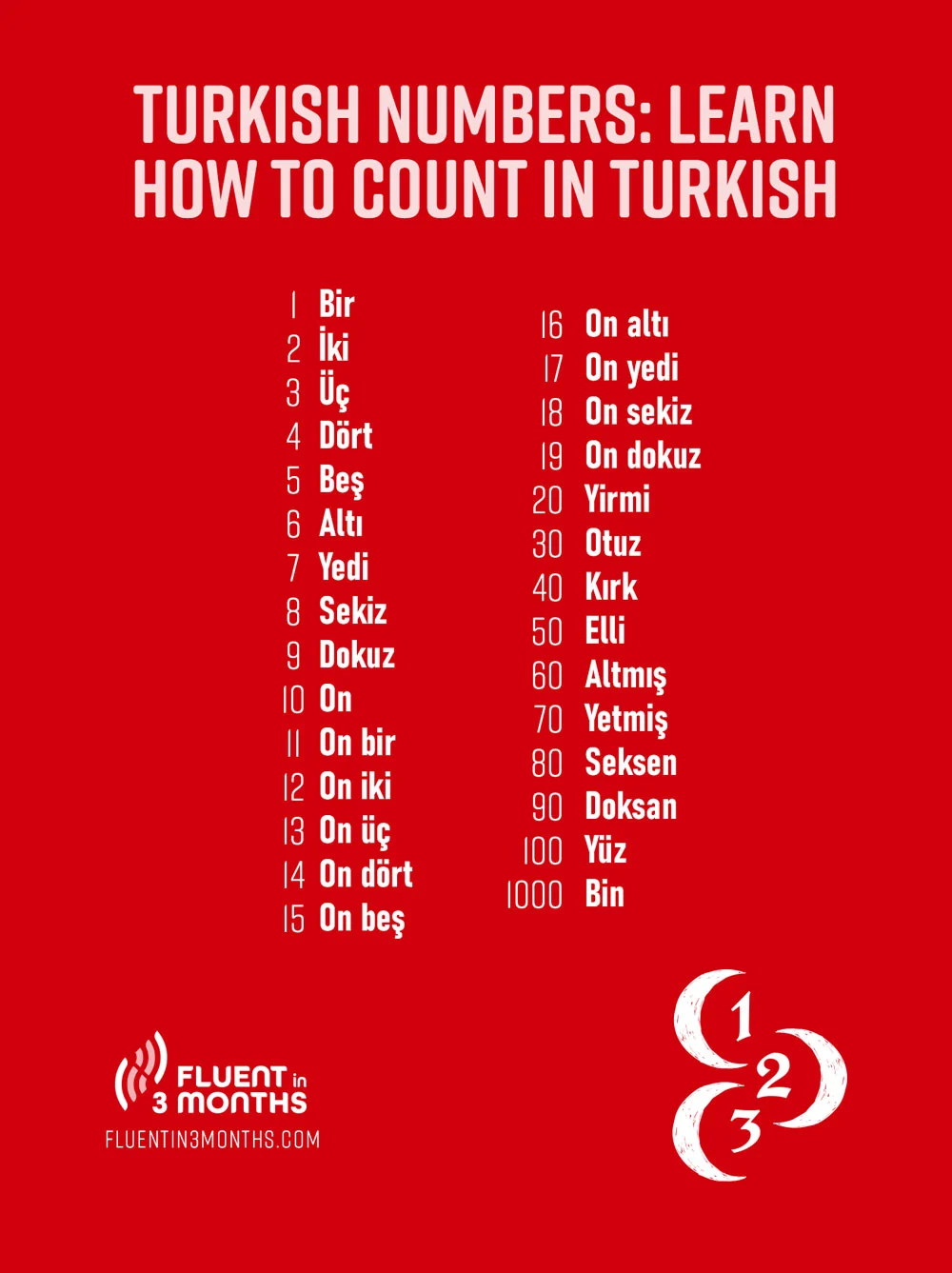
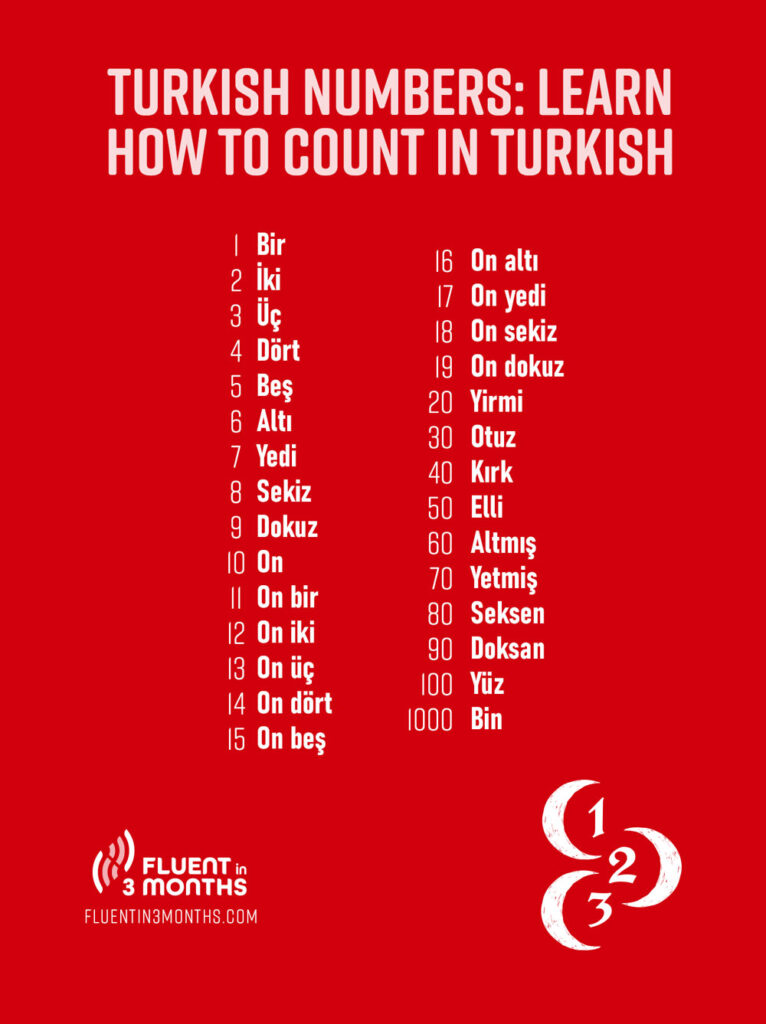
The core of the Turkish numbering system is comprised of ten primary digits. These monosyllabic and disyllabic words form the basis for all higher-order calculations. In a journalistic or commercial context, precision in these ten digits prevents errors in fundamental transactions.
- Bir (One)
- İki (Two)
- Üç (Three)
- Dört (Four)
- Beş (Five)
- Altı (Six)
- Yedi (Seven)
- Sekiz (Eight)
- Dokuz (Nine)
- On (Ten)
Language experts note that the pronunciation of these digits is phonetic. For instance, the number four (dört) and the number three (üç) utilize specific Turkish vowels—the "ö" and "ü"—which require rounded lips, a hallmark of the Ural-Altaic language family.
Logical Progression: 11 through 99
Turkish follows a transparent "Ten + Digit" logic for numbers between 11 and 19. This eliminates the need for unique words like the English "eleven" or "twelve." By simply placing the word for ten (on) before the single digit, the number is formed:
- 11: On bir
- 12: On iki
- 15: On beş
- 19: On dokuz
As the scale increases to the tens, the system remains strictly modular. To master the range from 20 to 90, a learner must memorize eight specific words. Once these are acquired, any intermediate number is created by adding the single digit after the ten-unit.
The Tens Scale:
- 20: Yirmi
- 30: Otuz
- 40: Kırk
- 50: Elli
- 60: Altmış
- 70: Yetmiş
- 80: Seksen
- 90: Doksan
For example, to express the number 45, one combines kırk (40) and beş (5), resulting in kırk beş. This consistency is a significant advantage in fast-paced environments, such as the Istanbul Stock Exchange or regional logistics hubs, where numerical clarity is paramount.
Scaling Up: Hundreds, Thousands, and Beyond
The Turkish approach to large numbers is equally systematic. The word for one hundred is yüz. To express multiples of a hundred, one simply places the multiplier before the word yüz.
- 100: Yüz
- 200: İki yüz
- 500: Beş yüz
- 900: Dokuz yüz
Intermediate numbers follow the same additive rule. The number 235 is expressed as iki yüz otuz beş (two hundred + thirty + five).
The word for one thousand is bin. Following the same logic as the hundreds:
- 1,000: Bin
- 2,000: İki bin
- 10,000: On bin
- 100,000: Yüz bin
In 2005, Turkey underwent a significant currency revaluation, removing six zeros from the Turkish Lira. This historical event shifted the daily use of numbers from the millions back down to the thousands and hundreds, a move that economists argue simplified domestic accounting and reduced psychological barriers to trade.
Ordinal Numbers and the Rule of Vowel Harmony
In Turkish, expressing sequence (first, second, third) requires the addition of suffixes. This introduces the linguistic concept of "Vowel Harmony," where the suffix must match the vowel sound of the base number. The suffixes used are -ıncı, -inci, -uncu, or -üncü.
- 1st: Birinci (bir + inci)
- 2nd: İkinci (iki + nci)
- 3rd: Üçüncü (üç + üncü)
- 4th: Dördüncü (dört + üncü)
- 10th: Onuncu (on + uncu)
This grammatical nuance is essential for formal documentation, such as identifying the floor of a building, the rank of a corporate official, or the specific day in a chronological sequence of events.
Practical Applications in the Turkish Economy
1. Currency and Financial Transactions
The Turkish Lira (TL) and its subunit, the Kuruş (kr), dictate daily commerce. A price of 15.50 TL is spoken as on beş lira elli kuruş. A critical data point for international observers is the Turkish use of punctuation in mathematics: Turkey uses a comma (,) as a decimal separator and a period (.) as a thousands separator. Therefore, one million is written as 1.000.000,00. Misinterpreting this can lead to significant errors in contractual agreements or financial reporting.
2. Temporal Logistics
Timekeeping in Turkey operates on both 12-hour and 24-hour cycles. In formal broadcasts, military operations, and transportation schedules (TCDD railways or Turkish Airlines), the 24-hour clock is standard.
- 09:00: Saat dokuz
- 18:30: Saat on sekiz otuz
Informally, the terms buçuk (half) and çeyrek (quarter) are used. For example, 10:30 is saat on buçuk. Understanding these nuances is vital for punctuality in a culture that, while hospitable, values professional timeliness in its modern corporate sector.
3. Telecommunications and Identity
Turkish mobile numbers consist of a three-digit area code (starting with 5) followed by a seven-digit number. They are typically recited in a 3-2-2 grouping pattern. For instance, 05XX XXX XX XX would be spoken as "five hundred [X], [XX] hundred, [XX], [XX]." Furthermore, the T.C. Kimlik Numarası (Republic of Turkey Identity Number) is an 11-digit string required for everything from opening a bank account to receiving medical care. Mastery of numbers allows residents to dictate these crucial digits without administrative friction.
Demographic and Social Context
In social interactions, age and measurements are frequent topics of conversation. Age is expressed using the phrase yaşındayım (I am [X] years old). For example, "I am thirty years old" is otuz yaşındayım.
In the culinary and manufacturing sectors, the metric system is universal. Quantities are expressed in kilo (kilograms), gram (grams), or litre (liters). A typical market request might be iki kilo elma (two kilos of apples), demonstrating the immediate utility of the "Number + Unit" structure.
Implications for Integration and Diplomacy
The clarity of the Turkish numerical system reflects a broader cultural emphasis on logic and directness in communication. For the expatriate community—which has grown significantly in hubs like Antalya, Izmir, and Istanbul—linguistic integration begins with numbers. Data from language learning platforms suggests that students who master Turkish numbers within the first month of study report a 40% higher confidence level in navigating local markets and public services.
From a diplomatic and macro-economic perspective, the standardization of the Turkish numbering system facilitates smoother integration into the Customs Union and other international frameworks. As Turkey expands its footprint in global construction and textile exports, the ability of its workforce to communicate measurements and values in a universally understood decimal format remains a key competitive advantage.
Conclusion
The Turkish numerical system is a testament to the country’s successful modernization and its commitment to logical, structured communication. By moving away from the complexities of the past and embracing a transparent, additive system, Turkey has made its language accessible to the global community. For the traveler, the businessman, or the diplomat, these numbers are more than just mathematical tools; they are the keys to unlocking a deeper understanding of one of the world’s most dynamic and historically rich nations. Mastering them is not merely a linguistic exercise but a strategic necessity for anyone looking to engage seriously with the Republic of Turkey.
