

The strategic acquisition of high-frequency vocabulary serves as the primary catalyst for achieving functional literacy in any foreign tongue, and Turkish—a language spoken by over 80 million people globally—is no exception. For contemporary learners, the challenge lies not in the memorization of an exhaustive lexicon, but in identifying the core building blocks that facilitate daily communication. Linguistic research consistently demonstrates that mastering the top 1,000 most common words in a language can provide a learner with the ability to understand approximately 75% to 80% of daily spoken interactions. This report delineates the essential categories of the Turkish language, providing a structured framework for beginners to navigate social, professional, and domestic environments effectively.
The Historical and Linguistic Evolution of Modern Turkish
To understand the current state of the Turkish lexicon, one must look to the radical linguistic transformation that occurred in the early 20th century. Following the establishment of the Republic of Turkey, the 1928 Alphabet Reform, led by Mustafa Kemal Atatürk, replaced the Arabic-based Ottoman script with a modified Latin alphabet. This "Language Revolution" (Dil Devrimi) aimed to increase literacy rates and "purify" the language by replacing many Persian and Arabic loanwords with Turkic roots.
Today, Turkish is categorized as an agglutinative language within the Turkic language family. Unlike English, which relies heavily on word order and independent prepositions, Turkish utilizes a sophisticated system of suffixes to indicate tense, possession, and mood. This structural uniqueness makes the mastery of basic nouns and verbs particularly critical, as these words serve as the anchors for various grammatical attachments.
Essential Social Protocols: Greetings and Polite Expressions
In Turkish culture, social harmony and respect are paramount, often reflected in a complex array of greetings and polite formulas. These phrases are not merely functional but serve as essential social lubricants in both formal and informal settings.
The standard greeting, Merhaba (Hello), remains the most versatile entry point for any conversation. For more informal settings among peers, Selam (Hi) is widely accepted. As the day progresses, speakers transition through time-specific greetings: Günaydın (Good morning) and İyi akşamlar (Good evening).
Distinctions between formal and informal address are deeply embedded in the language. The concept of "Hoş geldin" (Welcome) is used for individuals or close acquaintances, whereas "Hoş geldiniz" is the mandatory plural or formal version used for guests, elders, or superiors. Similarly, when inquiring about one’s well-being, "Nasılsın?" (How are you?) is reserved for friends, while "Nasılsınız?" is used in formal contexts.
Beyond basic pleasantries, Turkish contains unique "social wish" phrases that lack direct English equivalents but are used daily:
- Kolay gelsin: Literally "May it come easy to you," used when passing someone who is working, whether they are a street sweeper or a corporate executive.
- Afiyet olsun: "Bon appétit" or "Enjoy your meal," used both before and after eating.
- Elinize sağlık: "Health to your hands," a specific compliment directed at the person who prepared a meal or performed manual work.
- Geçmiş olsun: "May it be past," used for illness, accidents, or any unfortunate event.
The Sociolinguistics of Turkish Kinship and People
Turkish kinship terms are significantly more specific than their English counterparts, reflecting the historical importance of the extended family structure. The language distinguishes between relatives on the maternal and paternal sides, a distinction that linguists note provides clarity in social hierarchy and inheritance traditions.
For instance, an uncle on the father’s side is Amca, while an uncle on the mother’s side is Dayı. Similarly, a paternal aunt is Hala, and a maternal aunt is Teyze. For siblings, Turkish distinguishes by age and gender: Abla (Older sister) and Abi (Older brother) are not just family terms but are used as respectful titles for older strangers or acquaintances in daily life.
General descriptors for people include:
- İnsan: Person
- Arkadaş: Friend
- Kadın: Woman
- Adam: Man
- Çocuk: Child
- Bebek: Baby
Navigating the Physical World: Food, Places, and Time
The Turkish economy and social life are heavily centered around gastronomy and urban navigation. Mastering high-frequency nouns in these categories allows learners to interact with the service industry and manage logistics independently.
Culinary Lexicon and the "False Friend" Phenomenon
Turkish cuisine is a point of national pride, and its vocabulary is foundational. Common terms include Ekmek (Bread), Su (Water), Çay (Tea), and Kahve (Coffee). Protein sources are identified as Et (Meat), Tavuk (Chicken), and Balık (Fish).
Linguists often warn students about "false friends"—words that look similar to English but carry different meanings. A notable example is Pasta. In English, pasta refers to noodles; in Turkish, Pasta means "Cake." The correct term for noodles or pasta is Makarna.
Urban Infrastructure
Navigating a Turkish city requires familiarity with key locations:
- Ev: House/Home
- Okul: School
- Hastane: Hospital
- Restoran: Restaurant
- Banka: Bank
- Havaalanı: Airport
Temporal Markers
To coordinate schedules, learners must master time-related vocabulary. Turkish follows a logical progression from the smallest unit to the largest: Saniye (Second), Dakika (Minute), Saat (Hour), Gün (Day), Hafta (Week), Ay (Month), and Yıl (Year). Relative time markers include Bugün (Today), Dün (Yesterday), Yarın (Tomorrow), and Şimdi (Now).
Structural Dynamics: Verbs and the SOV Word Order
The most significant hurdle for English speakers learning Turkish is the sentence structure. While English follows a Subject-Verb-Object (SVO) pattern (e.g., "I am learning Turkish"), Turkish utilizes a Subject-Object-Verb (SOV) pattern: Ben Türkçe öğreniyorum (Literally: "I Turkish learning-am").
High-Frequency Verbs
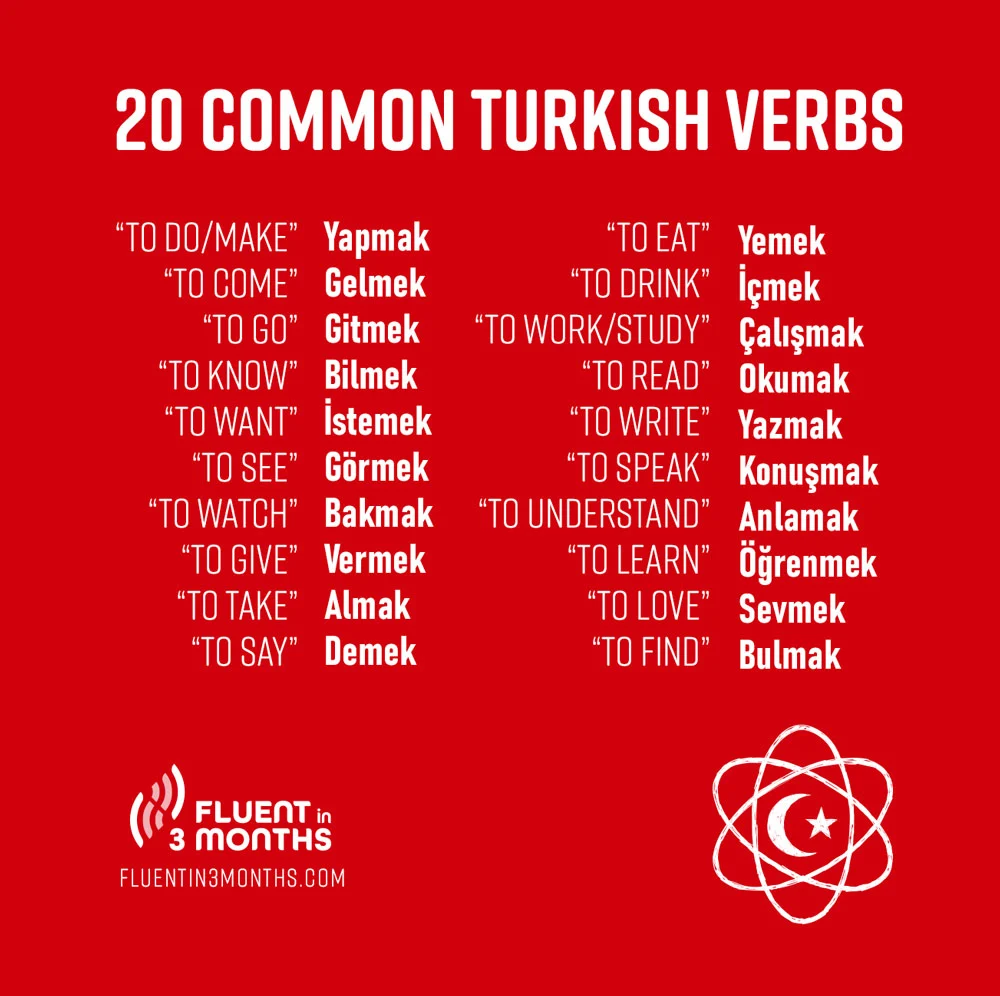
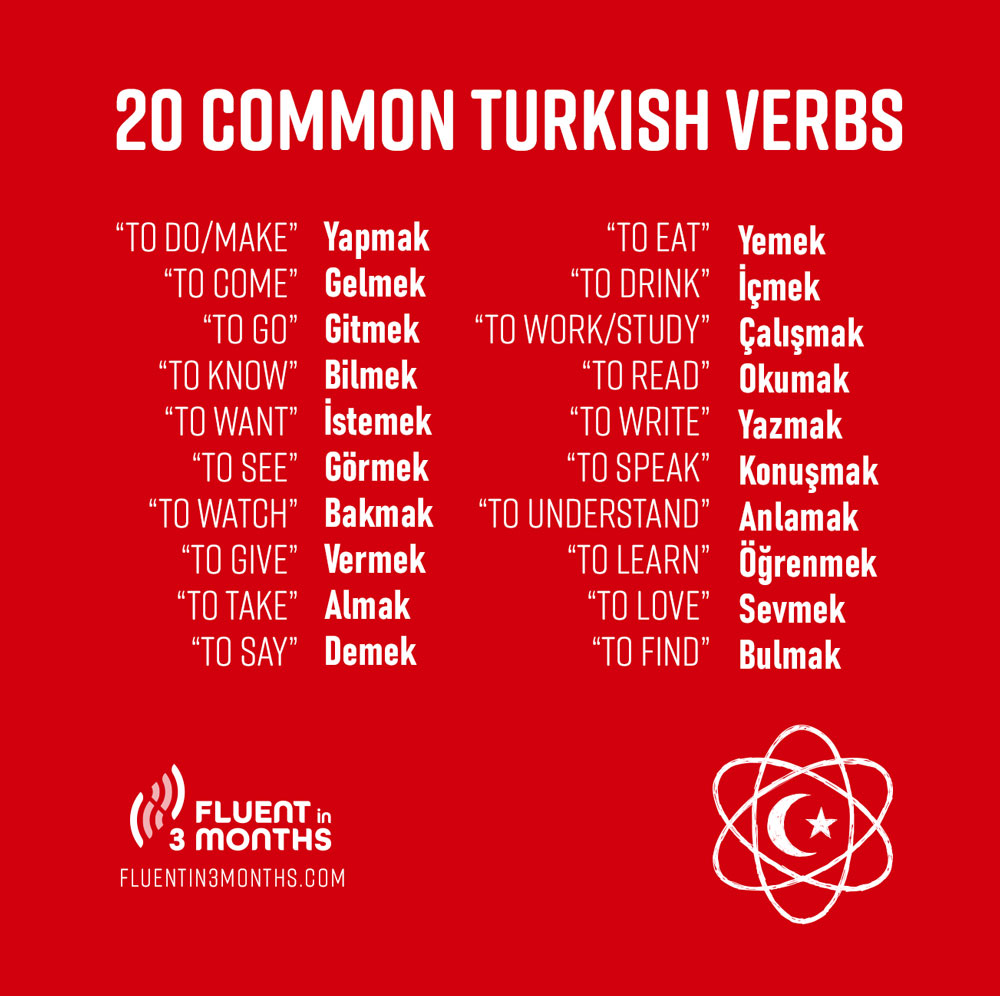
Verbs in their infinitive form end in -mak or -mek. Common verbs include:
- Yapmak: To do/make
- Gitmek: To go
- Gelmek: To come
- İstemek: To want
- Bilmek: To know
- Görmek: To see
- Çalışmak: To work/study
The Absence of "To Be" and "To Have"
In a notable departure from Indo-European languages, Turkish does not have a standalone verb for "to be" or "to have." These concepts are expressed through suffixes or existential particles. To say "I am a teacher," one adds the personal suffix to the noun: Öğretmenim. To express possession, Turkish uses the words Var (There is/exists) and Yok (There is not/does not exist). For example, "I have a car" is expressed as Arabam var (Literally: "My car exists").
Qualitative Description: Adjectives and Colors
Adjectives in Turkish are consistently placed before the noun they modify, mirroring the English structure. This provides a rare point of familiarity for Western learners.
Common Opposites
- Büyük / Küçük: Big / Small
- İyi / Kötü: Good / Bad
- Yeni / Eski: New / Old (for objects)
- Genç / Yaşlı: Young / Old (for people)
- Kolay / Zor: Easy / Difficult
- Pahalı / Ucuz: Expensive / Cheap
The Spectrum of Color
Colors often carry symbolic weight in Turkish culture. Kırmızı (Red) is the color of the national flag, while Turkuaz (Turquoise) is a word that actually derives from the French word for "Turkish." Basic colors include Mavi (Blue), Sarı (Yellow), Yeşil (Green), Beyaz (White), and Siyah (Black).
Functional Connectors and Interrogatives
Fluency is often defined by the ability to link thoughts and ask questions. Conjunctions such as Ve (And), Ama (But), Veya (Or), and Çünkü (Because) allow for the construction of complex sentences.
Question words are equally vital for information gathering:
- Ne? (What?)
- Kim? (Who?)
- Neden? (Why?)
- Nasıl? (How?)
- Nerede? (Where?)
- Ne zaman? (When?)
The "Dizi" Effect: Cultural Influence on Language Acquisition
In recent years, the global popularity of Turkish television dramas, known as Diziler, has created a new wave of informal language learners. This cultural export—now the second highest in the world after the United States—has introduced international audiences to "filler" words and emotional expressions.
Common "Dizi" vocabulary includes:
- Canım: My dear (Literally: "My life/soul")
- Aşkım: My love
- Tabii ki: Of course
- Hadi: Come on / Let’s go
- İnşallah: God willing (used generally to mean "I hope so")
- Maalesef: Unfortunately
Statistical Analysis and Broader Implications
According to data from the Turkish Statistical Institute and the Yunus Emre Institute, the number of foreigners learning Turkish has increased by over 300% in the last decade. This surge is attributed to Turkey’s growing role as a regional hub for trade, education, and medical tourism.
From a pedagogical perspective, the transition from "basic" to "intermediate" Turkish depends heavily on the learner’s ability to move beyond isolated vocabulary into the realm of suffixation. However, for the casual traveler or the business professional, the high-frequency word lists provided in this guide constitute the necessary foundation for most social and commercial interactions.
The broader impact of mastering these basics extends beyond simple communication. It fosters cultural empathy and facilitates deeper integration into a society that values the effort made by foreigners to speak its national tongue. As the Turkish language continues to expand its digital and cultural footprint, these linguistic "building blocks" will remain the essential starting point for any successful educational journey.
