

The resurgence of international travel to the Hellenic Republic has highlighted a growing necessity for linguistic preparation among global voyagers. As Greece continues to solidify its position as a premier destination for cultural tourism, the ability to navigate the nuances of the Modern Greek language—an Indo-European isolate with a documented history spanning over 3,400 years—has become a vital tool for meaningful engagement. Linguistic experts and travel industry analysts suggest that even a rudimentary grasp of "Survival Greek" can significantly enhance the quality of interaction between visitors and locals, fostering a deeper sense of mutual respect and facilitating smoother logistical transitions in both urban centers like Athens and remote island communities.
The Strategic Importance of Linguistic Preparation in Modern Tourism
Data from the Greek Ministry of Tourism indicates that the country welcomed over 32 million international visitors in recent years, contributing approximately 20% to the national Gross Domestic Product (GDP). Within this economic framework, the "hospitality gap"—the social distance between a tourist and a resident—is most effectively bridged through language. While English is widely spoken in major hospitality hubs, the use of Greek by foreigners is often viewed by locals as a gesture of profound cultural appreciation.
The Greek language is classified by the United States Foreign Service Institute (FSI) as a Category IV language, meaning it is significantly different from English and requires approximately 1,100 hours of study for professional proficiency. However, for the casual traveler or the business professional on a short-term assignment, the mastery of high-frequency phrases provides an immediate return on investment. These linguistic building blocks are essential for navigating social hierarchies, dining etiquette, and emergency situations.
Foundations of Social Interaction: Greetings and Formalities
In Greek society, social interactions are governed by a distinct sense of "philotimo"—a complex concept encompassing honor, hospitality, and doing the right thing. This begins with the correct use of greetings. Unlike the more egalitarian structures of some Western languages, Modern Greek maintains a clear distinction between formal and informal address.
The phrase "Yassas" (Γεια σας) serves as the formal or plural version of "Hello." It is the standard greeting for elders, professionals, and strangers. Conversely, "Ya sou" (Γεια σου) is reserved for friends, family, and children. Misusing these can lead to minor social friction, though Greeks are notoriously forgiving of linguistic errors made by foreigners.
Supporting this social framework are the essential particles of conversation: "Ne" (Ναι) for "Yes" and "Ochi" (Όχι) for "No." For English speakers, "Ne" often presents a phonetic challenge, as it sounds remarkably similar to the English word "No," leading to frequent misunderstandings during initial interactions. Rounding out the basic etiquette are "Parakalo" (Παρακαλώ) for "Please" and "Efcharisto" (Ευχαριστώ) for "Thank you," the latter of which is often considered the most important word in a traveler’s lexicon.
Navigating the Temporal Landscape: Situational Greetings
The Greek day is structured around specific temporal greetings that reflect the Mediterranean lifestyle. "Kalimera" (Καλημέρα), meaning "Good morning," is generally used until midday. As the afternoon progresses, "Kalispera" (Καλησπέρα) becomes the standard for "Good evening."
In professional and social settings, the transition from greeting to departure is equally codified. "Adio" (Αντίο) serves as a formal "Goodbye," while the more colloquial "Ta leme" (Τα λέμε) translates to "See you later" or "Speak soon." For those concluding an evening, "Kalinihta" (Καληνύχτα) is the requisite "Good night." Understanding these transitions is crucial for maintaining the flow of social commerce in Greece’s vibrant "plateias" (public squares).
Analytical Breakdown of Everyday Life and Transactional Greek
Beyond simple greetings, the functional application of the language involves transactional phrases. In the context of the Greek economy, where small businesses and independent tavernas predominate, the ability to inquire about costs and services is paramount.
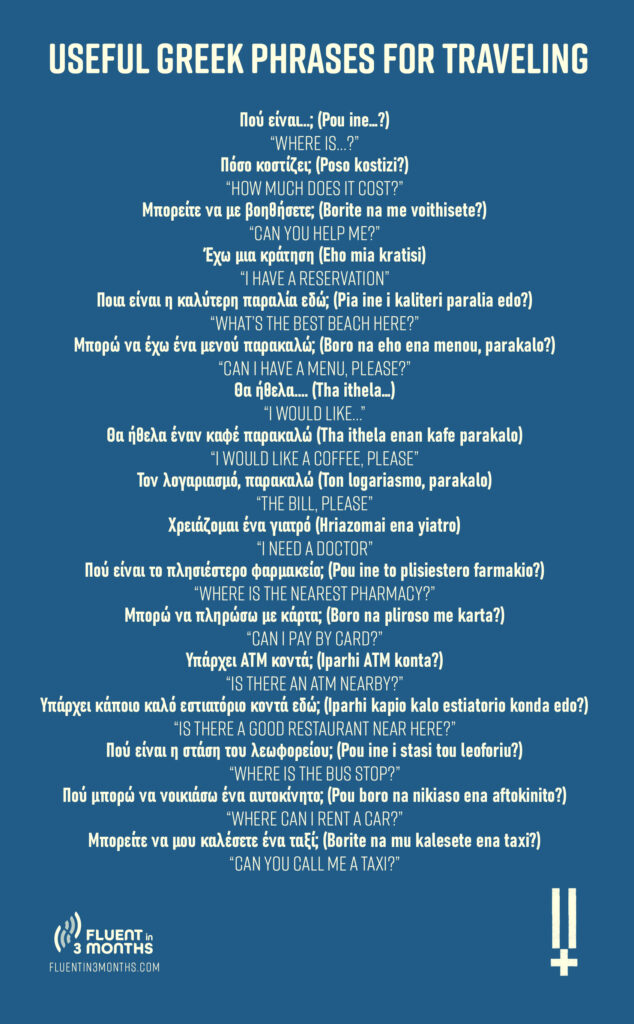
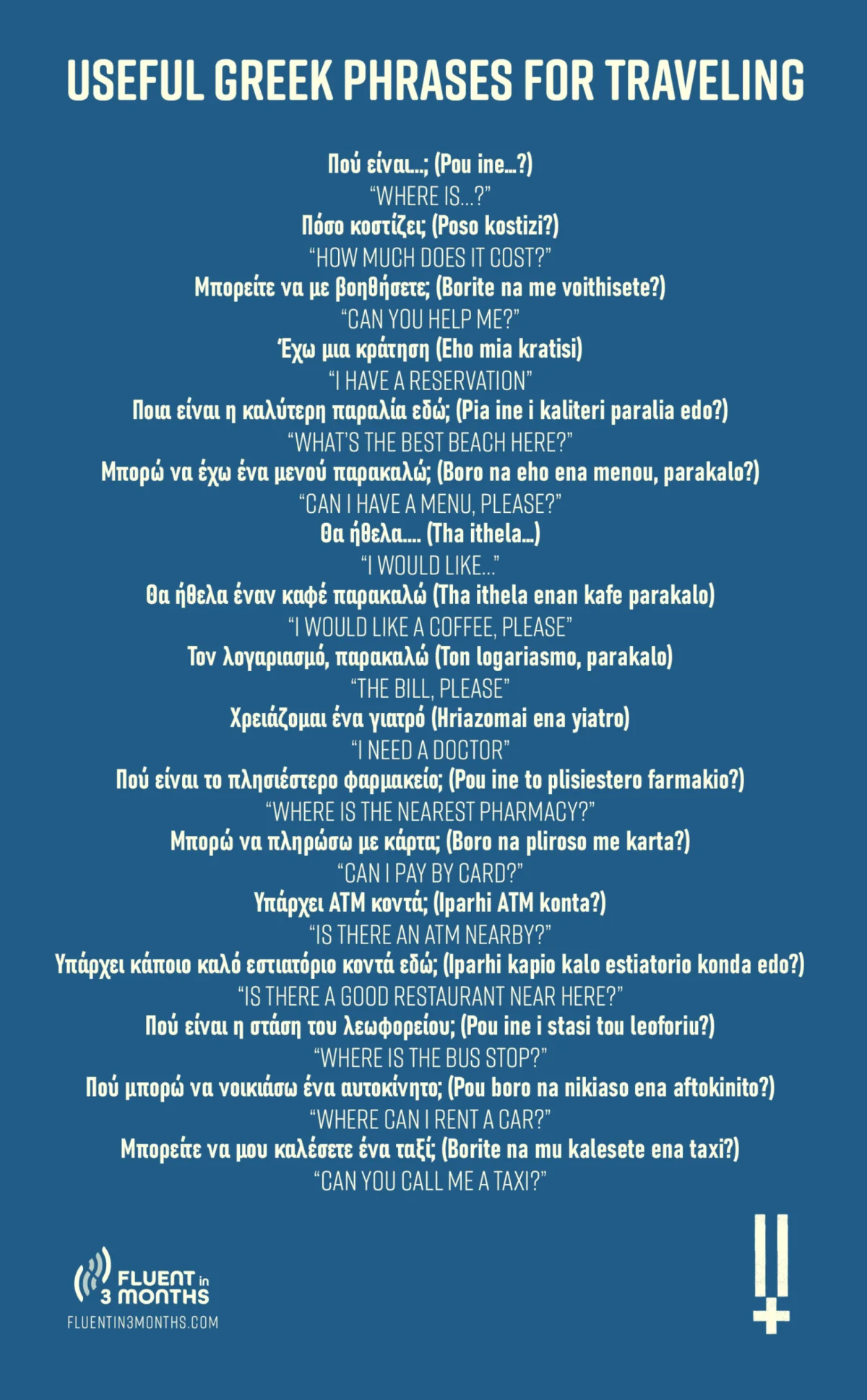
The phrase "Poso kani?" (Πόσο κάνει;) or "Poso kostizi?" (Πόσο κοστίζει;) allows a traveler to navigate the marketplace effectively. In dining establishments, the phrase "Boro na eho ton logariasmo, parakalo?" (Μπορώ να έχω τον λογαριασμό, παρακαλώ;)—requesting the bill—is a staple of the culinary experience.
Furthermore, the phrase "Milate anglika?" (Μιλάτε αγγλικά?), meaning "Do you speak English?", serves as a strategic safety net. Analysts note that starting a conversation in Greek before pivoting to English significantly increases the likelihood of receiving helpful and enthusiastic assistance from local residents.
Survival Logistics: Health, Safety, and Transportation
For the international traveler, linguistic proficiency is a matter of safety as much as it is of culture. In the event of a medical or logistical emergency, specific "survival" phrases are indispensable. "Hriazomai ena yiatro" (Χρειάζομαι ένα γιατρό) translates to "I need a doctor," and "Pou ine to plisiestero farmakio?" (Πού είναι το πλησιέστερο φαρμακείο;) asks for the location of the nearest pharmacy.
Greece’s geographical diversity, ranging from the mountainous mainland to the thousands of islands in the Aegean and Ionian seas, makes transportation a complex endeavor. Knowing how to ask "Pou ine i stasi tou leoforiu?" (Πού είναι η στάση του λεωφορείου;) for the bus stop or "Borite na mu kalesete ena taxi?" (Μπορείτε να μου καλέσετε ένα ταξί;) for a taxi service can prevent significant delays in transit-heavy regions like the Cyclades.
Socio-Linguistic Nuances and the Role of Slang
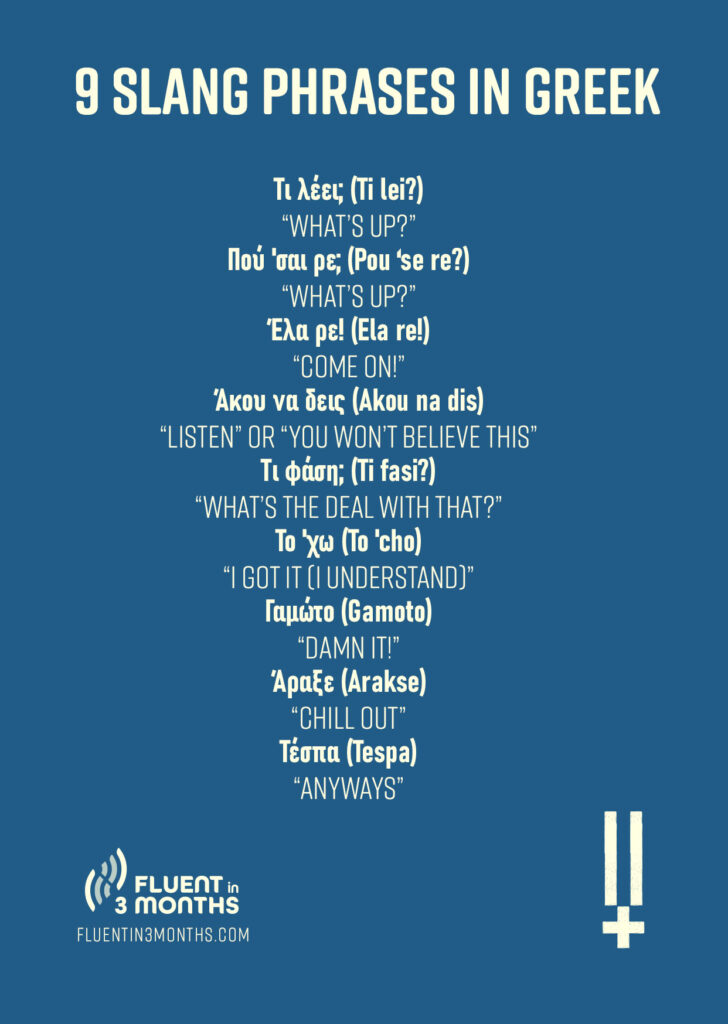
Modern Greek is a living, breathing entity that incorporates a significant amount of informal language and slang, which reflects the resilient and often humorous nature of the Greek people. One of the most ubiquitous, albeit controversial, terms is "malaka" (μαλάκα). While technically a swear word, it is used among friends as a term of endearment or a casual filler. However, linguistic experts caution travelers against using it without a deep understanding of the social context, as it can be perceived as highly offensive when used with strangers or elders.
Other informal expressions like "Ela re!" (Έλα ρε!)—an exclamation of surprise similar to "Come on!" or "No way!"—and "Arakse" (Άραξε), meaning "Chill out," provide a window into the relaxed "siga-siga" (slowly-slowly) pace of Greek life. The phrase "Yamas!" (Γεια μας!), used during toasts, is perhaps the most joyous expression of Greek social cohesion, literally translating to "To our health."
Cultural Wisdom: The Impact of Proverbs and Philosophy
The Greek language is the vessel for centuries of philosophical thought. Incorporating proverbs into one’s understanding of the language offers a deeper comprehension of the national psyche. Phrases such as "Kalo akougete" (Sounds good!) or "Kali tihi" (Good luck) are common, but traditional adages provide even more insight.
For instance, the proverb "Kathe empodio gia kalo" (Κάθε εμπόδιο για καλό), meaning "Every obstacle is for the best," reflects a stoic optimism prevalent in Greek culture. Another, "I poli logia ine ftohia" (Τα πολλά λόγια είναι φτώχεια), which translates to "Many words are poverty," suggests a preference for action over excessive talk. These idiomatic expressions demonstrate that language is not merely a collection of sounds, but a reflection of a civilization’s values and history.
Broader Implications and Future Outlook
As digital nomadism and long-term remote work become more prevalent, Greece has introduced the "Digital Nomad Visa," encouraging professionals to relocate to the country for extended periods. This policy shift has led to an increased demand for Greek language resources. Language learning platforms report a steady rise in Greek enrollment, reflecting a global trend toward "slow travel" and cultural immersion.
The integration of basic Greek phrases into the traveler’s repertoire does more than facilitate a transaction at a bakery or a ticket booth; it acts as a catalyst for cultural diplomacy. By making the effort to learn the Greek alphabet and basic syntax, the visitor acknowledges the historical weight and contemporary vitality of the Hellenic world.
In conclusion, the mastery of common Greek phrases is an essential component of modern travel. From the formal "Yassas" to the celebratory "Yamas," these linguistic tools empower the traveler to move beyond the role of a passive observer and become an active participant in the rich tapestry of Greek life. As the tourism sector evolves, the emphasis on linguistic and cultural competency will likely remain a cornerstone of the international travel experience in the Mediterranean.
