

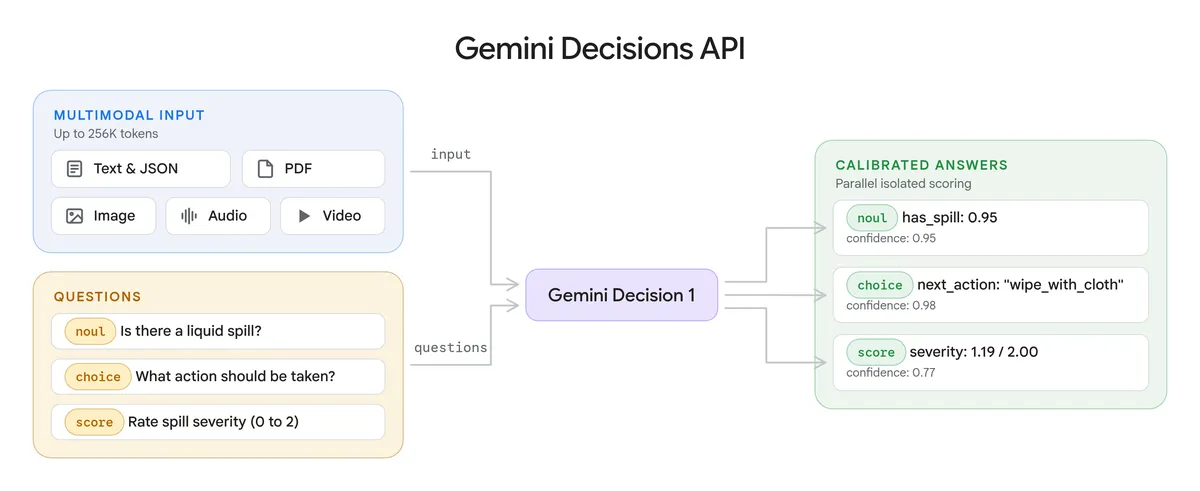
Google DeepMind has officially unveiled the Gemini Decisions API, a specialized endpoint designed to revolutionize how developers implement high-speed, bounded decision-making within artificial intelligence applications. Powered by the newly developed Gemini Decision 1 model (gemini-decision-1), this interface marks a significant shift from traditional generative AI workflows. Instead of producing open-ended text through token-by-token decoding, the model utilizes a single forward pass to score up to 1,000 independent questions simultaneously across diverse data formats, including text, high-resolution images, audio files, video, and complex PDF documents.
This release, spearheaded by Min Choi, Product Manager at Google DeepMind, and Felix Yu, Principal Scientist, addresses a critical bottleneck in the deployment of AI agents: the latency and cost associated with "closed-set" logic. By focusing on tool selection, policy compliance, model routing, and context grading, the Gemini Decisions API provides a purpose-built primitive for developers who require binary (yes/no), multiple-choice, or rubric-based scoring without the computational overhead of standard large language models (LLMs).
Technical Architecture: A Departure from Generative Norms
The fundamental innovation of the Gemini Decision 1 model lies in its scoring mechanism. Standard generative models, such as Gemini 1.5 Pro or Flash, operate by predicting the next most likely token in a sequence, a process that is inherently linear and time-consuming. In contrast, Gemini Decision 1 evaluates candidate options in a single pass. This architectural choice allows the model to return probabilities and confidence scores with an end-to-end latency of 150 to 250 milliseconds.
The model supports a substantial context window of up to 256,000 tokens, enabling it to ingest massive datasets—such as a 30-minute call recording or a hundred-page technical manual—before applying its decision logic. Furthermore, because the model does not "generate" text in the traditional sense, Google has eliminated billing for output tokens. This makes the Decisions API approximately five times more cost-effective than using Gemini 1.5 Flash-Lite for similar classification tasks.
Chronology of the Gemini Evolution
The launch of the Gemini Decisions API represents the latest milestone in Google’s rapid acceleration of its AI ecosystem. To understand its significance, one must view it within the broader timeline of Google’s 2024 development cycle:
- Early 2024: Google introduced Gemini 1.5 Pro, debuting the industry-leading 1-million-token context window, which focused on deep reasoning and massive data retrieval.
- Mid 2024: The release of Gemini 1.5 Flash optimized the architecture for speed and efficiency, catering to high-volume applications.
- Late 2024: Google introduced "Flash-Lite" and expanded the Interactions API to support more nuanced developer needs.
- Present: The introduction of the Gemini Decisions API signifies a move toward "agentic" AI, where the model acts less as a conversationalist and more as a high-speed logic gate or controller.
This progression indicates a strategic pivot toward modular AI. Rather than relying on a single "jack-of-all-trades" model, Google is providing developers with a suite of specialized tools: Pro for reasoning, Flash for speed, and now Decision 1 for calibrated logic and routing.

Performance Metrics and Benchmarking Data
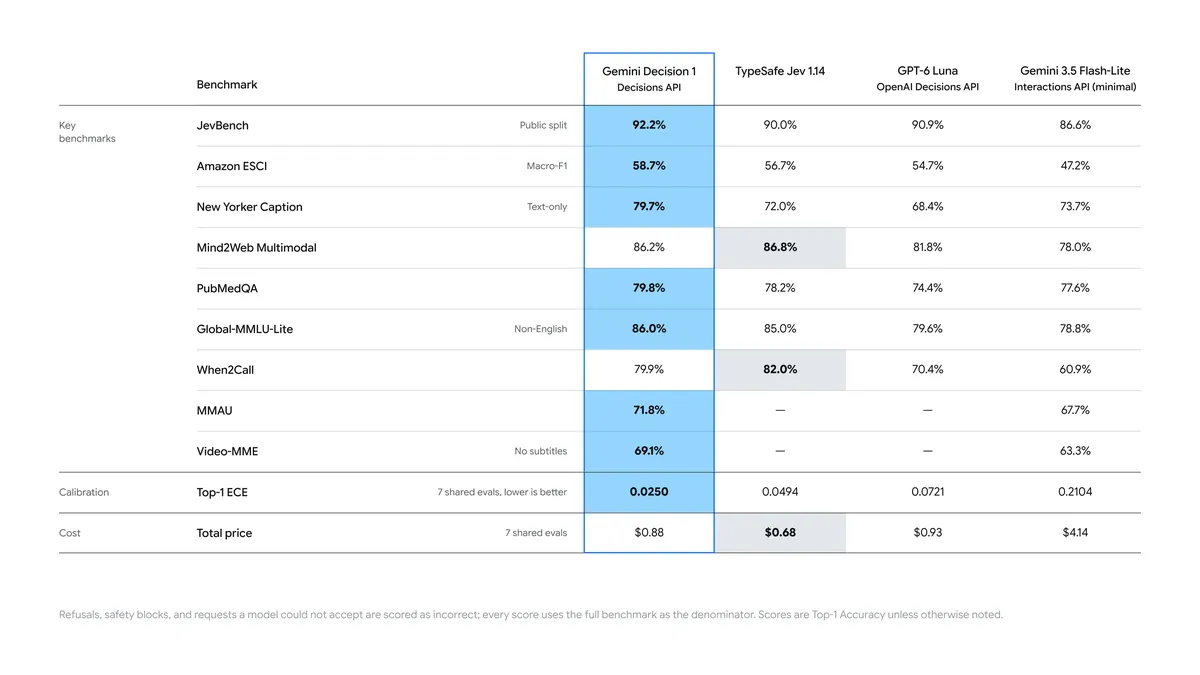
In rigorous testing across a suite of benchmarks—including agent routing, reasoning, ranking, and multimodal understanding—Gemini Decision 1 has demonstrated superior performance compared to its predecessors and competitors. A key metric highlighted by Google DeepMind is "calibration error." In the context of machine learning, calibration refers to the alignment between a model’s predicted probability and the actual likelihood of a correct outcome.
For instance, if the Decisions API assigns an 80% confidence score to a "yes" answer, a well-calibrated model will be correct exactly 80% of the time. High calibration is essential for enterprise applications where AI-driven decisions must be audited or where ambiguous cases must be routed to human reviewers. According to internal data, Gemini Decision 1 leads its class with the lowest calibration error, making it a reliable tool for automated safety checks and policy enforcement.
The latency remains remarkably stable even as the complexity of the request increases. While standard LLMs see a linear increase in time-to-first-token as more questions are added to a prompt, the Decisions API maintains a nearly flat latency curve from 1 to 100 questions per request. This efficiency is achieved by processing the shared input once and scoring all questions in parallel during the same compute cycle.
Multimodal Versatility and Real-World Applications
The Decisions API is built on Gemini’s native multimodal architecture, meaning it does not rely on separate OCR (Optical Character Recognition) or speech-to-text models to "see" or "hear" the input. It processes visual and auditory data directly. This capability allows for complex cross-modal queries.
Consider a logistics scenario: A developer can pass a photo of a delivery at a doorstep alongside a text-based customer delivery instruction. The model can simultaneously answer:
- "Is the package in a secure location?" (Yes/No)
- "Which delivery protocol was followed?" (Multiple Choice)
- "Rate the professional appearance of the delivery on a scale of 1 to 3." (Rubric Scoring)
Internal Google teams are already utilizing the API as a "low-latency control plane." For example, the Stitch Rapid team uses the Decisions API to design entire product flows in seconds. By defining options rather than training custom classifiers, they can iterate on user interfaces and installation flows with unprecedented speed. Other demo applications, such as "Doorstep Parcels," "Speed Sketch," and "Find the Zoo Keeper," showcase the model’s ability to handle rapid-fire visual Q&A and interactive gaming logic.
Economic Impact and Industry Implications
The pricing structure of the Gemini Decisions API is perhaps its most disruptive feature. Priced at $0.10 per 1 million input tokens and $0 for output tokens, it significantly lowers the barrier for high-frequency AI applications. Traditional models often charge a premium for output tokens, which can make large-scale classification expensive. By billing the shared input only once per request, regardless of the number of questions asked, Google is incentivizing developers to pack more logic into every API call.
Industry analysts suggest that this move is a direct challenge to specialized classification services and smaller, fine-tuned models. By offering a general-purpose "decision engine" that is faster and cheaper than custom-built alternatives, Google is positioning Gemini as the central nervous system for the next generation of AI agents.
Furthermore, the lack of variable "thinking-token" bills or separate costs for audio transcription and OCR simplifies the financial forecasting for startups and enterprises alike. This transparency is expected to accelerate the adoption of multimodal AI in sectors such as insurance (claims processing), retail (inventory management), and security (automated monitoring).
Developer Ecosystem and Integration Roadmap
Google has ensured that the Gemini Decisions API is accessible through a wide array of existing developer tools. It is currently available in Google AI Studio for prototyping, with a no-cost tier for initial development. The google-genai SDKs for Python and JavaScript already support the new endpoint, and the input field uses the same Content block format as the existing Interactions API, ensuring a smooth transition for those already building within the Gemini ecosystem.
The rollout includes immediate support from major third-party integrations, including:
- Orchestration Frameworks: LangChain, Pydantic AI, and Vercel.
- API Gateways: OpenRouter and LiteLLM.
- Real-time Communication: Pipecat and LiveKit.
Support for Gemini in Google Cloud (Vertex AI) is reportedly "coming soon," which will provide enterprise-grade security, residency, and compliance features for large-scale deployments.
Strategic Outlook: The Era of the AI Controller
The introduction of Gemini Decision 1 signals a maturation of the AI market. The industry is moving past the "chatbot" phase and into a phase where AI models function as invisible infrastructure. The Decisions API is not designed to write poetry or code; it is designed to be the "if-then" logic of the modern web.
By providing a model that is "calibrated"—meaning it knows what it knows and is honest about what it doesn’t—Google is addressing the primary concern of enterprise AI: reliability. When a model provides a confidence score of 0.2, a developer can programmatically trigger a fallback to a more powerful model like Gemini 1.5 Pro or escalate the task to a human operator. This "human-in-the-loop" capability, combined with sub-second latency, creates a viable path for AI integration in mission-critical systems.
As developers begin to integrate the Decisions API into their stacks, the focus will likely shift toward "agentic workflows" where multiple specialized models work in concert. In such a system, Gemini Decision 1 acts as the router, directing traffic and making split-second choices, while larger models handle the heavy lifting of content creation and deep analysis. This modularity is the blueprint for the next era of scalable, efficient, and intelligent software.
