

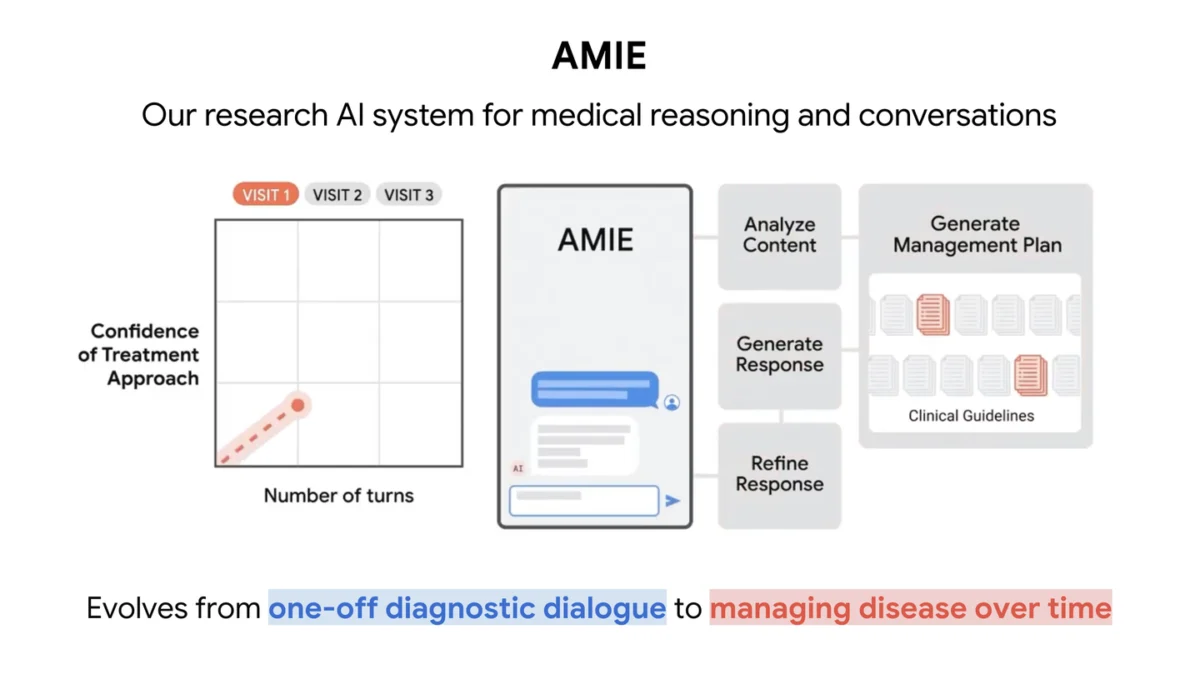
In a milestone for artificial intelligence in healthcare, researchers at Google have published new findings in the journal Nature detailing the evolution of the Articulate Medical Intelligence Explorer (AMIE). The research marks a significant transition for medical AI, moving beyond one-off diagnostic interactions toward the complex, long-term management of chronic health conditions. By leveraging the long-context capabilities of Google’s Gemini models, AMIE has demonstrated an ability to navigate the intricacies of longitudinal care, including the interpretation of evolving clinical guidelines and the adjustment of medications over time. This development addresses one of the most persistent challenges in modern medicine: the continuous management of patients after an initial diagnosis is made.
The Shift from Diagnosis to Longitudinal Management
For decades, the focus of medical informatics and early AI systems was primarily on diagnostic accuracy. While identifying a disease is a critical first step, the majority of healthcare delivery involves the ongoing management of chronic conditions such as diabetes, hypertension, and asthma. This process, often referred to as longitudinal care, requires physicians to track symptoms across multiple appointments, integrate new data from laboratory results, and stay abreast of frequently updated clinical guidelines.
The administrative and cognitive burden of this management is immense. Physicians are often required to cross-reference a patient’s specific history with vast drug formularies and hundreds of pages of authoritative medical literature. Google’s latest research suggests that AMIE can serve as a sophisticated "reasoning agent" to assist in these tasks. By processing vast amounts of information through a long-context window, the AI system can maintain a "memory" of a patient’s medical journey, ensuring that care plans remain precise and aligned with the latest scientific standards.
Technical Framework: Dialogue and Reasoning Agents
The architecture of AMIE for disease management is built upon two distinct but integrated components designed to mimic the dual nature of a clinical encounter: empathy and expertise. The first component is an empathetic dialogue agent. This interface is optimized for real-time patient conversations, utilizing natural language processing to gather symptom reports and address patient concerns in a manner that feels supportive and human-centric.
The second component is a deep-thinking management reasoning agent. Unlike standard chatbots, this agent is designed to perform "slow" thinking—a cognitive process where the AI cross-references the patient’s current status against a massive repository of clinical knowledge. This includes primary care guidelines, specialist recommendations, and insurance-approved drug lists. By utilizing the long-context capabilities of the Gemini model family, AMIE can ingest and synthesize hundreds of pages of medical documentation in a single session, a task that would take a human clinician significantly longer to complete.
Methodology and Comparative Performance Data
To validate the system’s efficacy, Google conducted a rigorous, blinded study involving patient actors. In this controlled environment, AMIE’s performance was compared directly against 21 board-certified primary care physicians. The study was designed to evaluate how each "provider"—whether human or AI—managed a variety of chronic disease scenarios over a simulated period of time.
The results, as published in Nature, indicate that AMIE matched the human clinicians in overall management reasoning. However, the AI outperformed the physicians in two specific categories: plan preciseness and guideline alignment. In the context of medical care, "plan preciseness" refers to the specificity of the treatment steps provided, while "guideline alignment" measures how closely the recommendations follow established medical protocols.
The data suggests that while human doctors are exceptional at intuitive reasoning, they are susceptible to "information overload" or the simple forgetting of a specific, recently updated guideline. AMIE, by contrast, operates with a comprehensive digital memory that does not degrade under the pressure of complex data sets. This finding highlights the potential for AI to act as a safety net, ensuring that no critical step in a patient’s management plan is overlooked.
Chronology of AMIE’s Development
The journey of AMIE began as a research project aimed at understanding if a large language model (LLM) could perform the diagnostic reasoning of a specialist.
- Phase 1: Diagnostic Exploration (2023): Initial versions of AMIE were tested on their ability to generate differential diagnoses. These early iterations proved that AI could suggest possible conditions based on a list of symptoms with a high degree of accuracy.
- Phase 2: Conversational Refinement: Google researchers focused on the "Articulate" aspect of AMIE, training the model to conduct medical interviews that were not only accurate but also empathetic, avoiding the "robotic" tone common in earlier AI systems.
- Phase 3: Longitudinal Integration (2024): With the integration of Gemini’s long-context windows, the system was expanded to handle "Mx" (medical management). This allowed the AI to look back at previous "visits" and adjust treatment plans based on the passage of time.
- Phase 4: Nature Publication and Clinical Feasibility (Present): The current phase involves the peer-reviewed validation of these management capabilities and the start of real-world feasibility studies to determine how AMIE can be integrated into actual clinical workflows.
Addressing the Global Healthcare Crisis and Physician Burnout
The implications of this research extend beyond technical achievement; they touch upon a growing crisis in global healthcare. The World Health Organization (WHO) has long warned of a looming shortage of healthcare workers, estimated to reach 10 million by 2030. Furthermore, physician burnout has reached record levels, driven largely by the administrative burden of documentation and the "pajama time" doctors spend catching up on patient charts and guideline updates after hours.
By automating the "reasoning" part of disease management—such as checking if a new medication is covered by a patient’s insurance or if a dosage adjustment aligns with the latest 2024 guidelines—AMIE could theoretically reclaim hours of time for physicians. This would allow doctors to focus on the aspects of medicine that AI cannot replicate: physical examinations, complex emotional support, and the final, high-stakes decision-making that requires human accountability.
Official Responses and Expert Perspectives
While Google’s internal teams are optimistic, the broader medical community maintains a stance of "cautious hope." Early reactions from independent medical AI researchers emphasize that while the Nature study is a breakthrough, the use of "patient actors" is different from real-world clinical practice.
In official statements accompanying the research, Google Health representatives noted that AMIE is currently a research-grade system and not yet a product available for public use. The emphasis remains on safety and the "human-in-the-loop" model, where the AI serves as an assistant to the doctor rather than a replacement. "The goal is to provide a tool that can parse the complexity of modern medicine so the physician can focus on the patient," the researchers noted.
Broader Impact and Future Directions
The next steps for AMIE involve moving out of the laboratory and into the real world. Google has announced the launch of a nationwide randomized study to assess the performance of AI in real-world virtual care settings. This study will evaluate how patients interact with the AI in a less controlled environment and how human doctors utilize the AI’s suggestions in real-time.
Furthermore, the research team is exploring the "feasibility of conversational diagnostic AI" in clinical settings, looking at how AMIE might be integrated into Electronic Health Records (EHR) systems. If successful, AMIE could become a ubiquitous "co-pilot" for primary care, providing instant summaries of patient histories and suggesting the most current, evidence-based management plans.
The publication in Nature serves as a foundational proof of concept. It demonstrates that AI reasoning has reached a level of sophistication where it can manage the "middle" of the patient journey—the long, often tedious years of managing a chronic condition. As the technology continues to evolve, the focus will likely shift toward ensuring these systems are equitable, secure, and seamlessly integrated into the diverse healthcare systems found across the globe. For now, AMIE stands as a testament to the potential of long-context AI to transform the practice of medicine from a series of disconnected appointments into a continuous, data-driven journey toward better health outcomes.
