


The accelerating integration of Artificial Intelligence (AI) into content creation workflows has ignited a critical debate within the influencer and professional communication spheres regarding authenticity, expertise, and the very definition of influence. This discussion, brought to the forefront by a candid LinkedIn post asserting, "I don’t use AI to write my content," probes the ethical boundaries and practical implications of leveraging AI in the creation of professional output. While the author of the post clarified this was not a declaration of superiority but rather a point about the intrinsic value of content, the underlying sentiment resonates deeply with concerns about genuine human contribution versus machine-generated output.
The core of the debate centers on a crucial distinction: is AI being employed as a tool to augment human intellect and refine existing ideas, or is it being used to circumvent the fundamental process of human thought and original ideation? This subtle but significant difference carries profound implications for how influence is perceived and built.
The Evolution of Content Creation and AI’s Role
The rise of AI-powered tools, such as large language models (LLMs) like ChatGPT, has democratized sophisticated content generation capabilities. These tools can assist with brainstorming, structuring arguments, improving clarity, editing prose, and even generating entirely new pieces of text based on user prompts. For many professionals, including content creators, marketers, and thought leaders, AI has become an indispensable assistant. For instance, a recent survey by Statista indicated that over 60% of content marketers reported using AI tools in their workflow, with the primary applications being content ideation, writing assistance, and SEO optimization.
However, this widespread adoption raises questions about the origin of the ideas and the depth of understanding behind the published content. The concern is that an over-reliance on AI could lead to a generation of influencers and professionals who present polished but ultimately hollow content, lacking the genuine lived experience, nuanced perspective, and authentic voice that traditionally underpins influence.
The "Milli Vanilli" Moment of the Digital Age?
The analogy frequently drawn in this discourse is the infamous Milli Vanilli scandal of the late 1980s. The pop duo achieved immense global success, winning awards and selling millions of records. Their careers imploded when it was revealed they had lip-synced to pre-recorded vocals, and the actual singers were uncredited. The music itself was not inherently flawed, but the deception of its origin undermined public trust and led to widespread disappointment and professional ruin.
This parallel suggests a potential "Milli Vanilli moment" for AI-generated content. If audiences discover that the individuals they follow and whose insights they value are not the true originators of the ideas, the perceived authenticity and authority of those individuals could be severely compromised. The disappointment stems not from a diminishment of the content’s informational value, but from a breach of trust. Consumers of content are not merely seeking information; they are often investing emotional capital and trust in the person or entity delivering it.
Authority and Authenticity in the Age of AI
Dr. Robert Cialdini’s well-established principles of influence, particularly the principle of Authority, are highly relevant here. People are naturally inclined to trust and be persuaded by individuals perceived as having genuine expertise. When AI is used to generate ideas, formulate arguments, craft narratives, and draw conclusions, the "expertise" being demonstrated shifts from personal knowledge and experience to proficiency in prompt engineering.
This transition is problematic. While skillful prompting can produce excellent results, it does not equate to the lived experience, the hard-won lessons from mistakes, the deep-seated convictions, or the unique perspective that a human develops over years of practice and reflection. These are the very elements that imbue a voice with authenticity and establish genuine authority. An AI has not experienced the triumphs and failures that shape a professional’s outlook, nor has it grappled with the ethical dilemmas that forge character. Therefore, attributing AI-generated content solely to an individual without acknowledging the AI’s contribution, or worse, presenting it as entirely original thought, risks misrepresenting one’s actual expertise.
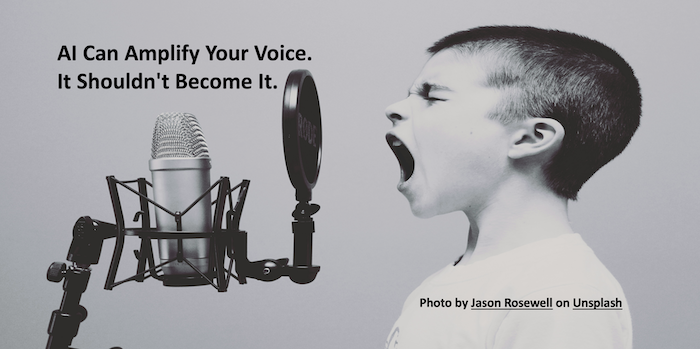
Differentiating Augmentation from Replacement
The critical distinction lies between using AI as a sophisticated tool to enhance human capabilities and allowing it to become a substitute for human cognition. When AI is used to organize thoughts, challenge assumptions, improve clarity, or edit existing material, it acts as a powerful amplifier of the individual’s own intellectual output. In this capacity, AI can significantly boost efficiency and refine the quality of communication. For example, a study by McKinsey & Company found that AI adoption in content creation can lead to an average productivity increase of 15-20%.
However, when AI is tasked with generating core ideas, composing narratives, or formulating conclusions without substantial human input, it crosses the line into replacing, rather than augmenting, human thinking. This is where the potential for a crisis of authenticity emerges.
The Future of Influence: Human Expertise Amplified by AI
The influencers and professionals who will thrive in the coming decade are likely to be those who have cultivated deep, authentic expertise over years and then leverage AI to communicate that expertise more effectively. AI should serve as a collaborator, a sounding board, or a powerful editing suite, but never as the primary author of one’s intellectual or experiential output.
The unique stories of personal journeys, the hard-learned lessons from failures, the developed convictions, and the individual perspectives are irreplaceable by AI, as these are products of human consciousness and experience. AI can process vast amounts of information and identify patterns, but it cannot replicate the subjective, qualitative essence of human life that forms the bedrock of genuine influence.
The question for professionals and content creators alike becomes: where is the line drawn between using AI as a valuable tool and allowing it to become the de facto author of one’s expertise? Navigating this boundary with integrity will be crucial for maintaining trust and genuine influence in an increasingly AI-integrated world. The ethical application of AI in content creation demands transparency, a clear understanding of its limitations, and a steadfast commitment to preserving the unique value of human thought and experience.
Broader Implications and Industry Responses
The implications of this debate extend beyond individual influencers to impact brands, educational institutions, and the broader media landscape. Companies that utilize AI to generate customer service responses or marketing copy without clear disclosure risk alienating consumers who value human interaction and personalized experiences. Educational institutions are grappling with how to assess student work in an era where AI can generate essays and solve complex problems.
While specific official responses from major AI developers like OpenAI or Google regarding the ethical use of their models in professional contexts are often framed around user responsibility, industry organizations are beginning to establish guidelines. The Content Marketing Institute, for instance, has emphasized the importance of human oversight and editorial review for AI-generated content. Similarly, many marketing agencies are developing internal policies that mandate disclosure of AI usage in client-facing materials to maintain transparency.
The narrative surrounding AI in content creation is evolving from one of novelty to one of responsible integration. The future of authentic influence will depend on individuals and organizations demonstrating that AI is a tool to enhance human capabilities, not a crutch to avoid the essential work of thinking, experiencing, and genuinely connecting with an audience. The true power of influence will always lie in the unique, human voice, amplified and refined, but never replaced.
