

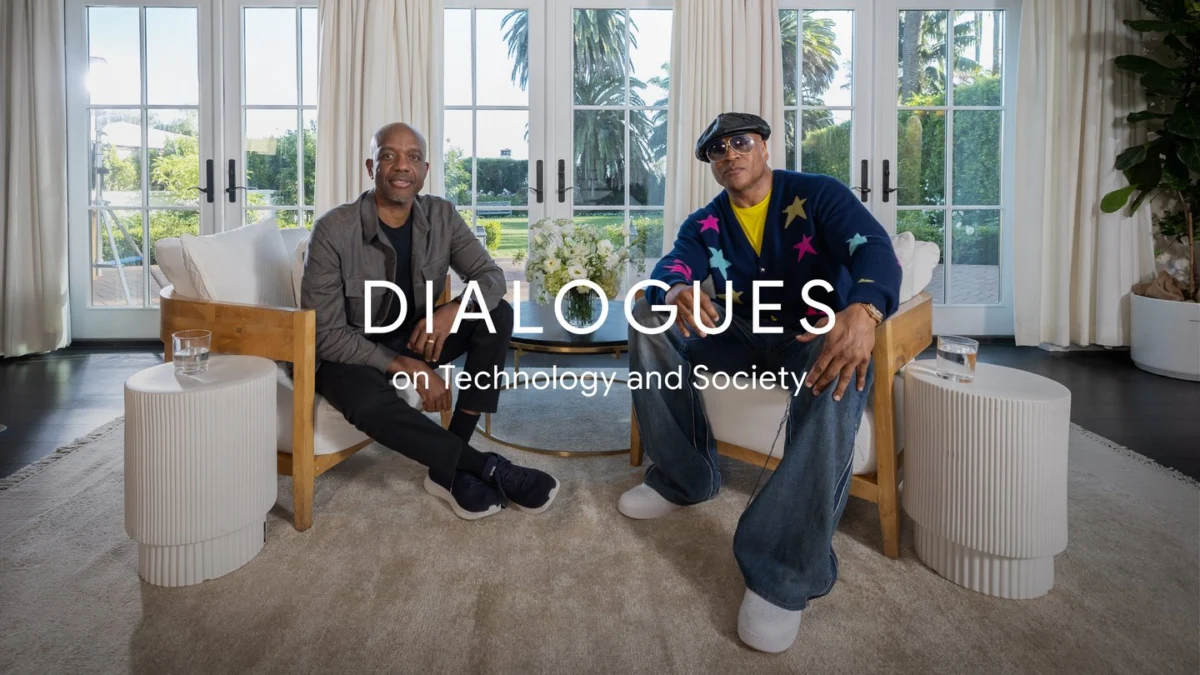
The intersection of legacy artistic expression and cutting-edge computational power took center stage in the latest installment of Google’s Dialogues on Technology and Society series. This episode featured a deep-dive conversation between LL COOL J, a foundational figure in hip-hop and a Rock and Roll Hall of Fame inductee, and James Manyika, Google’s Senior Vice President of Research, Labs, Technology, and Society. The dialogue explored the trajectory of creative tools over the last four decades, focusing specifically on how generative artificial intelligence (AI) is poised to reshape the landscape of music, storytelling, and cultural production.
The discussion served as a bridge between the historical evolution of hip-hop—a genre birthed from technological repurposing—and the future of digital creation. LL COOL J, whose career spans the transition from analog recording to the streaming era, provided a practitioner’s perspective on the ethical and creative hurdles presented by machine learning. Manyika, representing one of the world’s leading AI developers, offered insights into the technical and societal frameworks being constructed to ensure that technology serves as an augmentative tool rather than a replacement for human ingenuity.
The Evolution of Technology in Hip-Hop and Modern Music
To understand the current anxiety and excitement surrounding generative AI, the dialogue first established a historical context. LL COOL J reflected on his entry into the music industry in 1984, a period defined by the emergence of the Roland TR-808 drum machine and early sampling technology. At that time, critics argued that the use of drum machines and samples was "cheating" or a sign of the death of traditional musicianship. However, as LL COOL J noted, these tools did not kill music; they birthed a global movement by allowing individuals without formal classical training to compose complex rhythms and narratives.
This historical parallel is significant when analyzing the current rise of generative AI. Just as the 808 drum machine democratized beat-making in the 1980s, AI tools like Google’s MusicLM or Gemini are now providing a new generation of creators with the ability to synthesize sounds and ideas that were previously locked behind the gates of expensive studio time and technical expertise. The transition from hardware-based creation to software-based synthesis represents a four-decade arc of increasing accessibility.
Generative AI and the Democratization of Access
A primary theme of the conversation was the potential for AI to democratize the creative process. James Manyika emphasized Google’s commitment to building tools that lower the barrier to entry for aspiring artists. In many parts of the world, access to high-end instruments, recording software, and distribution networks remains limited. Generative AI has the potential to bridge this gap, allowing a teenager in a remote area to produce a high-quality track using only a smartphone and an AI interface.
According to data from the International Federation of the Phonographic Industry (IFPI), the global recorded music market grew by 10.2% in 2023, largely driven by streaming. However, as the volume of content increases, the tools to create that content are becoming more sophisticated. Market analysts suggest that the generative AI in music market is expected to reach a valuation of approximately $2.6 billion by 2032, growing at a compound annual growth rate (CAGR) of 28.6% from 2023. This growth highlights a massive shift in how intellectual property is generated and consumed.
LL COOL J acknowledged this shift, noting that "democratization" is a double-edged sword. While it allows more voices to be heard, it also necessitates a new understanding of what constitutes "originality." He argued that while the tools are changing, the fundamental requirement for a "vision" remains the same. The machine can provide the palette, but the human must still choose the colors and the subject matter.
Protecting the Divine Spark: The Human Element in Art
One of the most poignant moments of the dialogue centered on what LL COOL J termed the "divine spark." This refers to the intangible quality of human emotion, lived experience, and soul that characterizes great art. The artist argued that while an AI can analyze millions of data points to create a song that sounds like a hit, it lacks the "suffering, the joy, and the heartbeat" that comes from a human being’s life journey.
James Manyika echoed this sentiment from a technological perspective, discussing the concept of "Responsible AI." He noted that Google’s research initiatives are not aimed at replacing the artist but at providing a "co-collaborator." The challenge for developers is to ensure that AI models are trained in a way that respects the nuances of human creativity without infringing upon the rights of the creators who provided the data for those models.
The "divine spark" debate is not merely philosophical; it has real-world implications for copyright law and intellectual property. In 2023 and 2024, the music industry saw a surge in "ghostwritten" AI tracks, such as the viral "Heart on My Sleeve" song that mimicked the voices of Drake and The Weeknd. These incidents have sparked legislative discussions, including the introduction of the NO FAKES Act in the United States, which aims to protect the voice and likeness of individuals from unauthorized AI replication.
A Chronology of Technological Transitions in Music
To provide a framework for the current AI revolution, the following timeline illustrates the key technological shifts discussed or implied in the dialogue:
- 1980–1984: The rise of the Roland TR-808 and MIDI (Musical Instrument Digital Interface), allowing electronic instruments to communicate. LL COOL J releases "I Need a Beat" (1984), marking the start of his career.
- 1990s: The shift toward Digital Audio Workstations (DAWs) like Pro Tools, which moved recording from physical tape to computer hard drives.
- 2000s: The explosion of Napster and digital distribution, followed by the rise of streaming services like Spotify and YouTube, changing how music is consumed and monetized.
- 2010s: The integration of algorithmic curation and "Big Data" in identifying hits and managing artist careers.
- 2020–Present: The emergence of Generative AI (LLMs and Diffusion Models) capable of creating lyrics, melodies, and full vocal clones.
Official Responses and Industry Reactions
The dialogue between LL COOL J and Manyika reflects a broader trend of collaboration between Silicon Valley and the creative arts. Major record labels, initially hesitant, have begun to seek middle ground. For instance, Universal Music Group (UMG) recently partnered with YouTube (a Google subsidiary) to establish an AI Music Incubator. This initiative aims to explore how AI can be used to enhance the industry while ensuring that artists are compensated and credited.
Sir Lucian Grainge, Chairman and CEO of UMG, has stated in previous industry addresses that the industry must embrace technology while "protecting the human element that is the heart of our business." This mirrors Manyika’s assertion that the goal of Google’s research is to foster a "symbiotic relationship" between human and machine.
However, not all reactions have been positive. Groups like the Human Artistry Campaign, a coalition of over 150 organizations across the creative spectrum, have emphasized that AI should never be granted the same legal status as human creators. They argue that copyright is a tool designed to incentivize human creativity, and extending those protections to machine-generated content could undermine the livelihood of professional artists.
Fact-Based Analysis of Broader Implications
The dialogue highlights several critical implications for the future of society and technology:
- Economic Disruption and Opportunity: While AI may automate certain technical aspects of music production (such as mixing and mastering), it creates new opportunities for "prompt engineers" and AI-curated artistic directors. The economic value will likely shift from the act of production to the act of curation and brand identity.
- Cultural Homogenization vs. Diversity: There is a risk that AI, by training on existing data, could create a feedback loop of "safe," derivative art. Conversely, as Manyika suggested, it could allow for the preservation and expansion of niche cultural expressions that have been historically overlooked by mainstream labels.
- The Ethics of Attribution: As generative tools become more sophisticated, the line between "influence" and "infringement" becomes blurred. The dialogue underscored the need for robust watermarking and metadata standards (such as those being developed by the Coalition for Content Provenance and Authenticity, or C2PA) to identify AI-generated content.
- Educational Shifts: The democratization of these tools means that future arts education will likely focus less on technical rote learning and more on conceptual thinking and the ethical use of technology.
Conclusion: The Path Forward
The conversation between LL COOL J and James Manyika serves as a high-level synthesis of where we stand at the dawn of the AI era. By looking back at the 40-year evolution of hip-hop, LL COOL J provided a grounded reminder that artists have always been at the forefront of technological adoption. He remains optimistic that the "divine spark" of human experience cannot be replicated, provided that society remains vigilant about the ethical implementation of these tools.
For Google and Manyika, the dialogue reinforces the importance of engaging with cultural leaders to shape the trajectory of AI. As generative models continue to evolve, the partnership between the technologist and the artist will be essential in ensuring that the future of creativity remains profoundly human, even as it becomes increasingly digital. The full dialogue, available on Google’s official channels, stands as a foundational document for understanding the ongoing negotiation between the "divine spark" and the digital algorithm.
