

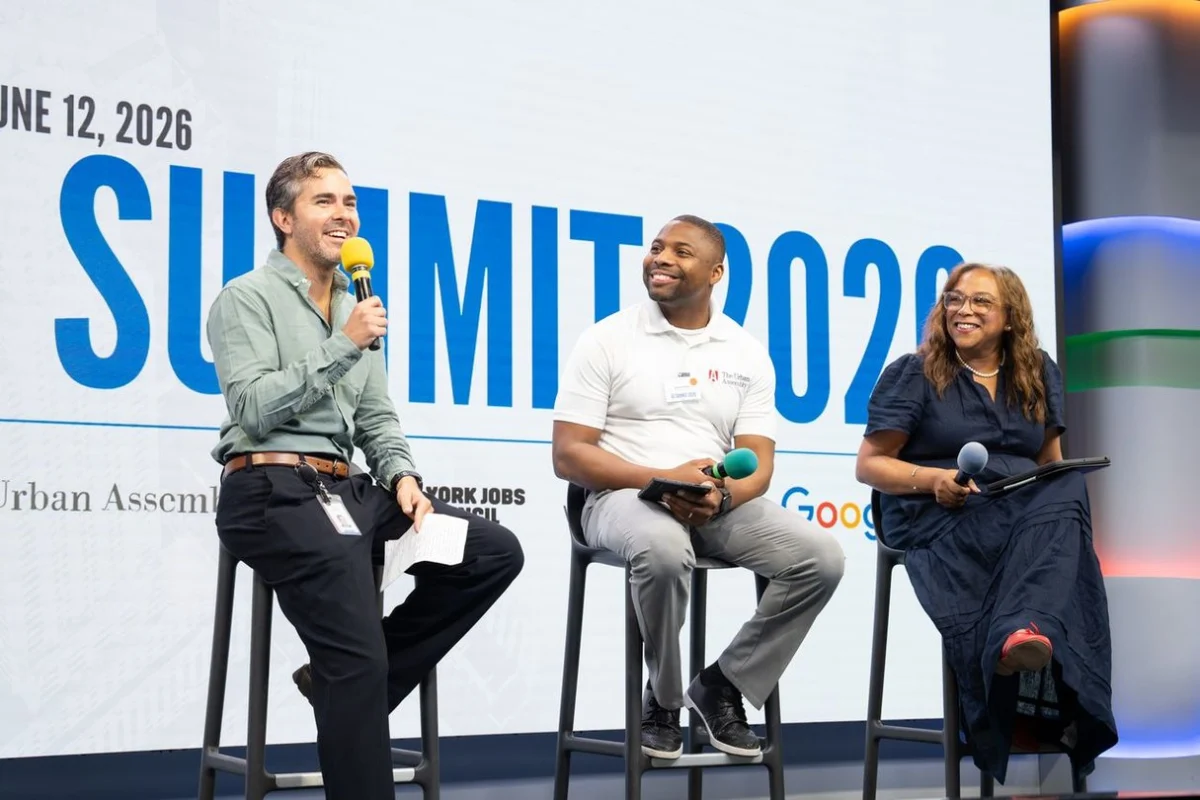
The rapid evolution of generative artificial intelligence is fundamentally altering the global labor market, prompting a necessary reevaluation of how secondary and post-secondary education prepares students for the workforce. To address this transition, Google’s New York City headquarters recently served as the staging ground for a high-level AI summit, bringing together 150 prominent figures from the educational sector and the corporate world. Hosted in collaboration with the New York Jobs CEO Council and the Urban Assembly, the event sought to bridge the gap between classroom instruction and the shifting requirements of modern industry, ensuring that the next generation of graduates possesses the "AI literacy" required for the 21st-century economy.
The summit arrived at a critical juncture for New York City’s public school system, the largest in the United States. As educators grapple with the dual challenges of academic recovery and technological disruption, the gathering emphasized that the integration of AI is no longer a peripheral concern but a core requirement for career readiness. The dialogue centered on the premise that technological innovation in education must be a collaborative endeavor, involving the very industries that will eventually employ these students.
A Strategic Alliance for Workforce Readiness
The partnership behind the summit represents a trifecta of influence in the New York landscape. Google, a global leader in AI research and infrastructure, provided the technological framework and the physical venue. The New York Jobs CEO Council, a coalition of CEOs from the city’s largest employers—including JPMorgan Chase, Amazon, and IBM—brought the perspective of the hiring market, detailing the specific competencies required for high-growth roles. The Urban Assembly, a non-profit organization dedicated to innovation within public schools, provided the pedagogical lens, ensuring that the strategies discussed remained grounded in the realities of urban education.
The primary objective of the summit was "knowledge sharing," a process designed to align the pace of educational reform with the speed of industrial advancement. Historically, a lag exists between the emergence of a new technology and its inclusion in public school curricula. The organizers argued that with AI, such a delay could result in a significant "skills gap," leaving students from underserved communities at a disadvantage. By facilitating direct interaction between those hiring for the future and those teaching it, the summit aimed to create a feedback loop that informs curriculum development in real-time.
Hands-On Exploration of AI Pedagogy
The event transitioned from theoretical discussions to practical applications through a series of hands-on workshops designed to demystify AI for educators. Two specific programs highlighted the potential for AI to serve as a co-pilot in the learning process: aiEDU’s “Vibe Coding” and Google’s “Meet LEA.”
"Vibe Coding" represents a paradigm shift in how computer science is taught. Rather than focusing solely on the syntax of specific programming languages like Python or C++, the session explored how natural language prompts can be used to direct AI in generating code. This approach emphasizes "computational thinking"—the ability to break down complex problems into logical steps—over the rote memorization of code. For educators, this means that the barrier to entry for software development is lowering, allowing students to focus on the creative and structural aspects of engineering.
In parallel, Google introduced "Meet LEA" (Learning Environment Assistant), a tool designed to demonstrate how AI can personalize the educational experience. By utilizing Google AI models and NotebookLM, an AI-powered note-taking and research assistant, educators explored ways to spark curiosity in students. NotebookLM, for instance, allows users to ground the AI in specific documents—such as a specific textbook or a set of historical primary sources—ensuring that the generated insights are factually accurate and relevant to the curriculum. These tools were presented not as replacements for teachers, but as instruments to reduce administrative burdens and allow for more one-on-one student interaction.
The Shift Toward "Human Skills" in an Automated Era
A recurring theme throughout the summit was the paradoxical effect of AI on the workforce: as technical tasks become increasingly automated, uniquely human skills become more valuable. Industry leaders from the New York Jobs CEO Council emphasized that while technical proficiency in AI tools is necessary, it is no longer sufficient.
The consensus among corporate executives was that the "human element"—comprising adaptability, collaboration, critical judgment, and ethical reasoning—is the most critical asset a student can possess. In a workflow streamlined by AI, the role of the human worker shifts from "producer" to "editor" or "strategist." The ability to evaluate the output of an AI for bias, accuracy, and ethical implications was cited as a top priority for future hires.
This shift has significant implications for classroom instruction. Educators at the summit discussed the need to move away from standardized testing that rewards memorization and toward project-based learning that fosters teamwork and problem-solving. The goal is to produce graduates who are not just "users" of technology, but critical thinkers who can navigate an environment where the "right" answer is often generated by an algorithm and requires human verification.
Data and Economic Context: The Impetus for Change
The urgency of the summit is supported by a growing body of economic data. According to the World Economic Forum’s "Future of Jobs Report 2023," nearly 75% of surveyed companies expect to adopt AI, with a significant portion of the workforce requiring retraining. Furthermore, LinkedIn data suggests that job postings mentioning AI or Generative AI have more than doubled globally over the past year.
In New York City, the stakes are particularly high. The city is positioning itself as a global hub for the "AI economy," but this growth is contingent on a local talent pipeline. The New York Jobs CEO Council has set a goal to hire 100,000 low-income New Yorkers into high-demand jobs by 2030. Achieving this target requires that the New York City Department of Education (NYCDOE) and local colleges integrate AI literacy into their foundational programs immediately.
The summit also addressed the "digital divide." Research from organizations like the Pew Research Center has long highlighted that students from lower-income households often have less access to cutting-edge technology at home. If AI is only integrated into private or well-funded suburban schools, the existing opportunity gap will widen. The Urban Assembly and Google emphasized that equitable access to AI tools in public schools is a matter of economic justice.
A Chronology of AI in New York City Schools
To understand the significance of this summit, one must look at the timeline of AI adoption within the New York City school system.
- November 2022: The public release of ChatGPT triggers a global debate on academic integrity and the future of writing instruction.
- January 2023: The New York City Department of Education (NYCDOE) officially bans ChatGPT on all department devices and networks, citing concerns over "negative impacts on student learning" and "safety and accuracy."
- May 2023: In a significant reversal, Schools Chancellor David Banks announces that the ban will be lifted. He acknowledges that "the reflexive fear and risk overlooked the potential of generative AI to support students and teachers."
- Late 2023: The NYCDOE begins forming an AI task force to develop guidelines for responsible use, focusing on teacher training and ethical guardrails.
- Current (2024): Events like the Google AI Summit mark a transition from "permissive use" to "active integration," where industry and education leaders collaborate to build a formal framework for AI in the classroom.
Ethics, Privacy, and the Regulatory Landscape
While the mood of the summit was generally optimistic, attendees remained "uncompromising" on the issues of data privacy and ethical implementation. Educational data is subject to strict federal regulations, such as the Family Educational Rights and Privacy Act (FERPA) and the Children’s Online Privacy Protection Rule (COPPA).
Google representatives addressed these concerns by highlighting the "enterprise-grade" protections built into their educational tools, which differ from consumer-facing AI. In a classroom setting, data used to train or interact with AI models must be siloed to prevent the exposure of sensitive student information.
Furthermore, the discussion turned toward the inherent biases in AI training sets. Educators raised concerns that if AI models are trained on biased data, they may replicate stereotypes in the classroom. The summit concluded that teaching "AI literacy" must include teaching students how to identify and challenge these biases. The consensus was clear: technological innovation must not come at the expense of student safety or social equity.
Implications for the Future of Education
The ultimate takeaway from the Google summit is that the future of education is not a competition between humans and machines, but a partnership. The "innovation with schools, not around them" philosophy suggests that technology companies cannot simply "drop" tools into the classroom and expect results. Instead, they must work with teachers to ensure that AI enhances the pedagogical goals of the school.
For New York City, this summit serves as a blueprint for other metropolitan areas. By aligning the interests of big tech, corporate employers, and public educators, the city is attempting to create a sustainable ecosystem for workforce development. The success of this initiative will be measured not by the complexity of the AI tools themselves, but by the ability of New York City students to navigate a labor market that is increasingly defined by algorithmic change.
As the 150 leaders departed Google’s offices, the mandate was clear: the classroom must become a laboratory for the future. The integration of AI is not merely a technical upgrade; it is a fundamental shift in how society defines intelligence, work, and the role of the educator in a digital age. Through collaboration, transparency, and a focus on "human skills," the organizers believe they can prepare a generation that is not just ready for tomorrow’s careers, but capable of shaping them.
