

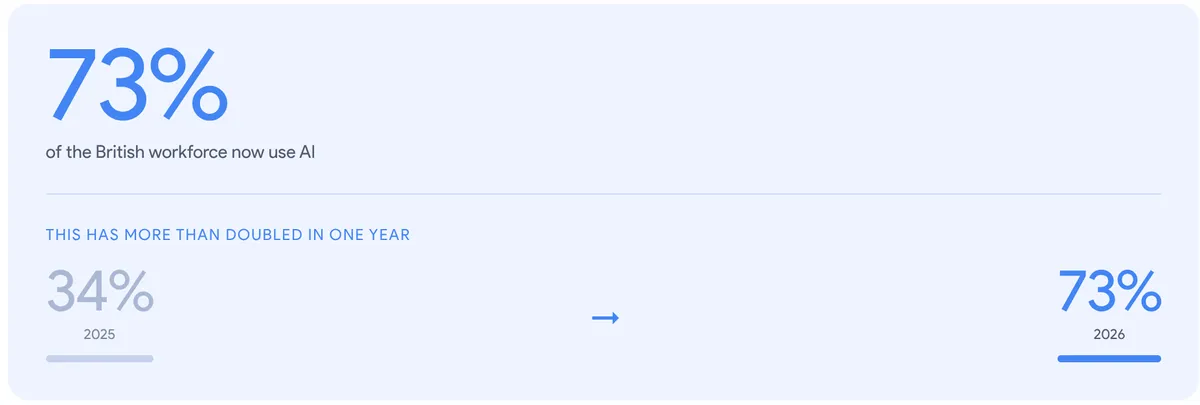
The United Kingdom is currently navigating a pivotal shift in its economic landscape, driven by a rapid acceleration in the adoption of artificial intelligence across its workforce. According to a landmark study conducted by Public First in collaboration with Google UK, workplace AI adoption has more than doubled in just twelve months, surging from 34% in 2025 to 73% in 2026. However, while the sheer volume of users has grown, a significant "adoption gap" has emerged, separating a small elite of high-performing "AI Trailblazers" from the rest of the professional population. This disparity suggests that while the nation is eager to embrace new technology, the benefits of the AI revolution—higher pay, faster promotions, and reclaimed time—are currently concentrated within the top 15% of the workforce.

Kate Alessi, Vice President and Managing Director of Google UK & Ireland, highlights that the challenge for the British economy is no longer just about access to tools, but about deepening literacy and upskilling the remaining 85% of workers. The findings indicate that those who have mastered AI are not just working faster; they are fundamentally altering their career trajectories. These "Trailblazers" report significantly stronger performance reviews and substantial time savings, effectively gaining an extra day of productivity every working week. To ensure that this technological shift facilitates broad-based economic growth rather than deepening existing inequalities, a concerted effort between the private sector and the government is now underway to democratize AI expertise.
A Chronology of Rapid Integration
The journey toward the current state of AI integration in Britain began in earnest in early 2024, following the global explosion of generative AI tools. By 2025, the UK saw a foundational adoption rate of 34%, primarily driven by early adopters in the technology and financial services sectors. However, the period between mid-2025 and mid-2026 marked a "hyper-growth" phase. During this time, AI moved from a niche experimental tool to a mainstream workplace staple.

This acceleration was supported by several key milestones. First, the integration of AI into everyday productivity suites—such as Google Workspace and Microsoft 365—lowered the barrier to entry for office workers. Second, the UK Government’s Department for Science, Innovation and Technology (DSIT) launched several pilot programs aimed at integrating AI into public services and small businesses. By the time the Public First study was conducted in 2026, the data showed that nearly three-quarters of the British workforce was interacting with AI in some capacity.
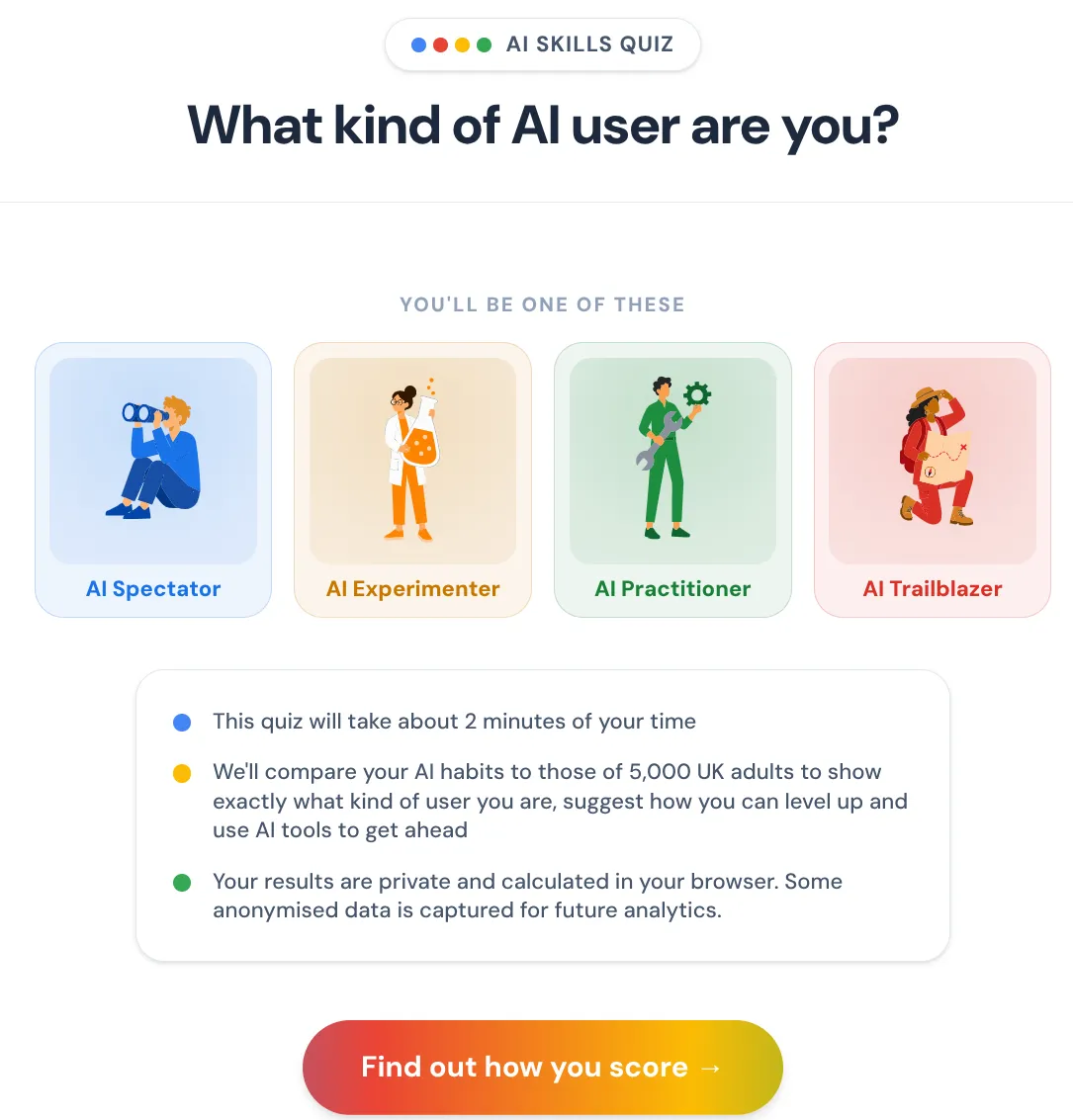
Despite this rapid uptake, the transition has been uneven. The research identifies a clear spectrum of usage, categorizing the workforce into four distinct stages of proficiency. At the bottom are the "AI Spectators" (10%), who remain largely disengaged from the technology. Above them are the "AI Experimenters" (38%), who use tools for basic queries or simple drafting. The "AI Practitioners" (37%) represent the emerging middle class of the digital era, using AI regularly for research and problem-solving. Finally, the "AI Trailblazers" (15%) represent the gold standard, utilizing AI for creative automation, complex data analysis, and the deployment of autonomous agents.
The Trailblazer Advantage: Quantifying the Impact
The divide between a Practitioner and a Trailblazer is not merely technical; it is economic. The Public First research suggests that Trailblazers are creating a new benchmark for modern professional standards. On average, these high-level users save nearly eight hours per week across their personal and professional lives. In a standard 40-hour work week, this represents a 20% increase in time efficiency, a figure that Alessi describes as "effectively gaining an extra day."
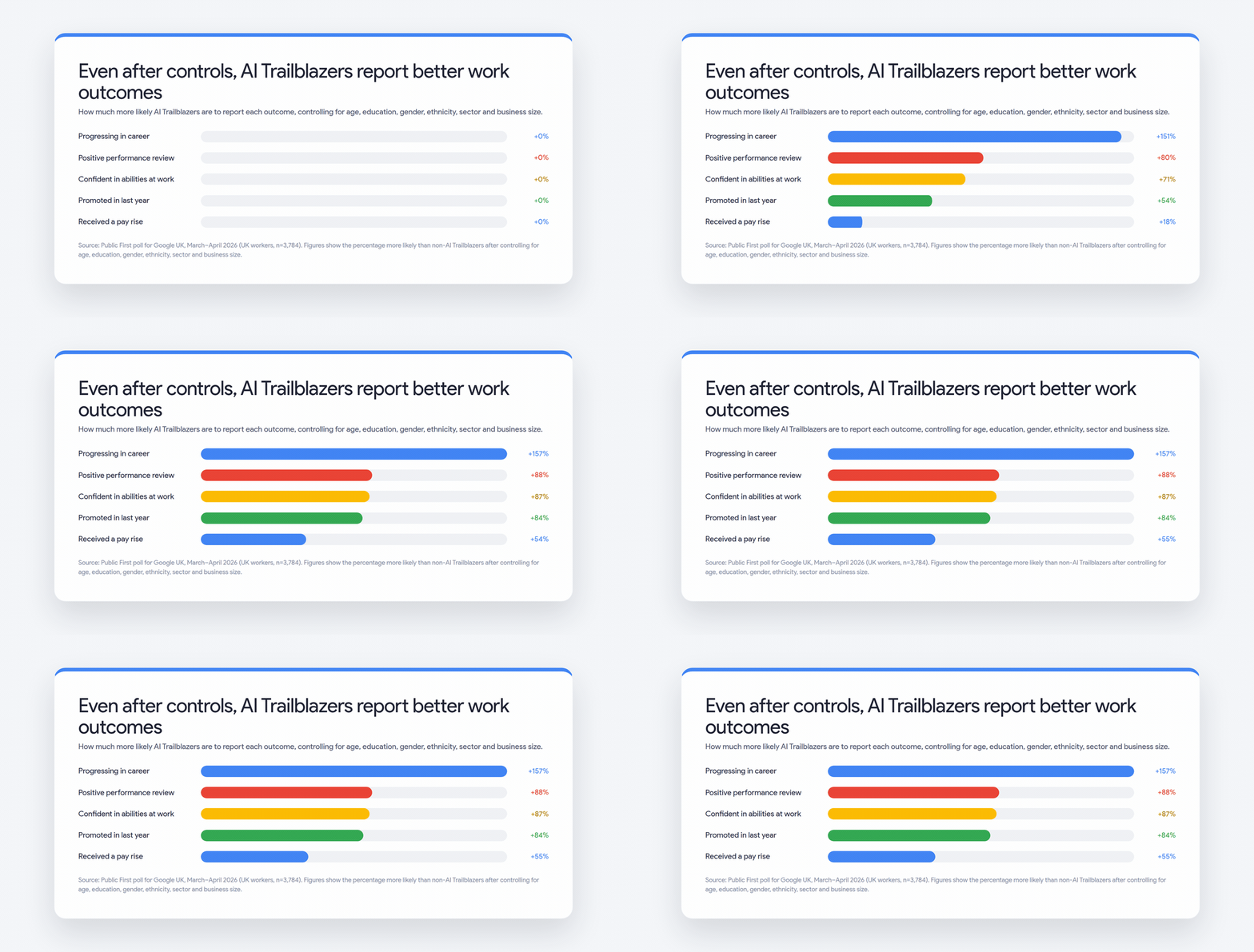
The professional momentum associated with this proficiency is stark. Even after controlling for variables such as age, sector, gender, ethnicity, and education, the study found that Trailblazers are significantly more likely to receive pay raises and promotions. This suggests that AI proficiency is becoming a primary "soft skill" that employers are rewarding with tangible career progression.

However, the "uneven adoption curve" mentioned in the report poses a risk to social mobility. Currently, deeper AI use is disproportionately concentrated in certain demographic groups and geographical hubs, particularly in London and the South East. If these disparities are not addressed, the UK risks a "digital divide 2.0," where career advancement is gated by AI literacy.
Breaking Behavioral and Organizational Barriers
To bridge the gap between the 15% and the 85%, the report identifies three primary categories of barriers: behavioral, cognitive, and organizational. Behavioral barriers often manifest as "imposter syndrome" or a fear of job displacement, leading workers to use AI covertly rather than as a celebrated part of their workflow. Cognitive barriers involve a lack of understanding of "prompt engineering" or the capabilities of different AI models. Organizational barriers are perhaps the most persistent, as many companies lack the formal training structures or clear policies needed to encourage employees to move beyond basic experimentation.
In response to these findings, Public First has launched an interactive "AI Skills Quiz." This diagnostic tool is designed to help workers benchmark their current skills against the national average and provide actionable steps to elevate their usage. The goal is to move "Experimenters" into "Practitioners" and "Practitioners" into "Trailblazers" by demystifying the technology.
Government and Industry Collaboration
The push for a "Nation of Trailblazers" is not a solo effort by the tech industry. It is a central pillar of a broader partnership between Google and the UK Government. The government has set an ambitious target of training 10 million workers in AI skills by 2030, recognizing that national productivity is inextricably linked to digital competence.
Google’s "AI Works for Britain" initiative serves as the primary vehicle for this upskilling. This program builds upon the existing "Google Digital Garage," which has provided digital training to over 1.2 million people in the UK over the last decade. By focusing specifically on AI, the initiative aims to provide workers in traditional sectors—such as retail, manufacturing, and healthcare—with the tools to automate repetitive tasks and focus on higher-value creative work.
The economic stakes are massive. In 2025 alone, Google’s various AI-powered tools and services supported an estimated £140 billion in economic activity across the United Kingdom. This figure is roughly equivalent to the entire economy of Greater Manchester. Notably, £60 billion of this impact was generated by small and medium-sized businesses (SMBs), which are using AI to compete with larger corporations on a more level playing field.

Broader Economic Implications and the Future Outlook
The broader implications of this AI surge are best understood through the lens of time. The report notes that products like Google Search, Android, Cloud, and YouTube are currently saving British workers 51 million hours per week. To put this in perspective, this is roughly equivalent to the total weekly output of the entire National Health Service (NHS) workforce.
If the UK can successfully transition a larger portion of its workforce into the "Trailblazer" category, the resulting productivity boom could provide a much-needed boost to the national GDP. Analysts suggest that widespread AI adoption could help solve the "productivity puzzle" that has plagued the UK economy since the 2008 financial crisis. By automating administrative burdens, AI allows the workforce to focus on innovation and complex problem-solving, which are the true drivers of long-term economic value.
However, the road ahead requires more than just training; it requires a shift in workplace culture. Industry leaders are calling for "psychological safety" in the workplace, where employees feel empowered to experiment with AI without fear of being replaced. As Kate Alessi notes, the disparities in AI adoption are "entirely addressable" because reaching an advanced level does not require coding expertise or deep technical knowledge—it requires a mindset of curiosity and the right educational support.
As the UK moves toward the 2030 goal, the focus will likely shift from basic access to sophisticated implementation. The emergence of "AI Agents"—tools that can execute multi-step tasks autonomously—will likely define the next phase of the Trailblazer advantage. For the UK to remain a global leader in the AI space, it must ensure that its workforce is not just using AI, but mastering it. The transition from a nation of experimenters to a nation of trailblazers may well be the defining economic challenge and opportunity of the decade.
