

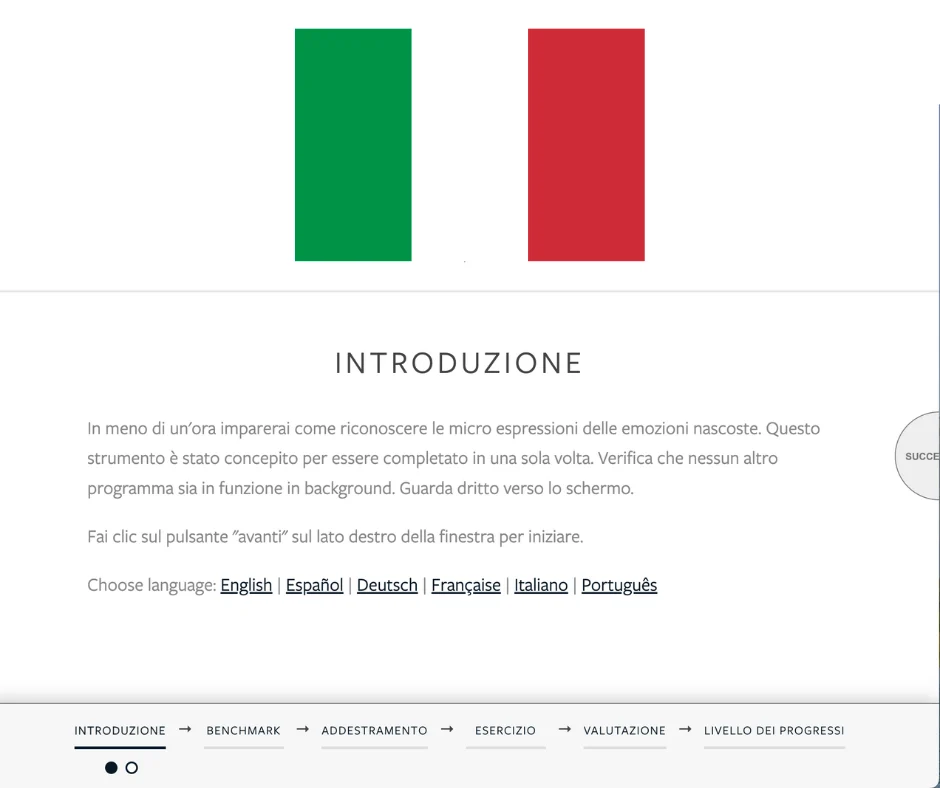
The Paul Ekman Group, a leading authority in the science of emotions and facial expressions, has announced a significant expansion of its online microexpression training tools, now offering comprehensive modules in Italian, French, and German. This strategic initiative aims to democratize access to crucial emotional intelligence and deception detection skills for a broader international audience. The newly translated materials encompass all seven core online training tools developed by the renowned psychologist Dr. Paul Ekman, building upon existing offerings in Spanish and Portuguese. Users can now select their preferred language at the commencement of each course, a feature designed to foster a more inclusive and effective learning experience.
This expansion represents a pivotal step in the Paul Ekman Group’s ongoing mission to enhance global emotional awareness and understanding. By translating their science-based curriculum into key European languages, the organization is directly addressing a growing demand for accessible, high-quality training in recognizing the subtle, involuntary facial signals that betray genuine emotions. The initiative underscores the universal applicability of Dr. Ekman’s research, which has consistently highlighted the shared human experience of emotions and their corresponding facial expressions across diverse cultures.
The Genesis of Global Emotional Literacy
The foundation of the Paul Ekman Group’s work lies in decades of rigorous scientific research into the nature of emotions and their expression. Dr. Paul Ekman, a pioneer in the field, rose to prominence through his groundbreaking studies on facial expressions and their universality. His seminal work, particularly his research on microexpressions – fleeting, involuntary facial movements that reveal a person’s true emotional state – has revolutionized the understanding of human communication and behavior.
Microexpressions, typically lasting less than half a second, occur when an individual attempts to conceal or suppress an emotion. They are often undetectable by the untrained eye, yet they offer a powerful window into a person’s authentic feelings. Dr. Ekman’s research, conducted over several decades and across numerous cultures, established that certain facial expressions of emotion are universal, transcending linguistic and cultural barriers. This discovery provided the bedrock for developing training programs that could equip individuals with the ability to recognize these subtle yet significant cues.
The development of online training tools by the Paul Ekman Group was a natural evolution, driven by the desire to disseminate this vital knowledge beyond academic circles and into practical applications. The initial rollout of these tools, primarily in English, saw widespread adoption by law enforcement, intelligence agencies, healthcare professionals, educators, and individuals seeking to improve their interpersonal skills. However, the organization recognized the inherent limitation of an English-centric approach in a globally interconnected world. The linguistic barrier, while less pronounced for microexpressions themselves, could hinder the effective acquisition of the knowledge and skills related to their interpretation.
A Phased Approach to Linguistic Accessibility
The decision to introduce Italian, French, and German language options is not an isolated event but rather a continuation of a deliberate strategy to expand the global reach of their training. This follows the earlier successful integration of Spanish and Portuguese, indicating a clear commitment to serving non-English speaking populations.
The timeline for this latest expansion likely involved a significant investment in translation and localization. This process would have entailed not only direct linguistic translation of the course content but also the careful adaptation of any cultural nuances or examples to ensure maximum resonance with native speakers. The development of a user-friendly interface that seamlessly integrates language selection at the outset of each course is a testament to the user-centric design philosophy of the Paul Ekman Group.
Key Milestones in Global Expansion (Inferred Timeline):
- Early Research & Foundation: Dr. Paul Ekman’s seminal work on universal facial expressions and microexpressions (spanning several decades).
- Development of Core Training Tools: Creation of the foundational online modules in English.
- Initial Global Rollout (English): Widespread adoption and application across various professional fields.
- Introduction of Spanish and Portuguese Modules: First significant step in linguistic expansion, acknowledging the importance of Romance languages.
- Announcement of Italian, French, and German Modules: The latest phase, broadening accessibility to a substantial European demographic.
- Future Expansion: Ongoing commitment to introducing additional languages based on user demand and strategic global outreach.
Unveiling the Enhanced Training Modules
The expanded offering comprises all seven of the Paul Ekman Group’s primary online microexpression training tools. These tools are typically structured into three distinct training packages, catering to different levels of depth and specialization. The complete translation of these modules into Italian, French, and German means that learners in these linguistic regions can now engage with the content in their mother tongue, from the initial theoretical explanations to the practical exercises and assessments.
The core of the training revolves around teaching users to identify the subtle, fleeting facial cues associated with the seven universal emotions: happiness, sadness, anger, fear, surprise, disgust, and contempt. Participants are typically exposed to a vast library of images and video clips, learning to distinguish between genuine expressions and posed or feigned ones. The training emphasizes not only the visual recognition of these expressions but also an understanding of the underlying emotional states they represent and the contexts in which they might appear.
The user experience is designed to be intuitive. Upon accessing any of the online training tools, users will be prompted to select their preferred language from a dropdown menu or a similar interface. This immediate customization ensures that the learning journey is as seamless and effective as possible, removing any potential barriers to comprehension. The availability of these modules in multiple languages is crucial for ensuring that the nuances of Dr. Ekman’s research are accurately conveyed and that learners can fully absorb the complex information presented.
The Profound Importance of Recognizing Microexpressions
The significance of microexpression training extends far beyond academic curiosity. Microexpressions are involuntary, rapid facial movements that betray a person’s true emotional state, even when they are attempting to conceal it. Their importance lies in their ability to provide a more accurate understanding of an individual’s emotional truth, which can be invaluable in a multitude of personal and professional contexts.
Why is this training crucial?
- Enhanced Empathy and Connection: By understanding the emotions others are experiencing, even those they try to hide, individuals can respond with greater empathy and build stronger, more authentic relationships. This is particularly vital in fields like healthcare, counseling, and social work.
- Improved Communication: Recognizing microexpressions can help individuals navigate complex social interactions more effectively. It allows for a deeper understanding of unspoken sentiments, preventing misunderstandings and fostering more productive dialogue.
- Deception Detection: While not a foolproof method, the ability to recognize microexpressions can be a powerful tool in discerning truth from deception. This is of immense value to law enforcement, security personnel, negotiators, and anyone in a position where assessing the veracity of statements is critical.
- Professional Advancement: For professionals in fields such as sales, human resources, law, and leadership, the ability to read and respond to emotions can significantly enhance their effectiveness, leading to better outcomes in negotiations, client interactions, and team management.
- Self-Awareness: Understanding how emotions manifest on the face can also lead to greater self-awareness. By observing one’s own fleeting expressions, individuals can gain insights into their internal emotional landscape.
The Paul Ekman Group emphasizes that this training is not about labeling individuals as "liars" but about fostering a more nuanced and accurate understanding of human emotions. The implications of this are far-reaching. For instance, in law enforcement, officers trained to recognize microexpressions might be better equipped to de-escalate tense situations by understanding the underlying fear or anger in a suspect. In healthcare, a doctor might be able to identify unspoken pain or distress in a patient, leading to earlier intervention. In the corporate world, leaders can foster more trusting and productive environments by genuinely understanding the emotional states of their teams.
A Global Footprint: Science for a World Stage
The universal nature of emotions, a cornerstone of Dr. Ekman’s research, is amplified by the global reach of his training tools. With applications already documented in over 230 countries, the addition of Italian, French, and German further cements the Paul Ekman Group’s position as a global leader in emotional intelligence education. This expansion is not merely about linguistic translation; it is about actively dismantling barriers to knowledge and empowering individuals worldwide with skills that can profoundly impact their lives and interactions.
The organization’s commitment to accessibility is evident in their outreach. The stated hope is that these new versions will provide greater opportunities for individuals whose native languages are not English, Spanish, or Portuguese. This inclusive approach recognizes that the ability to learn and grow should not be constrained by linguistic limitations.
The fact that these tools are used in over 230 countries is a powerful testament to the universal applicability of the core concepts. It suggests that the emotional expressions and their underlying meanings are indeed fundamental aspects of the human experience, transcending geographical and cultural boundaries. The expansion into these new languages is a logical and necessary step to ensure that this profound understanding is accessible to an even wider segment of the global population.
The Road Ahead: Continuous Growth and User Input
The Paul Ekman Group is not resting on its laurels. The announcement explicitly states that they are actively working to expand their language offerings further. This forward-looking approach indicates a commitment to continuous improvement and a responsiveness to the needs of their global community.
Crucially, the organization has opened a direct channel for user feedback regarding desired languages. By inviting individuals to "let us know here" via email at [email protected], they are fostering a collaborative environment where the development of new language modules can be guided by genuine demand. This user-centric strategy ensures that future expansions will align with the needs of the global audience, further solidifying the Paul Ekman Group’s position as a responsive and impactful educational provider.
The closing sentiment, "Thank you for being a part of our global community. We look forward to continuing this journey together – whatever your language," encapsulates the organization’s ethos. It is a message of inclusivity, partnership, and a shared commitment to fostering a more emotionally intelligent world. The expansion into Italian, French, and German is more than just a linguistic update; it is a significant stride towards making the science of emotions and the skills of emotional intelligence universally accessible, enriching lives and strengthening connections across the globe.
