

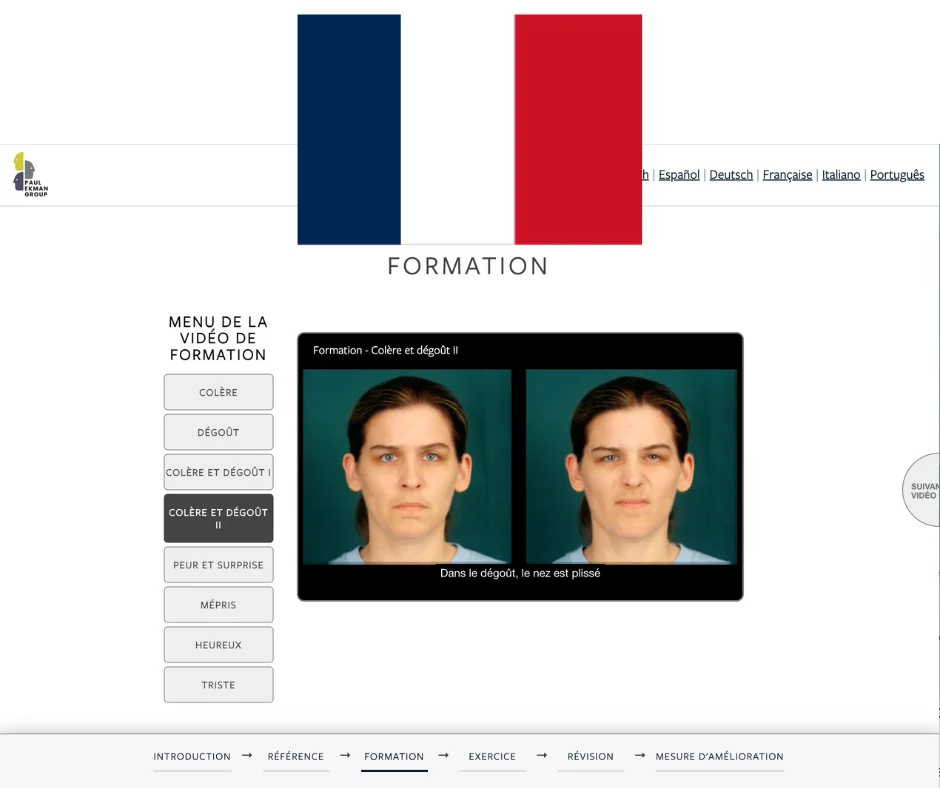
The Paul Ekman Group, a leading authority in the science of emotions and micro-expressions, announced today a significant expansion of its online training tools, now offering comprehensive courses in French, Italian, and German. This strategic move dramatically increases the accessibility of its scientifically validated emotional intelligence and deception detection training for a global audience, building upon existing offerings in Spanish and Portuguese. The expanded language availability marks a pivotal moment in the organization’s mission to democratize the understanding of human emotions and their subtle expressions across diverse linguistic communities.
A Commitment to Global Emotional Literacy
At its core, the Paul Ekman Group is driven by a profound mission: to empower individuals with enhanced self-awareness and a deeper understanding of others through the development of emotional competence. For decades, the research pioneered by Dr. Paul Ekman has underscored the universality of human emotions and their corresponding facial expressions, a principle that underpins the effectiveness of his training methodologies. The introduction of French, Italian, and German translations represents a crucial step in translating this scientific understanding into practical skills accessible to a broader spectrum of learners.
"We are thrilled to announce that the Paul Ekman Group’s online micro-expression training tools are now available in French, Italian, and German, making our scientific approach to online emotional training more accessible than ever before," stated a representative from the Paul Ekman Group. "This initiative directly supports our goal of fostering greater emotional intelligence and enabling more accurate interpretation of human behavior worldwide."
The organization’s commitment extends to individuals from all walks of life. Whether they are law enforcement professionals, educators, therapists, corporate executives, or simply individuals seeking to enrich their interpersonal understanding, the training provides invaluable benefits. The ability to recognize micro-expressions—fleeting, involuntary facial movements that betray a person’s true emotional state—can significantly enhance empathy, precision, and clarity in communication and decision-making. These are not merely soft skills but foundational elements of sophisticated emotional intelligence, crucial in an increasingly interconnected and complex world.
The Science Behind Micro-Expressions
Micro-expressions are defined as brief, involuntary facial displays that occur when a person is attempting to conceal or suppress an emotion. Typically lasting between 1/25th to 1/5th of a second, they are often imperceptible to the untrained eye but can reveal a wealth of information about a person’s genuine feelings. Dr. Ekman’s extensive research, beginning in the 1960s, identified a universal set of seven basic emotions—happiness, sadness, anger, fear, surprise, disgust, and contempt—each associated with distinct, albeit subtle, facial configurations.
The significance of understanding these involuntary signals cannot be overstated. In critical situations, such as interrogations, negotiations, or medical diagnoses, misinterpreting emotions can lead to flawed judgments and negative outcomes. Conversely, the ability to detect and interpret micro-expressions can provide crucial insights, enabling individuals to respond with greater accuracy, compassion, and strategic awareness. This is particularly relevant in fields where trust, deception, and emotional nuance play a critical role.
A Phased Rollout and Global Reach
The Paul Ekman Group’s online training program encompasses seven core tools, meticulously designed to equip learners with the skills to identify and understand micro-expressions. These tools are integrated into three distinct training packages, catering to varying levels of depth and specialization. The recent addition of French, Italian, and German brings the total number of available languages to five, including the already established Spanish and Portuguese versions.
The user experience has been designed for seamless integration. Upon initiating any of the online courses, users are prompted to select their preferred language from a readily accessible menu. This simple yet effective mechanism ensures that the learning journey is personalized and culturally relevant, removing linguistic barriers that might otherwise hinder engagement.
This expansion is not an isolated event but rather a continuation of a long-term strategy to extend the reach of emotional science. Dr. Ekman’s groundbreaking work has already found application in over 230 countries, highlighting the universal appeal and relevance of understanding human emotions. The new language offerings are a direct response to increasing demand from European markets and a broader global community seeking to leverage this specialized knowledge.
"We are committed to making the science of emotions accessible to as many people as possible," the spokesperson added. "These new translations represent a significant stride towards ensuring that individuals whose native languages are not English, Spanish, or Portuguese can also benefit from our comprehensive training."
Chronology of Expansion and Future Prospects
While the exact timeline for the development of each translated module is not publicly detailed, the announcement signifies a concentrated effort to broaden the linguistic accessibility of the Paul Ekman Group’s flagship training. The initial availability of online micro-expression training tools predates this recent expansion, with a gradual introduction of language options reflecting growing international interest and market demand.
The decision to prioritize French, Italian, and German is likely informed by demographic data, educational trends, and the significant presence of these languages in international business, diplomacy, and academic spheres. The European Union, with its multilingual framework, represents a particularly fertile ground for such an initiative.
Looking ahead, the Paul Ekman Group has explicitly stated its intention to continue expanding its language offerings. The organization actively encourages feedback from its user base and invites suggestions for future language additions. This inclusive approach ensures that the development pipeline is responsive to the evolving needs of its global community.
"We are actively working to broaden our offerings to include more languages," the statement confirmed. "If you would like us to add a new language, please let us know here [[email protected]]." This open channel for communication underscores the organization’s dedication to serving its diverse clientele and solidifying its position as a global leader in emotional intelligence education.
Implications for Professionals and Organizations
The ramifications of this linguistic expansion are far-reaching, particularly for professionals and organizations operating in multicultural environments. For law enforcement and security agencies, the ability to accurately assess emotional cues, even fleeting ones, can be critical in threat detection and suspect interrogation. Therapists and counselors can leverage this knowledge to build deeper rapport with clients and gain a more nuanced understanding of their emotional states, leading to more effective treatment.
In the corporate world, executives and HR professionals can utilize micro-expression training to improve negotiation skills, enhance team dynamics, and foster more authentic leadership. Sales teams can better understand customer needs and objections, while customer service representatives can respond with greater empathy and efficiency. The ability to "read between the lines" of emotional expression can foster stronger relationships, reduce misunderstandings, and ultimately drive better business outcomes.
The availability of training in native languages also has significant implications for educational institutions. Educators can equip students with essential emotional literacy skills from an early age, preparing them for success in both academic and personal endeavors. This early intervention can contribute to the development of more resilient, self-aware, and socially adept individuals.
Furthermore, the expansion aligns with global efforts to promote mental health and well-being. By demystifying emotions and providing practical tools for understanding them, the Paul Ekman Group is contributing to a more emotionally intelligent and empathetic society. The accessibility of this knowledge in multiple languages ensures that these vital skills are not confined to an elite few but are available to all who seek to improve their lives and the lives of those around them.
Analysis of Market Impact
The global market for emotional intelligence training has witnessed steady growth, driven by increasing recognition of its importance in personal and professional development. By offering its scientifically rigorous training in more languages, the Paul Ekman Group is strategically positioning itself to capture a larger share of this expanding market. The move addresses a significant unmet need for high-quality, research-backed emotional intelligence resources in non-English speaking regions.
The competitive landscape for emotional intelligence training includes a variety of providers, from online course platforms to corporate training consultants. However, the Paul Ekman Group’s unique selling proposition lies in its direct lineage to Dr. Paul Ekman’s foundational research and its established reputation for scientific accuracy and efficacy. The expansion into new languages amplifies this advantage, making its unparalleled expertise accessible to a wider audience.
The success of this expansion will likely depend on several factors, including effective marketing and outreach within the target language communities, the continued quality and user-friendliness of the online platform, and the ongoing relevance of micro-expression analysis in an evolving socio-technological landscape. However, given the universal nature of human emotions and the enduring importance of understanding them, the prospects for this initiative appear robust.
Conclusion: A More Emotionally Connected World
The Paul Ekman Group’s decision to launch its micro-expression training in French, Italian, and German is more than just a business expansion; it is a testament to the universal language of human emotion and the organization’s dedication to bridging cultural and linguistic divides. By making its scientifically validated tools more accessible, the group is empowering individuals worldwide to navigate the complexities of human interaction with greater insight, empathy, and precision. This move promises to foster a more emotionally intelligent and interconnected global community, one learner at a time. The journey towards a deeper understanding of ourselves and others continues, now spoken in a richer tapestry of languages.
