

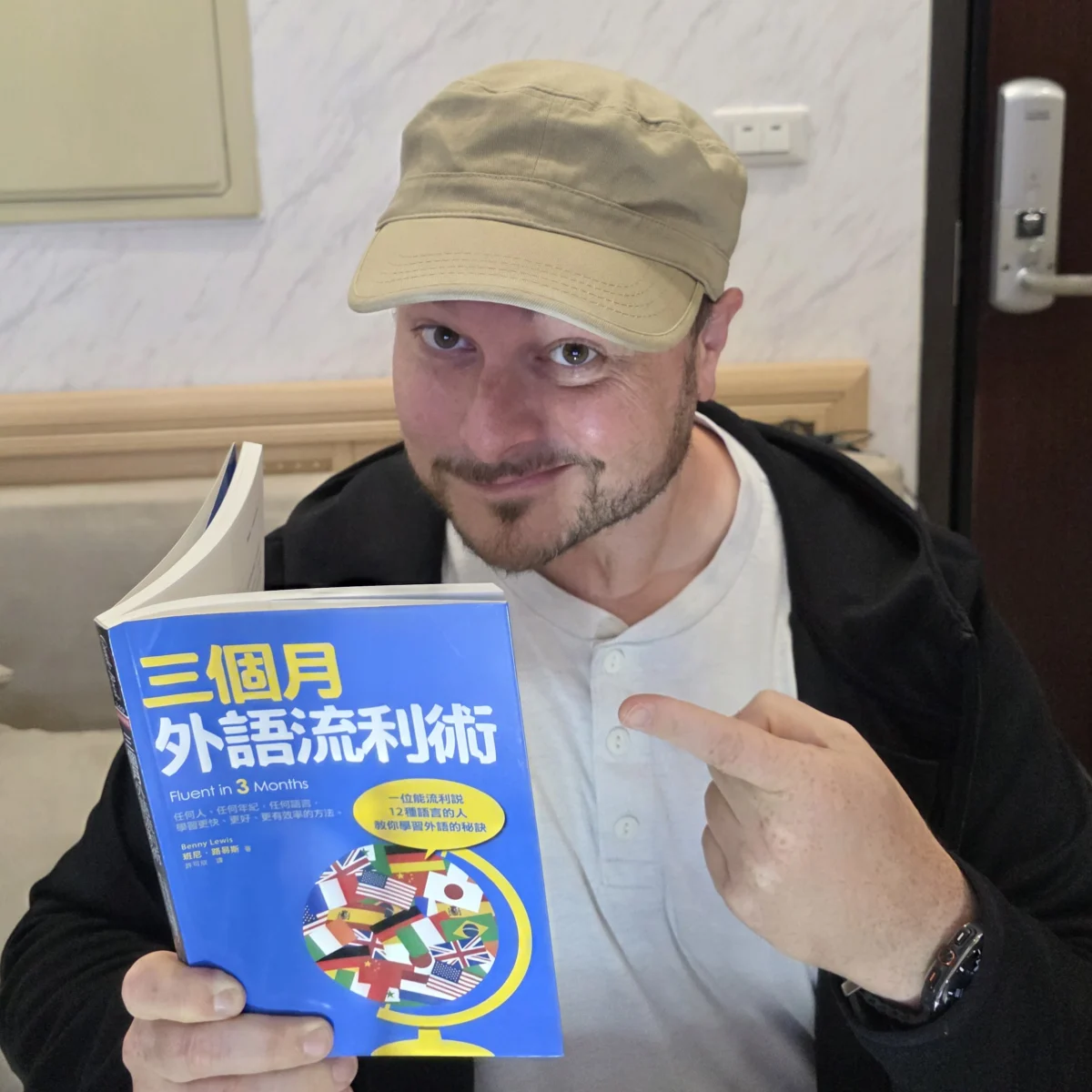
Benny Lewis, the founder of the prominent language-learning platform Fluent in 3 Months, has announced a strategic return to Taipei, Taiwan, marking a significant effort to regain his intermediate proficiency in Mandarin Chinese. This return occurs 14 years after his initial intensive immersion project in the city, signaling a new phase for both his personal linguistic development and the editorial direction of his digital media presence. Lewis, an Irish-born polyglot known for his "speak from day one" methodology, reached a B1 level—categorized as "lower intermediate" under the Common European Framework of Reference for Languages (CEFR)—during a high-profile 2012 mission. After years of linguistic attrition, during which his Mandarin skills receded due to a lack of consistent use, Lewis has committed to a two-month intensive residency in Taiwan to stabilize the language as a permanent fixture in his repertoire.
Historical Context and the 2012 Mandarin Mission
The foundation of Lewis’s current endeavor dates back to 2012, when he launched what would become one of the most documented language projects in the digital age. The original "Mandarin Mission" consisted of three months of intensive study in Taipei followed by two months of solo travel through mainland China. The project was unique for its transparency and its focus on spoken communication over traditional literacy, as Lewis intentionally omitted reading and writing from his initial goals to accelerate oral fluency.
The 2012 project concluded with an independent evaluation that placed Lewis at a B1 level. At this stage, a learner can typically understand the main points of clear standard input on familiar matters and deal with most situations likely to arise while traveling in an area where the language is spoken. This level enabled Lewis to engage in complex cultural activities, including practicing martial arts in rural fishing villages and conducting interviews with native-speaking television presenters.
However, the project was not without controversy. In the years following, Lewis acknowledged that the intensity of the 2012 mission created significant stress, leading to a recent retrospective analysis in his podcast series where he detailed the psychological toll of high-pressure language acquisition. Between 2012 and 2024, Lewis’s primary engagement with Mandarin was limited to the co-authoring of "Language Hacking Mandarin" and sporadic interactions at international language exchange events.
The Challenge of Language Attrition and the Malaysian Catalyst
Language attrition, the process of losing a native or second language, is a well-documented phenomenon in linguistics, particularly when a learner lacks a community of speakers or a professional necessity to maintain the tongue. For Lewis, the decline of his Mandarin skills was a byproduct of his focus on other languages, including Spanish, French, German, and Italian.
The impetus for his return to Mandarin was a two-month journey through Malaysia in early 2024. During this period, Lewis encountered the substantial Chinese diaspora in Malaysia and a high volume of tourists from mainland China. These interactions served as a linguistic catalyst, shifting his focus away from the Malay language and back toward Mandarin. This experience reinforced the global utility of Mandarin, which remains the most spoken native language in the world, with over 1.1 billion speakers globally. According to data from the Foreign Service Institute (FSI), Mandarin is classified as a "Category IV" language for English speakers, requiring approximately 2,200 class hours to reach professional working proficiency—making the maintenance of such a language a significant logistical challenge.
Strategic Methodology and Modern Learning Tools
Upon arriving in Taipei, Lewis implemented a structured daily routine designed to address the specific hurdles of an intermediate learner. Unlike his 2012 approach, which prioritized raw immersion, his 2024 strategy incorporates a sophisticated blend of traditional grammar study, digital tools, and social integration.
- Grammar and Syntax Refinement: Lewis has adopted a grammar-centric approach, utilizing texts that specifically account for Taiwanese Mandarin—a dialect that utilizes traditional characters and possesses distinct phonetic and lexical variations from the "Putonghua" spoken in mainland China. While he advises beginners against heavy grammar focus, he maintains that intermediate learners require formal structure to achieve natural-sounding sentence construction.
- Spaced Repetition Systems (SRS): A core component of his routine involves the use of Anki, a flashcard application based on spaced repetition. Lewis recovered his original vocabulary decks from 2012, which required technical conversion from legacy file formats to modern software. These decks contain highly personalized vocabulary derived from his past one-on-one lessons, which he posits is more effective than generic public decks.
- Digital Tutoring and AI Integration: Lewis utilizes Preply for regular online lessons with native instructors to maintain momentum. Additionally, he has integrated AI-driven conversation tools into his regimen. This reflects a broader trend in the EdTech industry, where AI is increasingly used to provide low-cost, 24/7 speaking practice to supplement human instruction.
- Physical and Cognitive Health: Notably, Lewis has linked his linguistic goals with physical fitness, incorporating daily long-distance running into his routine. This holistic approach aligns with neuroscientific research suggesting that aerobic exercise can enhance cognitive plasticity and memory retention, both of which are critical for adult language acquisition.
The Linguistic Environment of Modern Taiwan
Despite Taiwan’s "Bilingual 2030" policy, which aims to increase English proficiency across the island, Lewis reports that immersion in Taipei remains robust. He noted that even in international hubs like Starbucks, English is not always a viable fallback, necessitating the use of specific Mandarin terminology for basic transactions. This environment serves as a "forcing function," preventing the "lazy" reliance on English that often plagues expatriates in major global cities.
Lewis’s observations highlight a critical aspect of language tourism: the difference between "standing" social events and "seated" social events. He noted that many language exchanges in Taipei are structured as large group dinners, which can be challenging for non-native speakers due to high ambient noise and the rapid-fire nature of group conversation. This has led him to adjust his social strategy, seeking out environments where one-on-one or small-group interaction is more feasible.

Expansion into Regional "Deep Travel"
Following his residency in Taipei, Lewis plans to embark on a "Deep Travel" project across the broader Taiwanese landscape. This follows a pattern established in his previous projects, such as visiting every state in Brazil, all 48 contiguous U.S. states, and every province in South Korea. By moving beyond the capital city, Lewis intends to test his Mandarin in regions where English proficiency is statistically lower, thereby deepening his cultural and linguistic immersion. This geographical expansion is expected to provide a more comprehensive understanding of Taiwan’s diverse regional dialects and cultural nuances.
Strategic Reorientation of the Fluent in 3 Months Digital Platform
The return to Taipei also marks a pivotal shift in Lewis’s business and content strategy. For over a decade, the Fluent in 3 Months blog operated on a high-volume SEO (Search Engine Optimization) model, employing a team of writers to produce technical tips aimed at capturing search traffic. However, Lewis has announced a move away from this model, citing the impact of generative AI on the digital publishing landscape.
The rise of AI-generated "snippets" in search results has significantly reduced click-through rates for informational articles, as search engines often provide the answer directly on the results page. In response, Lewis is transitioning the blog back to its original 2009–2013 format: a personal, narrative-driven chronicle of human experience. While he admits to using AI for minor grammar corrections and rephrasing, he has committed to writing the core content himself to combat what he terms "AI slop"—generic, algorithmically generated content that lacks personal insight.
Broader Impact and Implications
The evolution of Lewis’s Mandarin project reflects broader shifts in the global language-learning community. The transition from "rapid fluency" goals to "long-term maintenance" mirrors a maturing market where learners are increasingly aware of the effort required to sustain high-level skills. Furthermore, his stance on AI content highlights a growing tension in the creator economy between automated efficiency and human authenticity.
As Lewis progresses through his two-month residency, his journey serves as a case study for "re-learning" a language—a process that is often faster than initial acquisition but requires overcoming the frustration of past proficiency loss. His success or failure in stabilizing his Mandarin will likely influence the methodologies adopted by his global audience, emphasizing that language acquisition is not a destination, but a continuous cycle of engagement and renewal.
