

The Greek language, one of the oldest recorded living languages in the Indo-European family, possesses a sophisticated system of endearments that reflects the nation’s deep-rooted emphasis on family, social cohesion, and emotional expression. Beyond simple translations of "I love you," the Greek lexicon offers a nuanced array of terms that vary based on relationship dynamics, regional dialects, and historical evolution. As globalization and digital communication continue to reshape linguistic landscapes, the persistence of traditional Greek endearments provides a unique case study in the preservation of cultural identity through philology. Understanding these terms requires an analysis of their grammatical structures, their roots in ancient philosophy, and their practical application in contemporary society.
The Foundations of Linguistic Intimacy in Modern Greek
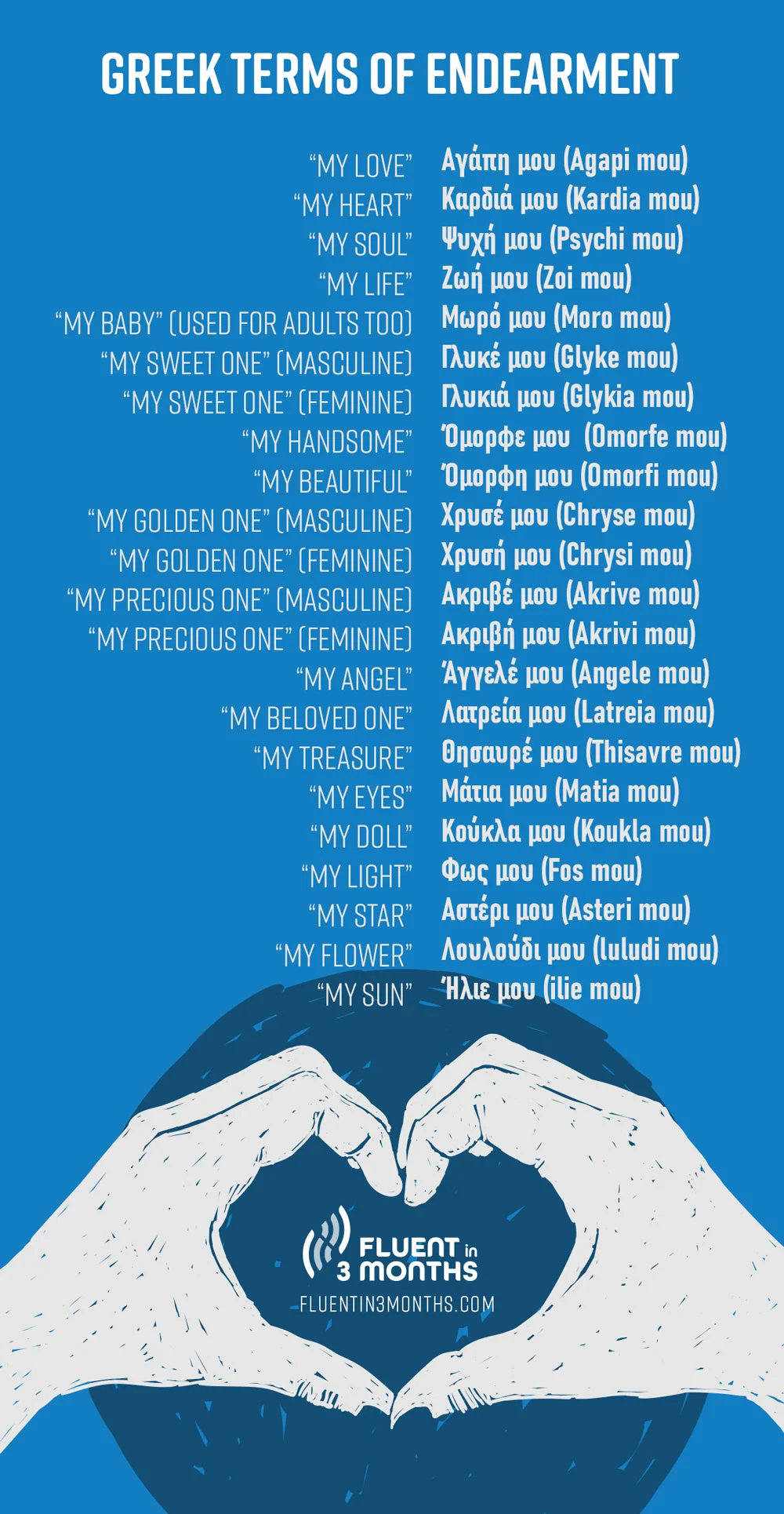
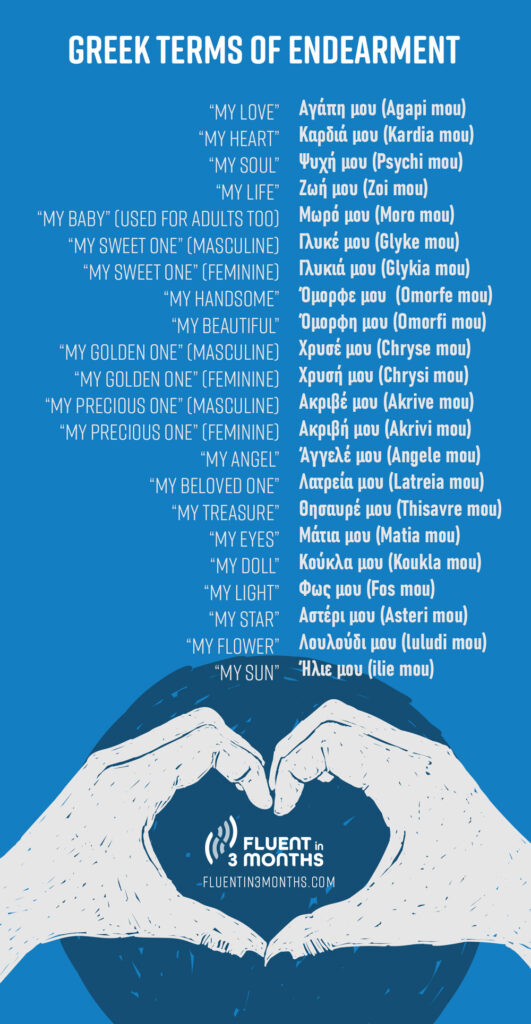
At the core of Greek endearment is the concept of the possessive pronoun "mou" (μου), meaning "my." In Greek syntax, this pronoun is placed after the noun to denote a sense of belonging and closeness. For example, the phrase agapi mou (αγάπη μου) translates literally to "my love." This structural consistency serves as the baseline for nearly all affectionate addresses, whether directed at romantic partners, children, or close associates.
Linguistic researchers note that the Greek language often prioritizes emotional resonance over literal meaning. Terms such as kardia mou (καρδιά μου—my heart) and psychi mou (ψυχή μου—my soul) are not merely metaphorical; they are embedded in the daily vernacular as standard forms of address. This intensity of language is a hallmark of Mediterranean communication styles, where the boundaries between the self and the loved one are linguistically blurred to emphasize unity.
A Chronology of Love: From Ancient Philosophy to Modern Vernacular
The evolution of Greek endearments cannot be fully understood without referencing the classical categorization of love. Ancient Greek philosophers identified eight distinct types of love, each influencing modern terminology:
- Eros: Romantic, passionate love.
- Philia: Deep friendship or brotherly love.
- Storge: Familial love, particularly between parents and children.
- Agape: Unconditional, selfless love.
- Ludus: Playful, uncommitted love.
- Pragma: Long-standing, practical love.
- Philautia: Self-love.
- Mania: Obsessive or possessive love.
In modern usage, these concepts have merged into a more streamlined but equally potent vocabulary. While agape remains the root for the most common term of endearment, agapi mou, the playful nature of ludus is found in the widespread use of diminutives. The transition from Ancient Greek to the Byzantine era and finally to Modern Demotic Greek has seen a shift from rigid philosophical definitions to a more fluid, emotional application of these terms in the domestic sphere.
The Mechanics of Affection: Diminutives and Suffixes
A primary feature of Greek endearment is the use of diminutive suffixes to create nicknames. This morphological process involves adding specific endings to proper names or common nouns to denote smallness, youth, or affection. According to linguistic data, the use of diminutives in Greece is significantly higher than in northern European languages, serving as a primary tool for establishing social warmth.
Common diminutive suffixes include:
- -aki (-άκι): Used for both male and female names, as well as neuter nouns (e.g., paidaki for a small child).
- -itsa (-ίτσα): Primarily used for feminine names or objects (e.g., Elenitsa for Elena).
- -oulis/-oula (-ούλης/-ούλα): Masculine and feminine endings often used for children or romantic partners to signify "cuteness."
- -akis (-άκης): A masculine ending frequently found in surnames, particularly from Crete, but also used to create affectionate first names (e.g., Yiorgakis for Yiorgos).
The application of these suffixes is governed by complex phonetic rules, yet they are used instinctively by native speakers. For instance, the word for mother, mitera (μητέρα), becomes manoula (μανούλα), shifting the tone from formal respect to intimate warmth.
Categorization of Endearments by Relationship Dynamics
The Greek social fabric is tightly woven, and the choice of endearment often signals the specific nature of a bond.
Romantic Partnerships
In romantic contexts, terms often gravitate toward the vital organs or the essence of life. Zoi mou (ζωή μου—my life) and latreia mou (λατρεία μου—my worship/adoration) represent the higher end of the emotional spectrum. For casual romantic interactions, moro mou (μωρό μου—my baby) is ubiquitous among all age groups. Gender-specific terms also play a role, such as omorfe mou (όμορφε μου—my handsome) for men and omorfi mou (όμορφη μου—my beautiful) for women.
Familial Bonds
Family remains the cornerstone of Greek life. Endearments for children often involve nature-based metaphors or precious materials. Chryse mou (χρυσέ μου—my golden one) and thisavre mou (θησαυρέ μου—my treasure) are frequently used by grandparents (pappous and yaya) to address their grandchildren. The term matia mou (μάτια μου—my eyes) is perhaps one of the most culturally significant, implying that the loved one is as precious as the speaker’s own sight.
Friendship and Social Circles
Among friends, the language is often more relaxed but still maintains a high level of affection. Koukla mou (κούκλα μου—my doll) is a standard greeting among female friends, while glike mou (γλυκέ μου—my sweet one) can be used platonically to show appreciation or kindness.
Linguistic Data and Regional Variations
While Modern Greek is standardized, regional variations—particularly in Cyprus—introduce unique flavor to endearments. In the Cypriot dialect, phonetic shifts and the influence of surrounding cultures have created a distinct set of expressions. However, the core terms like agapi mou remain the universal standard across the Greek-speaking world.
Data from language learning platforms indicate a 15% increase in the study of Modern Greek as a "heritage language" over the last decade. This trend is driven largely by the Greek diaspora in the United States, Australia, and Canada, where second and third-generation immigrants seek to reconnect with their roots through the intimate vocabulary of their ancestors. For these learners, endearments are often the first words mastered, as they provide an immediate emotional bridge to older relatives.
Expert Analysis: The Psychological Impact of Endearments
Sociolinguists argue that the frequent use of endearments in Greek society contributes to a "high-involvement" communication style. Dr. Eleni Karas, a specialist in Mediterranean linguistics, suggests that these terms function as "social lubricants" that reduce interpersonal distance. "In Greek culture, to address someone solely by their name in a private setting can sometimes feel cold or distancing," Karas notes. "The addition of a diminutive or a possessive ‘mou’ validates the relationship and reaffirms the emotional connection."
Furthermore, the use of these terms in professional or semi-formal settings—such as a shopkeeper calling a customer agapi mou—reflects a cultural preference for "philoxenia" (hospitality). It creates an atmosphere of familiarity and trust, which is central to Greek commercial and social interactions.
Challenges in Translation and Cross-Cultural Communication
One of the primary challenges for non-native speakers is the translation of "intensity." For example, calling someone "my soul" (psychi mou) in English may sound overly dramatic or poetic, whereas in Greek, it is a standard, everyday expression. This discrepancy can lead to misunderstandings in cross-cultural relationships.
Linguistic experts recommend that those learning Greek focus not just on the vocabulary but on the "tonality of affection." The pronunciation of the Greek "gamma" (γ) or the rolling "rho" (ρ) carries an emotional weight that is lost in flat, literal translation. The correct usage of these terms requires an understanding of the "philippic" nature of Greek speech—expressive, rhythmic, and deeply connected to the speaker’s physical gestures.
Implications for the Digital Age
As communication moves toward text-based platforms like WhatsApp and Viber, Greek endearments are undergoing a digital transformation. The use of "Greeklish" (Greek words written with the Latin alphabet) has standardized the spelling of many endearments for the younger generation. Despite this shift in medium, the frequency of these terms has not diminished. If anything, the brevity of digital messaging has made short, punchy endearments like moro or agapi more common as signatures of affection.
The preservation of these terms serves as a bulwark against the homogenization of language in a globalized world. While English "loanwords" have entered the Greek vocabulary in the realms of technology and business, the language of the heart remains resolutely Greek.
Conclusion: The Enduring Power of the Greek Word
The study of Greek terms of endearment reveals a culture that is unapologetic about its emotional depth. From the ancient philosophical roots of agape to the modern, playful suffixes of the nursery, these words form a continuous chain of human connection. For the native speaker, they are a birthright; for the language learner, they are a key to unlocking the legendary warmth of the Greek spirit. As long as these terms continue to be spoken in the homes of Athens, Thessaloniki, Nicosia, and the diaspora, the unique linguistic heritage of Greece remains secure. Surprising a loved one with a well-placed kardia mou or asteri mou (my star) is more than a linguistic exercise; it is a participation in a multi-millennial tradition of expressing the inexpressible.
