

Sales professionals frequently inquire about the most potent principle of influence in the realm of sales. While the nuances of each sales interaction are unique, the principle of consistency emerges as a remarkably powerful driver of success. This assertion may seem counterintuitive to those who associate sales with relentless product pitches. However, extensive research and decades of observation in the sales arena reveal a consistent theme: the most effective salespeople prioritize listening and asking probing questions over dominating the conversation. Industry experts often suggest that accomplished salespeople speak only 25% to 30% of the time, dedicating the remainder to thoroughly understanding the customer’s needs and priorities. This strategic approach directly leverages Dr. Robert Cialdini’s principle of consistency, which posits that individuals experience both internal psychological pressure and external social pressure to align their actions with their prior statements and behaviors. This inherent desire to be perceived as reliable and committed individuals is a cornerstone of successful influence.
The Underpinning Psychology of Consistency in Sales
The principle of consistency, as elucidated by Dr. Robert Cialdini, a renowned social psychologist and author, is fundamental to understanding human behavior. Cialdini’s extensive research, spanning decades and documented in seminal works like "Influence: The Psychology of Persuasion," highlights how people strive to maintain a coherent self-image and act in ways that are congruent with their commitments. This psychological drive is not merely about avoiding cognitive dissonance; it also stems from a societal expectation that individuals who make promises or express beliefs should uphold them. When a salesperson can skillfully guide a customer to articulate their needs, desires, and values, they are essentially creating a series of small, personal commitments. The subsequent demonstration of how a product or service aligns with these articulated needs then becomes a natural extension of the customer’s own expressed preferences.
This aligns with the widely cited aphorism often shared in sales workshops: "People don’t resist their own values." When a solution is presented not as an external imposition, but as a direct fulfillment of something the customer has already identified as important, the perceived resistance diminishes significantly. The salesperson’s role, therefore, transforms from that of a persuader to that of a facilitator, helping the customer navigate towards a solution that is intrinsically aligned with their own established priorities.
The "Store X" vs. "Store Y" Analogy: Navigating the Customer’s Path
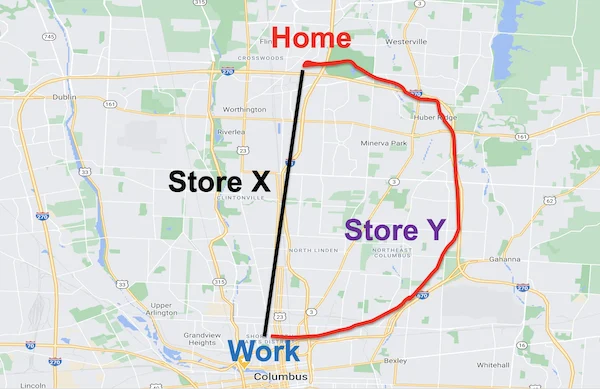
To illustrate the practical application of the consistency principle in sales, consider a relatable analogy. Imagine an individual who commutes approximately 15 miles to work daily, following the same established route. If a request comes from home to pick up essential items like batteries and bug spray, the response is likely to be positive if the required store, let’s call it "Store X," is conveniently located just a minute or two off their regular path. The reason for the acquiescence is clear: the request aligns seamlessly with their existing trajectory. The task requires minimal deviation from their established routine, making it an easy and logical addition to their journey.
However, the scenario changes dramatically if the only available source for these items is "Store Y," which is located several miles out of the way, potentially adding 20 minutes or more to their commute. In this instance, hesitation is probable, not due to a lack of willingness to help, but because of the significant inconvenience. The request demands a substantial departure from their habitual, efficient route, forcing them onto an unfamiliar and time-consuming detour.

This analogy directly mirrors the dynamics of many sales conversations. When salespeople invest time in asking thoughtful, open-ended questions early in the engagement, they empower customers to articulate their goals, challenges, priorities, and desired outcomes. This process of verbalizing needs effectively maps out the customer’s intended destination. The salesperson’s subsequent presentation of their offering then becomes a demonstration of how that offering serves as the most efficient and direct route to achieving those precisely stated objectives. In essence, the purchase becomes analogous to visiting Store X – it is already on the customer’s pre-determined path, requiring no significant diversion.
Conversely, when salespeople bypass or inadequately conduct the crucial discovery phase, they often find themselves attempting to persuade customers to embark on a "Store Y" journey. This typically involves extensive explaining, convincing, defending, and objection handling. The reason for this arduous process is the lack of a clearly established shared destination. The salesperson is essentially trying to steer the customer onto a path that was never initially chosen by the customer themselves. This "Store Y" approach is inherently more difficult, time-consuming, and often feels like overt selling, which, as famously stated by Jeffrey Gitomer, "People don’t like to be sold, but they love to buy."
The Data Behind Effective Sales Communication
The notion that listening is paramount in sales is not merely anecdotal; it is supported by empirical data. Studies conducted by organizations like the Miller Heiman Group, a prominent sales training and consulting firm, have consistently shown that top-performing sales professionals engage in significantly more active listening than their less successful counterparts. While specific percentages can vary depending on the study and industry, the overarching finding remains consistent: the disparity in talk time between high and low performers is substantial. This data underscores that the "talking 25% to 30%" guideline is not an arbitrary number but a reflection of a scientifically supported best practice.
Furthermore, research into buyer psychology, often drawing from behavioral economics and cognitive psychology, reveals that individuals are more likely to commit to decisions when they perceive a sense of ownership or agency in the process. When a salesperson facilitates a customer’s own articulation of needs, the customer feels a greater sense of control and personal investment in the eventual solution. This psychological phenomenon is a key reason why consistency, when leveraged ethically, is so effective. It taps into an intrinsic human motivation to remain congruent with one’s expressed beliefs and intentions.
Strategic Questioning: The Architect of Consistency
The art of asking the right questions is central to harnessing the principle of consistency. Effective salespeople do not merely ask questions to fill out a form or gather superficial data. Instead, their questions are designed to probe deeper, uncover underlying motivations, and help the customer gain clarity on their own needs. These questions can be categorized into several types:
- Diagnostic Questions: These aim to understand the current situation and identify pain points. Examples include: "What are the biggest challenges you’re facing with your current process?" or "What are the key metrics you’re trying to improve?"
- Implication Questions: These help the customer understand the consequences of their current situation or the benefits of a potential solution. Examples include: "How is this challenge impacting your team’s productivity?" or "What would be the financial benefit of resolving this issue?"
- Need-Payoff Questions: These focus on the value and benefits of a solution, framed from the customer’s perspective. Examples include: "How important is it for you to achieve X outcome?" or "If you had a solution that could do Y, how would that impact your business?"
By strategically employing these types of questions, salespeople guide the customer through a process of self-discovery. The customer’s responses become their own statements of need and desire, forming the foundation upon which the salesperson can then build their case. This approach ensures that the proposed solution is not perceived as an external suggestion but as a natural and logical consequence of the customer’s own identified requirements.

Broader Implications and Expert Perspectives
The application of the consistency principle extends beyond individual sales interactions, influencing broader business strategies and customer relationship management. Companies that prioritize understanding customer needs and aligning their offerings accordingly tend to foster greater customer loyalty and advocacy. This is because customers who feel understood and whose needs are consistently met are more likely to become repeat buyers and recommend the brand to others.
Brian Ahearn, Chief Influence Officer at Influence PEOPLE and a faculty member at the Cialdini Institute, has extensively researched and applied the principles of ethical influence in sales. Ahearn, who was personally trained and endorsed by Dr. Robert Cialdini, emphasizes that true influence is not about manipulation but about helping people make decisions that are in their own best interest. He notes, "The best sales conversations don’t push people toward a destination they never chose. They help people move toward outcomes they’ve already identified as important." This perspective highlights the ethical dimension of leveraging consistency; it’s about alignment, not coercion.
The implications of this approach are significant for sales organizations. It suggests a shift in training focus from product features and closing techniques to developing active listening skills and mastering the art of insightful questioning. Sales teams that embrace this philosophy are likely to see improvements in conversion rates, customer satisfaction, and ultimately, revenue. The data consistently points to a correlation between customer-centric questioning and successful sales outcomes.
The Future of Sales: A Consultative and Consistent Approach
In an era where information is readily accessible and customers are more informed than ever, the traditional hard-sell approach is becoming increasingly ineffective. Buyers are actively seeking partners who can help them navigate complex challenges and achieve their goals. This necessitates a move towards a more consultative and collaborative sales model. The principle of consistency, when applied through thoughtful questioning and genuine listening, provides the framework for such a model.
The question for sales professionals is not whether they are asking questions, but whether those questions are effectively guiding customers toward a "Store X" scenario – where the purchase is a natural, convenient, and consistent step towards their desired outcome. Alternatively, are their questions inadvertently forcing customers towards a "Store Y" scenario, characterized by resistance, inconvenience, and the feeling of being "sold to"? The answer to this question can often reveal the underlying reasons for the perceived ease or difficulty of certain sales conversations.
Ultimately, the most effective salespeople understand that their primary role is to understand. By mastering the art of listening and asking the right questions, they empower customers to articulate their own needs and desires. This creates a natural pathway where the proposed solution becomes a logical extension of the customer’s own journey, making the act of buying a seamless and satisfying experience. The shortest path to a sale is, in many cases, the path the customer has already chosen, and the salesperson’s role is to illuminate and facilitate that path. This profound understanding of human psychology, coupled with strategic communication, defines the modern, influential salesperson.
