

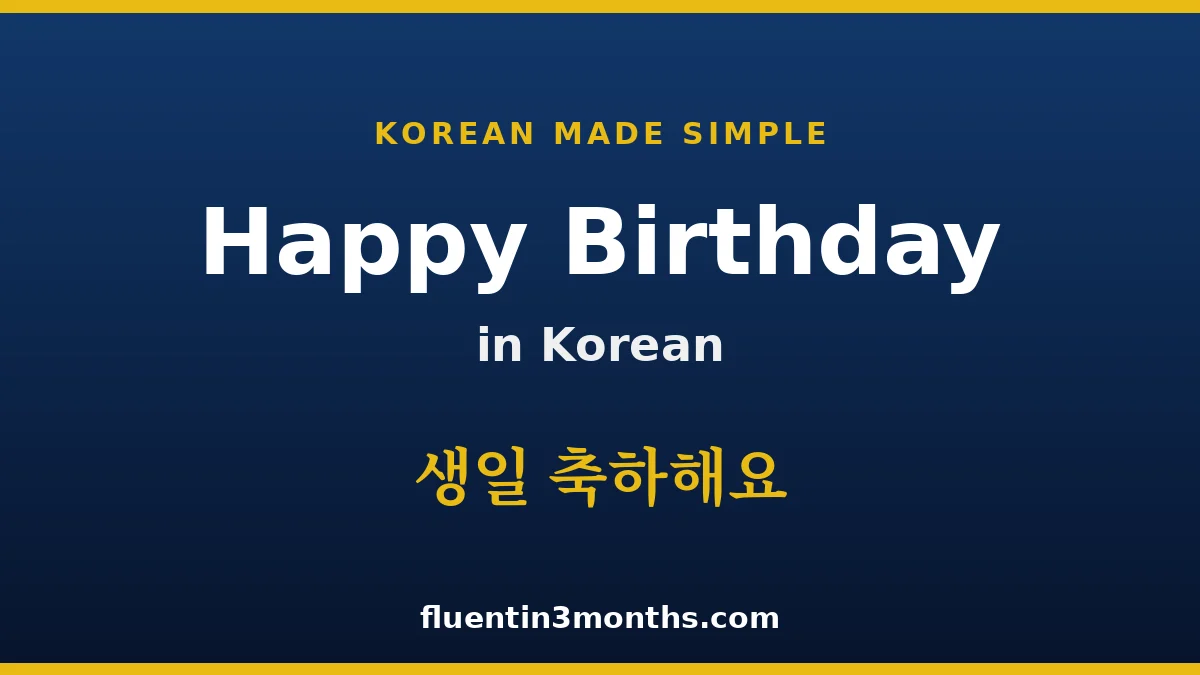
The complexities of Korean social hierarchy and the recent standardization of age calculations have brought renewed international attention to the specific linguistic and cultural rituals surrounding birthdays in South Korea. While the most common way to offer birthday greetings is the polite phrase "saengil chukhahaeyo," the underlying mechanics of the Korean language require a sophisticated understanding of social standing, age, and professional relationship. This linguistic intricacy is further complicated by the "Age Standardization Act," which took effect in June 2023, fundamentally altering how South Koreans calculate their legal age and, by extension, how they navigate social milestones.
The Sociolinguistic Framework of Korean Birthday Greetings
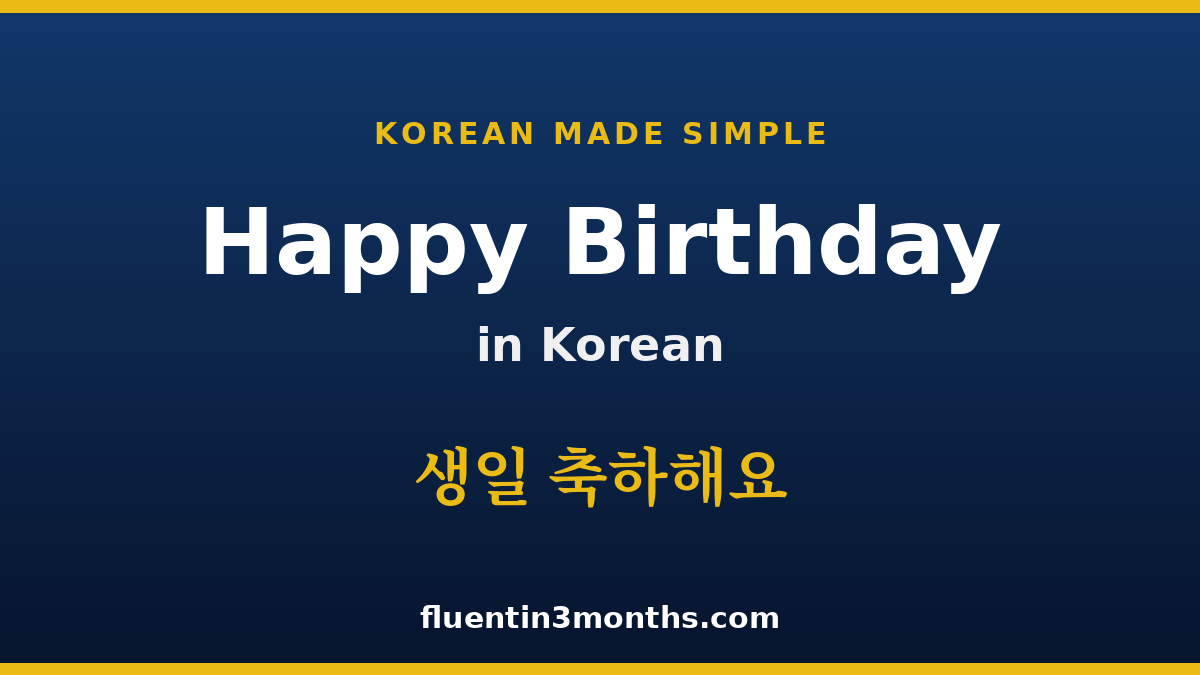
In the Korean language, a greeting is rarely just a transfer of information; it is a recalibration of the relationship between the speaker and the listener. The primary phrase for "Happy Birthday" is saengil chukhahaeyo (생일 축하해요). This expression is categorized as "jondaemal," or polite speech. It is the standard default for acquaintances, colleagues, and those of similar social standing with whom the speaker is not on intimate terms. The phrase is a combination of "saengil" (birthday), "chukha" (congratulation), and the polite ending "-haeyo."
However, the Korean language operates on a spectrum of formality that dictates at least four distinct levels of birthday greetings:
- The Formal/Honorific (Saengsin chukhadeurimnida): Used for grandparents, parents, or high-ranking superiors. This version replaces "saengil" with "saengsin"—an honorific noun for birthday—and utilizes "deurida," a humble verb for "giving" or "offering."
- The Formal/Standard (Saengil chukhahamnida): This version is frequently used in the Korean rendition of the "Happy Birthday" song. It employs the "-hamnida" ending, which is formal and respectful, suitable for public ceremonies or professional environments.
- The Polite/Everyday (Saengil chukhahaeyo): As noted, this is the most versatile form, balancing respect with a degree of social proximity.
- The Casual (Saengil chukhae): This is "banmal," or informal speech. It is strictly reserved for close friends, younger siblings, or children. Using this form with a superior or a stranger is considered a significant social transgression in Korean culture.
The 2023 Age Standardization Act: A Chronological Shift
For centuries, South Korea utilized a unique age-counting system known as "seneun nai" (counting age). Under this traditional system, a person is considered one year old at birth, and everyone in the nation gains a year simultaneously on New Year’s Day, regardless of their actual birth date. This meant that a baby born on December 31st would turn two years old the very next day, on January 1st.
The chronology of the shift toward the international system reached a turning point in late 2022 and early 2023:
- December 2022: The South Korean National Assembly passed a set of amendments to the Civil Act and the General Act on Public Administration.
- June 28, 2023: The laws officially took effect, mandating the use of the international "man nai" (full age) system for all judicial and administrative matters.
The Ministry of Government Legislation pushed for this change to resolve "unnecessary social and economic costs" and to align the country with global standards. Previously, the mix of three systems—the traditional Korean age, the international age, and "yeon nai" (year age, used for military conscription and the legal drinking age)—created confusion in medical insurance, social services, and legal contracts.
Despite the legal mandate, social researchers note that the traditional system remains deeply embedded in the "Kkkondae" (authoritarian senior) culture and workplace hierarchies. In South Korea, being even one year older often dictates who leads a conversation or who pays for a meal. The transition to the international system has, therefore, sparked a national dialogue about whether social seniority should be determined by the year of birth or the specific date of birth.
Cultural Rituals: Miyeokguk and the Symbolism of Motherhood
Beyond the linguistic requirements, Korean birthdays are marked by specific culinary and ritualistic traditions. The most pervasive of these is the consumption of "miyeokguk" (seaweed soup). This tradition is rooted in the post-partum care of mothers. Seaweed is rich in iodine and calcium, nutrients essential for recovery after childbirth.
By eating seaweed soup on their birthday, Koreans are not merely celebrating their own birth but are symbolically honoring their mother’s sacrifice and the care they received as infants. This creates a cycle of filial piety, a core tenet of Confucian influence in Korean society. Data from the Korean Food Promotion Institute suggests that miyeokguk remains the most consistently consumed traditional food on birthdays, even as Western-style cakes and parties have become standard.
Doljanchi: The High-Stakes First Birthday
The most significant birthday in a Korean person’s life is arguably the first, known as "doljanchi." This celebration has deep historical roots in a period when infant mortality was high due to lack of medical resources. Reaching the one-year mark was a major milestone indicating that a child was likely to survive into adulthood.
A central feature of the doljanchi is the "doljabi," a fortune-telling ritual where the child is placed before a variety of symbolic objects. The child’s future is playfully predicted based on which item they grasp first:
- Thread or Yarn: Symbolizes a long and healthy life.
- Money or Rice: Indicates future wealth and prosperity.
- Books or Brushes: Suggests the child will become a scholar or intellectual.
- Modern Additions: In recent decades, parents have added microphones (representing a career as an entertainer), stethoscopes (medicine), or computer mice (technology).
While modern doljanchi celebrations are often held in specialized banquet halls with professional photography and catered buffets, the core ritual of the doljabi remains the highlight of the event, reflecting the high value Korean society places on professional success and longevity.
The Global Expansion of Korean Language Learning
The demand for understanding Korean birthday etiquette has surged in tandem with the "Hallyu" or Korean Wave. According to data from the language-learning platform Duolingo, Korean is currently one of the fastest-growing languages globally, frequently ranking in the top ten most-studied languages. This interest is driven largely by the global popularity of K-pop and K-dramas, where birthday celebrations are often depicted with high emotional weight.
Linguistic experts, including those from the King Sejong Institute Foundation, emphasize that for foreign learners, the difficulty lies not in the alphabet (Hangul) but in the "honorifics" system. Hangul, created by King Sejong the Great in 1443, is lauded by linguists for its scientific design. The consonants are shaped to mimic the physical position of the tongue and mouth during pronunciation. However, the cultural layer—knowing when to use "saengil" versus "saengsin"—requires a deep dive into the Korean concept of "nunchi" (social emotional intelligence).
Implications for Social Integration and Diplomacy
The nuances of Korean birthday greetings have broader implications for expatriates and diplomats working in the region. In a professional Korean setting, failing to use the correct honorific for a superior’s birthday can be perceived as a lack of professional etiquette or "gyoyang" (refinement). Conversely, using overly formal language with a subordinate can create an unnecessary social distance that hinders teamwork.
The 2023 law change has provided a unique "reset" for many of these social interactions. While the law primarily affects administrative paperwork, it has encouraged a more flexible approach to age. Some companies have moved toward using "-nim" (a gender-neutral respectful suffix) or English names to bypass the age-based hierarchy altogether.
Conclusion: A Synthesis of Tradition and Modernity
As South Korea continues to export its culture globally, the rituals of the Korean birthday serve as a microcosm of the nation’s identity—a blend of ancient Confucian respect for elders and a hyper-modern, legally precise society. The transition to the international age system marks a significant step in South Korea’s globalization, yet the persistence of "miyeokguk" and "saengsin" suggests that the cultural heart of the celebration remains firmly rooted in tradition.
For the language learner or the cultural observer, "saengil chukhahaeyo" is more than a greeting; it is an entry point into a complex social fabric where age, language, and history are inextricably linked. Whether through a first-birthday "doljabi" or a respectful bow to a grandparent, the Korean birthday remains a vital expression of communal identity and familial gratitude.
