

The Spanish verb ir, translated as "to go," represents one of the most significant linguistic challenges for students of the Romance languages due to its extreme irregularity and its derivation from three distinct Latin roots. As a cornerstone of Spanish communication, ir is classified by linguists as a "suppletive" verb, a term used to describe a word whose various inflections are derived from different original stems rather than a single root. This characteristic results in a conjugation profile that appears fragmented to the untrained eye—comprising forms such as voy, fui, and iba—yet remains essential for expressing motion, daily routines, and future intentions. According to frequency dictionaries of the Spanish language, ir consistently ranks within the top 20 most frequently used verbs, making its mastery a non-negotiable requirement for functional fluency.
The Historical Evolution and Suppletive Nature of Ir
To understand the modern complexity of ir, one must examine its etymological chronology. The verb is a hybrid of three separate Latin verbs that merged over centuries of linguistic evolution. The first root, the Latin ire (to go), provides the infinitive form ir, the future tense (iré), and the conditional tense (iría). The second root, vadere (to go/to rush), serves as the foundation for the present indicative (voy, vas, va) and the present subjunctive (vaya). The third and perhaps most confusing root is the Latin esse (to be), which originally belonged to the verb ser. This historical crossover explains why the preterite forms of ir (fui, fuiste, fue) are identical to those of ser.
This merging process was not unique to Spanish but is particularly pronounced within it. Historically, the use of vadere was favored for the present tense because of its stronger phonetic presence compared to the shorter forms of ire. Meanwhile, the adoption of the esse root for the past tense reflects a conceptual overlap between "having been" and "having gone" that existed in Vulgar Latin. For the modern learner, this means that the context of a sentence is the sole arbiter of meaning when encountering the preterite tense; "fui a la tienda" clearly denotes movement to a store, while "fui profesor" denotes a past state of being.
Structural Analysis of Primary Conjugation Patterns
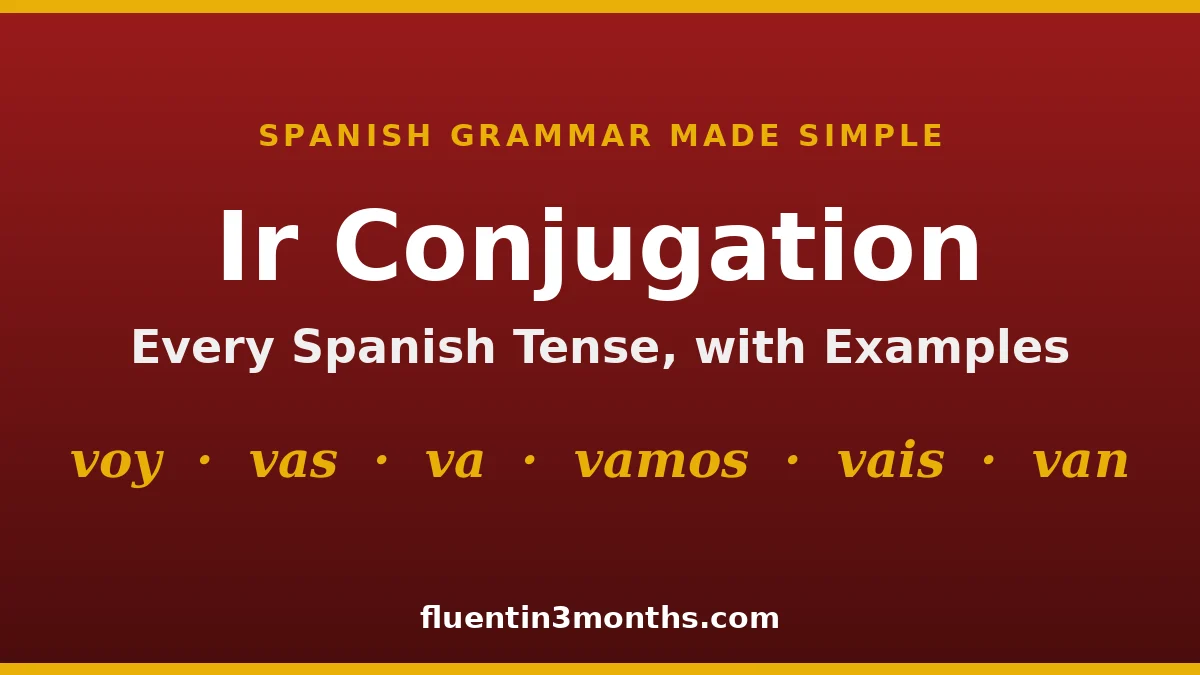
The communicative utility of ir is rooted in its indicative mood, which is used to state facts and describe reality. Data from linguistic studies suggest that the present indicative and the preterite are the most vital forms for beginners to internalize. The present tense forms—voy, vas, va, vamos, vais, and van—act as the primary vehicle for expressing current movement.
In the past tense, the verb bifurcates into the preterite and the imperfect. The preterite (fui, fuiste, fue, fuimos, fuisteis, fueron) is utilized for completed actions at a specific point in time. Conversely, the imperfect tense (iba, ibas, iba, íbamos, ibais, iban) is used for habitual actions or descriptions in the past. Notably, the imperfect of ir is one of only three irregular imperfects in the entire Spanish language, alongside ser and ver. This rarity necessitates specific pedagogical focus, as it does not follow the standard -ía endings typical of other -ir verbs.
Beyond simple tenses, ir functions as the auxiliary component in compound tenses. By combining the conjugated forms of haber with the past participle ido, speakers can form the present perfect (he ido), pluperfect (había ido), and other complex temporal structures. While the "pretérito anterior" (hube ido) remains part of the formal grammatical canon, contemporary linguistic analysis indicates it has largely vanished from spoken Spanish, surviving almost exclusively in high-register literature and legal documentation.
The Strategic Utility of the Periphrastic Future
One of the most significant implications of the verb ir for language learners is its role in the "periphrastic future" construction: ir + a + infinitive. This grammatical shortcut allows speakers to express future intent without employing the synthetic future tense (iré). For example, "voy a comer" (I am going to eat) is functionally equivalent to "comeré" (I will eat), but is far more common in everyday conversation across both Spain and Latin America.
Educational experts in Second Language Acquisition (SLA) emphasize that this construction provides a "fluency hack" for novices. By mastering only the six present-tense forms of ir, a student gains the ability to discuss an infinite number of future actions simply by attaching an infinitive. This reduces the cognitive load on the learner and allows for more rapid integration into conversational environments. Statistical analysis of spoken corpora shows that the periphrastic future is used significantly more frequently than the synthetic future in informal registers, particularly in Mexican and Caribbean dialects.
The Subjunctive and Imperative Moods: Nuance and Command
As learners transition to intermediate and advanced levels, the focus shifts toward the subjunctive and imperative moods. The subjunctive mood of ir (vaya, vayas, vaya, vayamos, vayáis, vayan) is triggered by expressions of doubt, emotion, or necessity. Its irregularity is a common point of frustration, as the stem "vay-" bears no resemblance to the infinitive "ir."
The imperative mood, used for giving commands, presents another unique irregularity. The informal singular command (tú) is "ve." This form is identical to the third-person singular present of the verb ver (to see), creating potential for ambiguity. However, as noted by the Real Academia Española (RAE), the surrounding syntax almost always clarifies the intent. Furthermore, the "nosotros" command "vamos" (let’s go) is an outlier in Spanish grammar. While the grammatically "correct" subjunctive-based command would be "vayamos," "vamos" has become the standard affirmative command in nearly all dialects, with "vayamos" reserved for negative commands (no vayamos) or highly formal exhortations.
Pedagogical Responses and Learning Methodologies
The complexity of ir has prompted various responses from the global language-learning community. Traditional methods favored the exhaustive memorization of conjugation tables, a process that many modern polyglots and linguists argue is inefficient. Benny Lewis, founder of Fluent in 3 Months, and other proponents of Communicative Language Teaching (CLT), suggest a prioritized approach. This methodology advocates for "speaking from day one" by focusing on high-frequency forms—specifically the present tense and the ir + a + infinitive construction—before tackling the more obscure subjunctive or conditional forms.
This shift in pedagogy is supported by data suggesting that learners who prioritize communicative ability over grammatical perfection tend to reach functional fluency faster. Resources such as SpanishPod101 and digital flashcard systems like Anki have integrated this "frequency-first" philosophy, emphasizing the most useful iterations of irregular verbs like ir to maximize the learner’s "return on investment" for their study time.
Broader Linguistic Implications and Regional Variations
The study of ir also reveals broader trends in the Spanish language, particularly regarding regionalism and the evolution of the gerund. The gerund of ir, "yendo" (going), is frequently used in progressive constructions (estoy yendo). In certain Andean and Caribbean dialects, there is a noted tendency to use ir reflexively (irse) to emphasize the act of leaving rather than the destination. The distinction between "voy a la escuela" (I am going to school) and "me voy" (I am leaving/I am off) is a vital nuance for achieving native-like expression.
Furthermore, the identical nature of the preterite of ir and ser remains a subject of fascination for historical linguists. This merger occurred because the semantic lines between "going" and "being" blurred in the transition from Latin to the Ibero-Romance languages. While this merger simplifies the number of forms a student must learn, it increases the reliance on context. Data from reading comprehension tests show that while beginners occasionally struggle with this ambiguity, intermediate learners resolve the meaning subconsciously based on the presence of the preposition "a," which almost always follows ir but never ser in this context.
Conclusion: The Path to Mastery
In summary, the verb ir is a microcosm of the Spanish language’s history, reflecting the pragmatic merging of Latin roots to serve modern communicative needs. While its 17 tenses and numerous irregular forms may appear daunting, a strategic approach focused on high-frequency usage allows learners to bypass initial hurdles. The combination of the present indicative, the periphrastic future, and the shared preterite with ser provides a robust foundation for most interactions.
As the global population of Spanish speakers continues to grow, exceeding 500 million native speakers, the importance of mastering these core irregularities cannot be overstated. Whether used to navigate a daily commute or to express complex desires in the subjunctive, ir remains the most dynamic and indispensable tool in the Spanish speaker’s arsenal. Through a blend of historical understanding, structural analysis, and modern pedagogical techniques, the "lovely chaos" of ir becomes not an obstacle, but a gateway to deep linguistic engagement.
