

The French language, spoken by approximately 321 million people globally according to the Organisation Internationale de la Francophonie (OIF), remains one of the most influential languages for international diplomacy, culture, and social interaction. Within this vast linguistic landscape, the act of celebrating a birthday—un anniversaire—carries specific phonetic, grammatical, and cultural weights that vary significantly between Europe and North America. To navigate these social waters effectively, one must understand that saying "Happy Birthday" in French involves more than a literal translation; it requires an awareness of regional dialects, the formal-informal divide, and local etiquette.
The Primary Linguistic Pillars: Joyeux and Bon Anniversaire
In standard Hexagonal French (the French spoken in France), two phrases dominate the celebratory landscape: "Joyeux anniversaire" and "Bon anniversaire." While they are often used interchangeably, they represent the foundational blocks of birthday greetings.
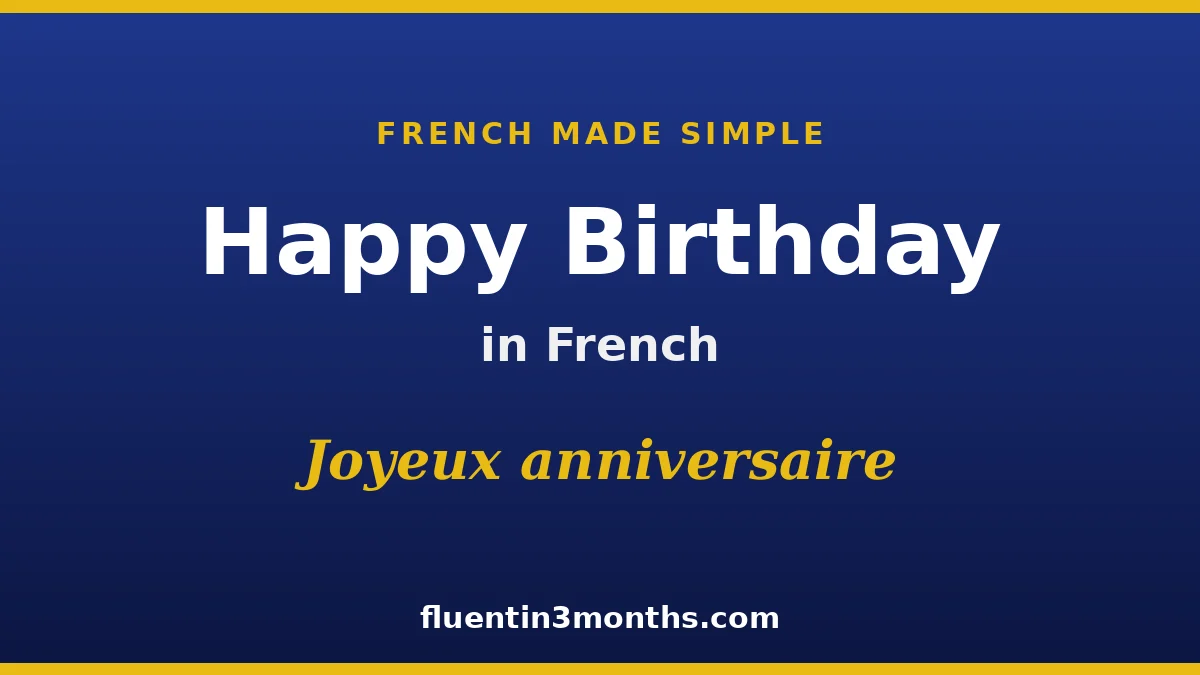
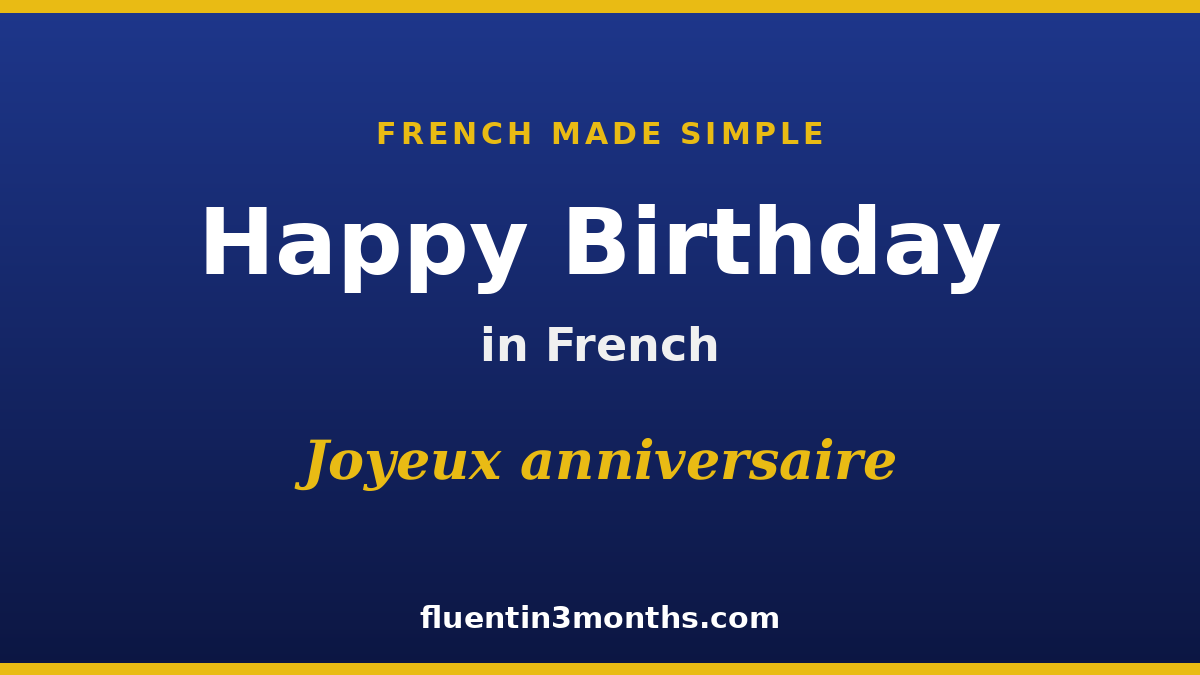
"Joyeux anniversaire" is perhaps the most direct equivalent to the English "Happy Birthday." From a grammatical standpoint, "joyeux" is an adjective meaning joyful or merry, while "anniversaire" functions as a masculine noun. The phrase is notable for its phonetic liaison; the final "x" in joyeux, which is usually silent, is pronounced as a "z" sound when followed by the vowel at the start of anniversaire (/ʒwa.jø.za.ni.vɛʁ.sɛʁ/).
The alternative, "Bon anniversaire," utilizes the adjective "bon" (good). This version is equally prevalent in speech, written cards, and digital correspondence. Like its counterpart, it requires a phonetic liaison where the "n" of "bon" carries over to the next word, resulting in a /bɔ.na.ni.vɛʁ.sɛʁ/ pronunciation. Linguists note that the choice between these two is largely stylistic and does not inherently dictate the level of formality.
The Evolution of Casual Lexicon: The Rise of Anniv
As with many modern languages, French has seen a trend toward "troncation," or the shortening of words, particularly among younger generations and in digital communication. The term "anniversaire" is frequently clipped to "anniv." Phrases such as "Bon anniv" or "Joyeux anniv" have become staples of text messaging (SMS) and social media platforms like Instagram and WhatsApp.
This linguistic evolution mirrors the English "b-day" and reflects a broader shift toward "le langage familier." However, linguistic experts advise caution: while "anniv" is appropriate for close friends and peers, it remains unsuitable for professional environments or when addressing elders, where the full form remains the standard of respect.
Regional Divergence: The Quebec Exception
One of the most critical distinctions in French birthday greetings is the geographical divide between France and Quebec. In Canada, specifically within the province of Quebec and Acadian communities, the standard greeting is "Bonne fête."
In France, "Bonne fête" is reserved for a "Name Day"—the feast day of the saint a person is named after. For example, a person named Pierre would receive "Bonne fête" wishes on the feast of St. Peter (June 29). However, in the 17th and 18th centuries, French settlers in North America maintained "Bonne fête" as a general celebratory greeting for birthdays, a tradition that has persisted for centuries.
According to data from the Office québécois de la langue française (OQLF), "Bonne fête" is the primary and most natural expression for a birthday in Canadian French. For a traveler or business professional, using "Joyeux anniversaire" in Montreal is perfectly understood but may mark the speaker as an outsider, whereas using "Bonne fête" in Paris to celebrate a birthday might result in confusion regarding the calendar date.
Socio-Linguistic Dynamics: The Tu and Vous Distinction
The French language is famous for its T-V distinction (tutoiement and vouvoiement), which dictates the level of social distance between speakers. This distinction is vital when extending birthday wishes.
When addressing a friend, family member, or a peer of similar age, the informal "tu" is used. Common phrases include "Je te souhaite un joyeux anniversaire" (I wish you a happy birthday). Conversely, in a professional setting, when speaking to a superior, or when addressing an elder, the formal "vous" is mandatory: "Je vous souhaite un joyeux anniversaire."
Sociologists specializing in French etiquette note that the transition from "vous" to "tu" is a significant social milestone. Using the wrong pronoun during a birthday celebration can either create an unintended barrier or, conversely, be perceived as overly presumptive.
A Chronology of French Birthday Customs
The celebration of a birthday in France follows a specific set of cultural expectations that differ from Anglo-American norms in subtle but important ways.
The Office and School Environment
In many French workplaces, the burden of celebration often falls on the person celebrating. It is a common custom for the "jubilé" (the birthday person) to bring "le petit déjeuner" (breakfast pastries like croissants and pains au chocolat) or a cake to share with colleagues. This practice, known as "ramener le gâteau," is a gesture of sharing one’s joy with the community rather than expecting the community to organize the event.
The Physical Greeting: La Bise
While handshakes are common in formal settings, "la bise" (the ritual of kissing on the cheeks) is the standard greeting among friends and family during a birthday gathering. The number of kisses varies by region: two is the standard in Paris, while three or four may be expected in parts of the south or the Loire Valley. In recent years, particularly following the COVID-19 pandemic, there has been a documented shift toward more verbal greetings or "le hug" (the hug), though the latter remains less common in France than in North America.
The Superstition of Early Wishes
A notable cultural nuance in France is the hesitation to wish someone a happy birthday before the actual date. Some French citizens consider "souhaiter un anniversaire en avance" to be bad luck (porter la poisse). While this superstition is fading among younger demographics, it remains a standard practice to wait until the clock strikes midnight or the day itself to send messages.
The Musical Heritage: Songs of Celebration
The French approach to birthday music involves two distinct paths. The first is a direct adaptation of the American "Happy Birthday to You" melody, using the lyrics: "Joyeux anniversaire, Joyeux anniversaire, Joyeux anniversaire [Name], Joyeux anniversaire."
However, there is also a uniquely French song titled "Bon anniversaire," composed by Louiguy with lyrics by Jacques Larue in 1951. Popularized by André Claveau, this song features a more traditional French chanson melody and lyrics that emphasize the passing of time and the hope for another year of health. While the "Happy Birthday" melody is more common at casual parties, the Claveau version is often heard in more traditional or formal settings, representing a piece of 20th-century French cultural heritage.
Implications of Linguistic Accuracy in Diplomacy and Business
The ability to correctly navigate birthday greetings has broader implications than simple politeness. In the realms of international business and diplomacy, cultural literacy—the ability to understand the "hidden rules" of a society—is a key performance indicator.
Data from cross-cultural communication studies suggest that professionals who adapt their greetings to local customs (such as using "Bonne fête" in Quebec or correctly applying "vouvoiement" in a Parisian boardroom) report higher levels of trust and rapport with their counterparts. Missteps, while often forgiven for non-native speakers, can subtly reinforce an "outsider" status.
Furthermore, as the French language continues to grow in Africa—a continent where the OIF predicts the majority of French speakers will reside by 2050—the evolution of birthday greetings may continue to diversify. Currently, Francophone Africa largely follows the standard French of "Joyeux anniversaire," but local idioms and "Francophonie" variations are increasingly common.
Summary of Key Birthday Phrases for Different Contexts
To provide a practical framework for learners and professionals, the following phrases represent the spectrum of French birthday communication:
- Standard/Formal: "Je vous souhaite un très joyeux anniversaire." (I wish you a very happy birthday.)
- Warm/Personal: "Plein de bonnes choses pour ton anniversaire." (Plenty of good things for your birthday.)
- Sentimental: "Que tous tes souhaits se réalisent." (May all your wishes come true.)
- Short/Casual: "Bon anniv !" (Happy b-day!)
- Regional (Quebec): "Bonne fête !" (Happy birthday!)
Conclusion
Understanding how to say "Happy Birthday" in French serves as a microcosm of the language itself: a blend of rigid grammatical rules, historical regionalisms, and evolving social norms. Whether one is blowing out the candles (souffler les bougies) in a Parisian bistro or a Montreal café, the choice of words reflects a deep-seated respect for the relationship between the speaker and the recipient. By mastering these nuances, one does not simply speak a language; one participates in a culture that prides itself on the art of celebration and the precision of expression.
